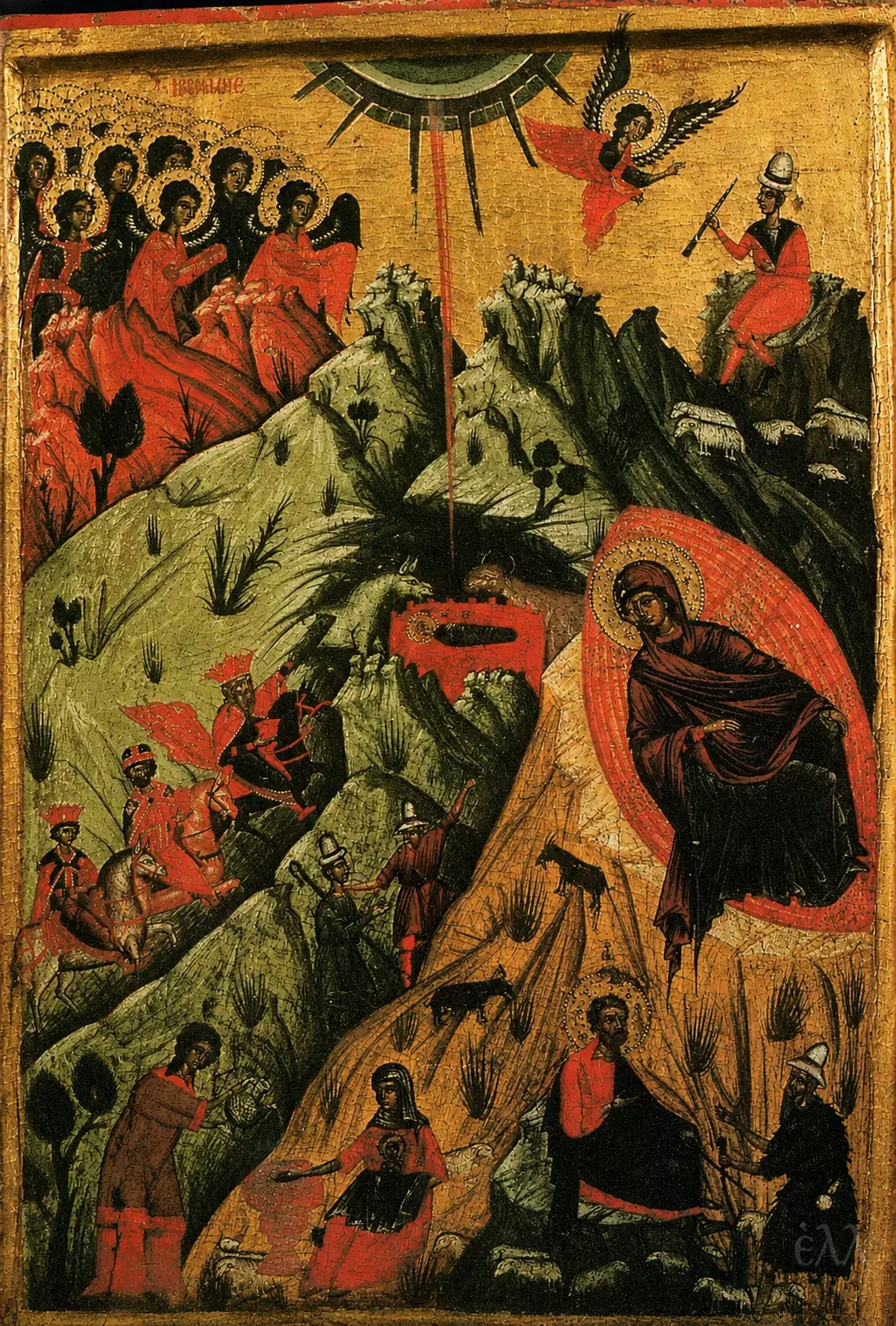
Nikolla Onufri’s sixteenth-century Nativity of Christ unfolds beneath a gold ground as a densely populated mountain landscape, its sacred narrative distributed across steep ridges, hollows and narrow paths. Preserved today in the National Iconographic Museum “Onufri” in Berat, the icon belongs to the artistic inheritance of Onufri’s workshop and to the broader Post-Byzantine tradition, the established term for artistic production that continued Byzantine forms after the end of the Byzantine Empire. Nikolla, identified in inscriptions as the son of Onufri, was active during the second half of the sixteenth century; an inscription at the Church of St Mary of Blachernae in Berat records his name and the date 1578. The museum itself occupies the Cathedral of the Dormition of the Virgin and preserves works by Onufri, Nikolla and other important painters of the Albanian iconographic tradition.
The first impression is one of movement held inside a strict vertical frame. A red ray descends from the heavenly semicircle at the upper edge towards the manger (Luke 2:12), establishing a central axis, while almost every surrounding figure approaches, announces, watches, travels or tends. Separate moments therefore coexist within a single pictorial field. At upper left, a choir of angels gathers in layered ranks; opposite them, an angel turns towards a seated shepherd among his flock (Luke 2:8–10). Farther down, the Magi advance on horseback across the green slopes (Matthew 2:1–2). The image accumulates events without dissolving their hierarchy.
Nativity of Christ: Narrative Density and Post-Byzantine Continuity
Near the compositional centre, the Christ Child lies swaddled in a red manger set against the dark opening of the rocky terrain. The ox and ass appear immediately behind him, their heads emerging from the shadow. Slightly to the right, the Theotokos occupies the largest single area of the panel, reclining upon an emphatically red couch whose curved form sets her apart from the angular mountain planes. Her dark maphorion, enlivened by restrained linear highlights, gives the figure visual weight; the surrounding red spreads through the garments of angels, Magi, shepherds and attendants.
Colour provides the icon with much of its internal cohesion. Scholarship has noted Nikolla’s preference in this work for warm reds, ochres and greens, together with the markedly decorative effect created by their combination. Comparison with an analogous Nativity by his father shows that Nikolla retained the inherited compositional scheme while increasing the number of figures and introducing an abundance of landscape elements—trees, grasses and animals—throughout the rocky setting. Shifting the Virgin towards the right side of the panel, Nikolla departs from her placement in Onufri’s version. Small in principle though this alteration may be, the equilibrium of the whole changes: the descending ray remains rigidly vertical, whereas the principal human figure has moved away from its axis.
Across the surface, vegetation punctures the mountains in black and dark-green tufts. Slender shrubs, isolated trees, grazing animals, sharply cut paths: little space remains inert. Landscape becomes connective tissue. Rather than simply occupying the lower-left zone, the Magi ride their horses through successive ridges, and their route carries the eye diagonally towards the manger (Matthew 2:9). Above them rises the mass of the angelic choir. On the other side, shepherd and sheep provide a quieter counterweight, with the announcing angel suspended above them. Vertical descent, diagonal ascent, clustered stillness—three distinct rhythms held together within a narrow panel.
The intense red recurring from the heavenly figures to the Virgin’s couch and the travelling Magi also establishes a visible relationship with the chromatic language associated with Onufri. His celebrated use of red became one of the defining features attached to his reputation, while Nikolla developed the inherited palette in a warmer, decorative direction. The connection between father and son was deeper than the mere repetition of iconographic prototypes: composition, colour, linear definition and workshop memory passed into another artistic generation.
At the bottom, two subsidiary episodes bring the narrative close to ordinary human action. An attendant pours water from a vessel while a seated woman holds the infant for the customary bath scene. Nearby sits Joseph, haloed and withdrawn, facing an elderly figure who leans towards him with a staff. Such episodes belong to the established Byzantine repertoire of the Nativity, yet Nikolla gives them considerable physical presence by placing them near the lower edge and enlarging their gestures. Sacred history acquires a domestic register while maintaining the hieratic order governing the icon as a whole.
Gold ground, abrupt mountain forms, compressed pictorial space and simultaneous narration preserve Byzantine convention; the crowded surface, warm chromatic range and persistent interest in animals and vegetation disclose the preferences of a painter working within that convention in sixteenth-century Berat. Particularly revealing is the relationship between density and clarity. Across the panel, many things happen, many figures enter, several directions compete; the ray falling towards the manger steadily secures the centre.
In Nikolla Onufri’s Nativity of Christ, continuity becomes visible: a son following the artistic language of a celebrated father, inherited models altered through new spatial and chromatic decisions, a Byzantine compositional memory still productive centuries after its formation. The result is an icon richly narrative, decorative, regionally inflected and unmistakably Post-Byzantine.
(The translation was edited by E. Alexandraki)