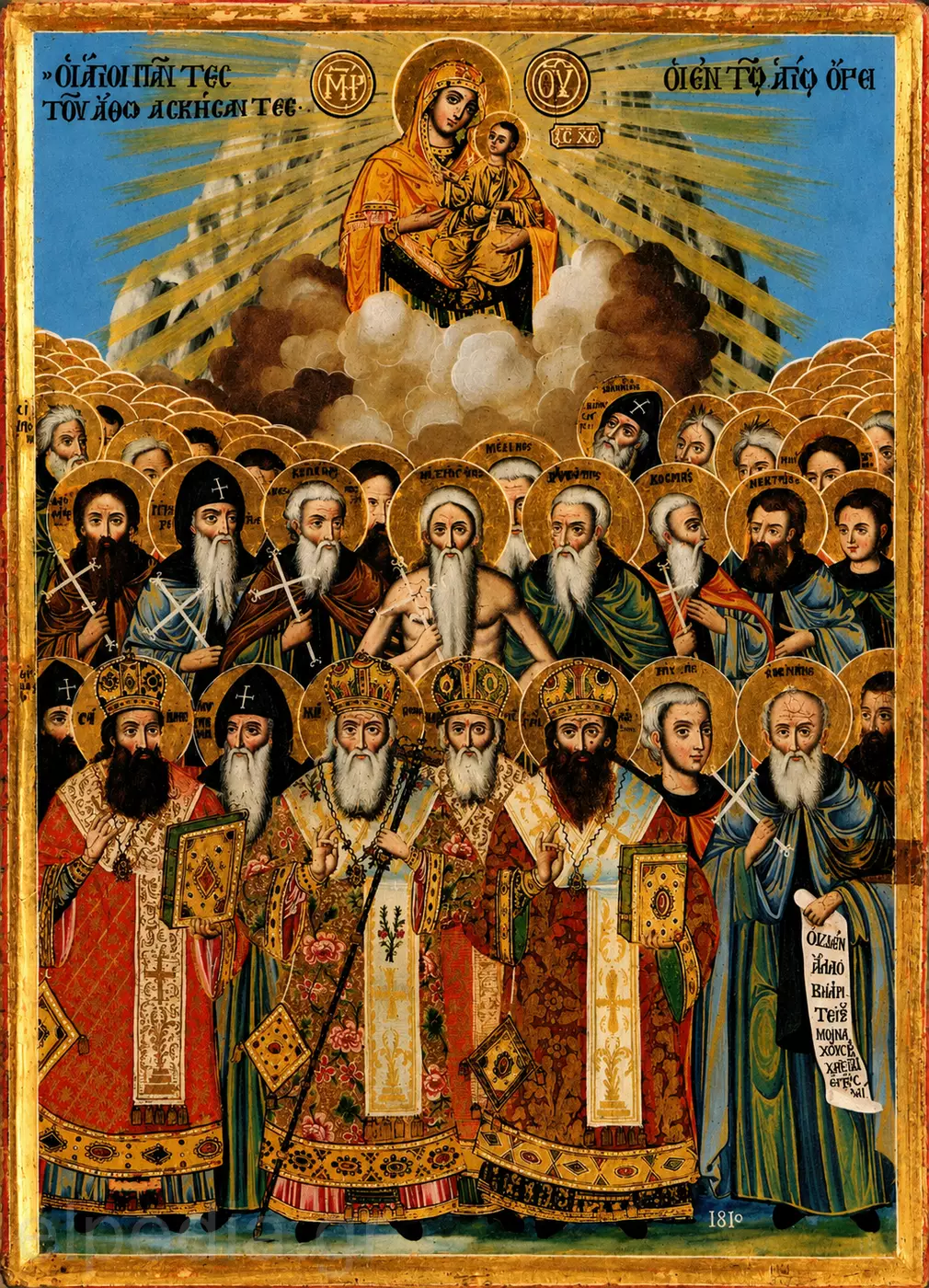
A dense, almost suffocatingly full multitude of haloes occupies the greater part of this portable icon, written in 1810 in the Monastery of Vatopedi of Mount Athos. It is not the depiction of an isolated person, nor a customary composition of supplication, but something more ambitious: a collective icon of the All Saints of Mount Athos, of all, that is, the monks, ascetics and hierarchs who lived and were sanctified on the peninsula of Athos, both those known by their name and the unknown, those whose memory was preserved only as a collective body.
The painter remains anonymous, as is the case with the greater part of the Athonite workshop production of the period, yet the dating to 1810 is clear and connects the work with a specific moment of Athonite spirituality, only a few years after the composition of the encomiastic discourse of Nikodemos the Hagiorite for the Fathers of Athos. In the upper section dominates the enthroned Theotokos with Christ, whilst below is spread, in successive rows, the innumerable multitude of the venerable figures. This work belongs to the process through which Mount Athos organised its own memory in visual form, something that the Monastery of Vatopedi continues to document even today through its archive and its library. The analysis which follows examines this composition as a historical document of a painting tradition, with emphasis upon its structure, its colours, and its inscriptions.
The Composition of the Platytera and the Athonite Fathers in Post-Byzantine Art
Upon a deep light-blue sky, without any other element of landscape to disrupt the surface, the All-Holy Virgin sits enthroned holding Christ in her embrace, wrapped both of them in a deep yellow, almost golden himation. Around them pour forth rays of light in a rectilinear, radial arrangement, filling the upper half of the panel with a radiance that calls to mind a solar disc rather than a conventional halo. Their figure is supported upon dense, greyish and brownish clouds, rendered with intense plastic volume, which function as a neutral zone between the heavenly throne and the earthly multitude. Above their heads are read the customary monograms MP ΘY and IC XC, whilst in the upper section of the background extends a two-column inscription which declares the subject, “the All Saints who on Mount Athos lived in asceticism”. Exactly beneath, like a second, earthly rainbow, unfolds the first row of the hierarchs. Five figures with richly decorated mitres, gold-embroidered sakkos and omophoria in deep red and ochre, stand frontal, each holding the symbols of his office, a pastoral staff the one, a closed Gospel with gem-studded binding the other. Their physiognomies, with long white beards and austere gaze, follow the established type of the hierarch teacher, as it survived in the post-Byzantine painting of the monasteries of Athos through a long chain of copyings. To the right of the group, a younger figure in simple attire holds an open scroll with an inscription, of which only a few words are clearly discerned.
Behind and amongst them, there where the first row recedes, emerges an even denser multitude of ascetics with simple, worn garments, many of them holding small crosses before the chest. In the centre stands out a bare-chested figure, with the right hand clenched at the chest and the gaze fixed upon the viewer, an image of extreme asceticism which refers to the tradition of the anchorites of Athos who lived without protection from the elements. Above several heads are preserved traces of names, written in small capital letters, an element which shows that the painter sought a certain individualisation within the collective multitude, without however abandoning the logic of accumulation. The golden background of the haloes, the one beside the other in dense succession, visually creates a second plane of light, lower than the radiance of the Theotokos yet equally intense, as if the whole multitude constitutes a single body illumined from the same divine centre.
This frieze of the venerables, organised into three to four successive rows without gaps, does not follow a hierarchical arrangement by place or epoch. On the contrary, it compresses onto one plane centuries of Athonite history, from the first hermits unto the hierarchs of the late period, in a composition which functions more as a visual catalogue than as a narrative. The lower right section of the frame bears the indication of the dating, whilst the golden background of the frame, with traces of wear at the edges, betrays the long use of the icon through time. That which remains ultimately of this composition is not a simple recording of persons; it is the attempt of an entire monastic community to see itself as a single, indivisible body of holiness, beneath the same light.
(Translated from the Greek text by K. Pappas)

