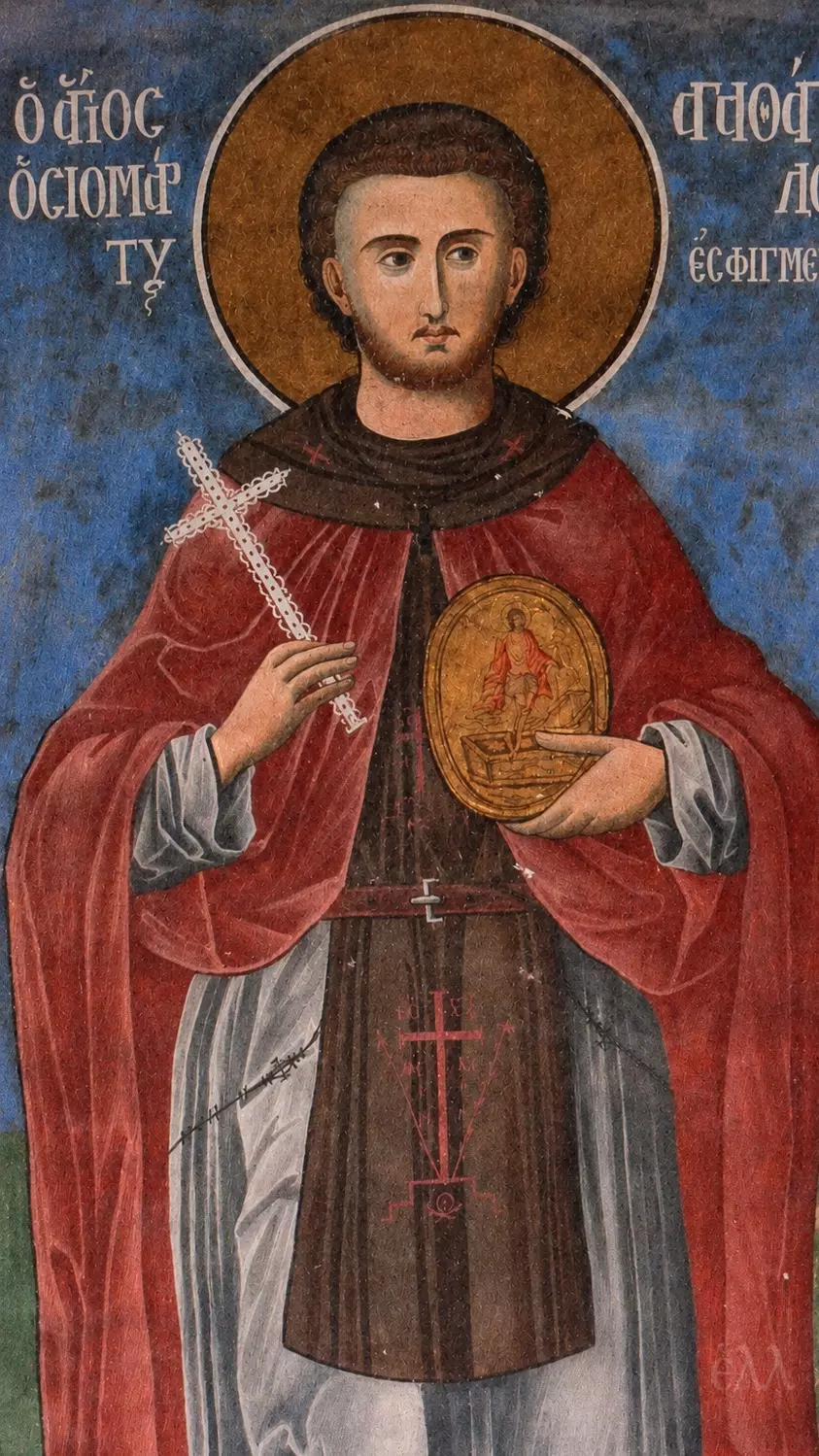
In the katholikon of the Holy Monastery of Esphigmenou, on Mount Athos, a fresco renders the figure of the Venerable Martyr Agathangelos of Esphigmenou, a monk who was martyred in Smyrna in 1819. Young, with delicate features, curly brown hair, and a short beard, he wears the heavy crimson ependytes over the dark monastic habit, the cross embroidered in the fabric. In one hand he holds a white chain shaped like a cross, and in the other a small oval icon of the Resurrection, where Christ rises from the tomb. The face, painted with a calm, almost subdued seriousness, is set within the golden disk of the halo against a deep blue ground, as was customary in Athonite wall painting of the period. To the right and left of the head, a portion of the inscription can be seen, naming him and linking him with the monastery of his spiritual martyrdom. This is a work of iconographic remembrance, made to keep alive the memory of a modern martyr in the very place where he spent the last years of his life. The image does not seek dramatic intensity; instead, it fixes the figure in a frontal, hieratic stance that recalls a devotional prototype more than a narrative scene.
The figure of the Venerable Martyr Agathangelos of Esphigmenou in post-Byzantine wall painting
Two objects organize the entire iconographic thought behind the composition. The chain, imaginatively designed like a lacework of white light, recalls the bonds he himself bore during his ascetic preparation before setting out for Smyrna. The small icon of the Resurrection in the other hand functions as a declaration of intent, since Christ’s Resurrection was for him the theological argument against the denial that weighed on him from his youth, when, under pressure from the captain of a Turkish ship on which he worked, he was forced into Islam against his will. The painter does not narrate the martyrdom here; he prefers to condense the biography into two symbols, leaving the viewer to complete mentally what followed: the return to Mount Athos, repentance, and his confession in Esphigmenou Monastery, where he received the angelic schema and was named Agathangelos.
Stylistic features of icon painting
The palette remains restrained, with the red of the garment set against the cool blue of the background, while the gray of the inner vestment adds an almost ascetic balance to the whole. Characteristic of the style of post-Byzantine Athonite art is the care devoted to modeling the face, where successive highlights give volume without abolishing the schematic, hieratic plasticity inherited by icon painting from older models. Monk Gregory, who accompanied the venerable martyrs of the skete of the Iberians to martyrdom, and Patriarch Gregory V were the ones who guided Agathangelos spiritually in the final steps toward Smyrna, where he appeared holding the precious cross and the icon of the Resurrection, publicly renouncing Islam. Neither flattery nor threats, beatings, or imprisonment managed to turn him from his decision. The fresco, probably painted decades later in the monastery’s katholikon, does not render the drama of those days; it preserves only the two symbols, the chain and the icon, as a concise summary of a life that began in Ainos in Thrace and ended in Smyrna.


