
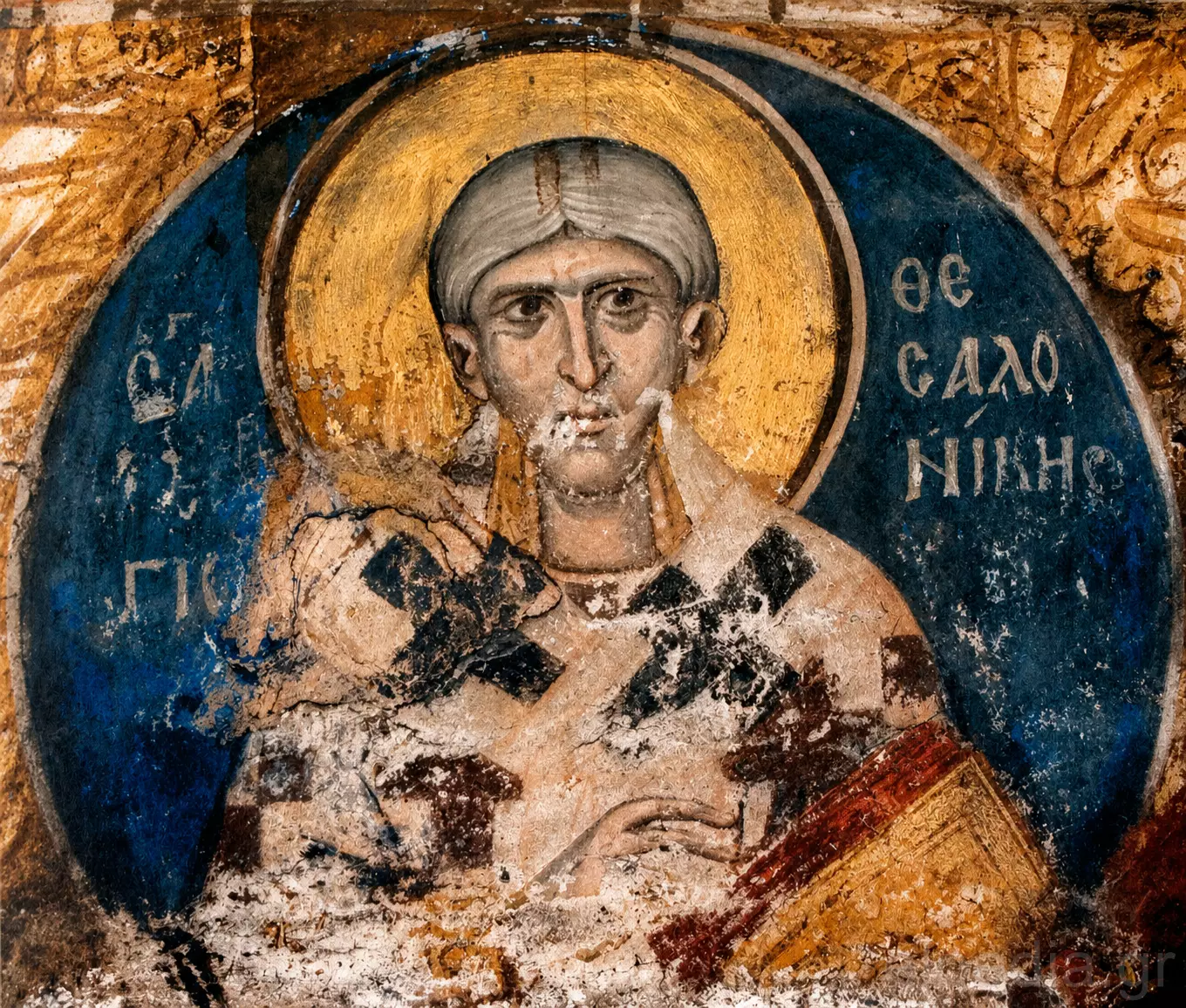
An elderly hierarch with white hair parted in the middle, without a beard, looks the viewer directly in the eyes from within a golden halo upon a deep cyan background. This is Saint George, bishop of Thessalonica, a figure whom Byzantine tradition places in the 11th century, between two known predecessors of the metropolitan see. His identity is preserved in a fresco which adorns the north wall of the prothesis in the Catholicon of the Holy Monastery of Vatopedi, a work of 1312, a year during which Thessalonican iconographers painted the entirety of the church in a style that approaches that of Panselinos in the Protaton of Karyes.
He is named rarely in the bibliography and even more rarely in the synaxaria, a fact which renders this figure a particularly precious document for the local ecclesiastical history of Thessalonica as well as for the history of the art of the Palaiologan period. His gaze, intense and penetrating, appears to withstand time more than the colour around it. The Holy Monastery of Vatopedi preserves this composition as part of a broader iconographic programme dedicated to the saints who are connected with its monastic history, among them also that bishop who oral tradition holds to have emerged from a cell of the monastery itself. The face, grave and almost ascetic, bears the marks of a painting which did not seek idealisation but individuality.
The Iconography of Saint George of Thessalonica in the Byzantine Art of the Monastery
The figure occupies almost the entire pictorial field in a bust, with the shoulders turned slightly and the face perfectly frontal. Above the head are discerned two thin red lines, traces perhaps of a preparatory drawing which the passage of centuries allowed to show through beneath the worn surface of the colour. The hair, grey and short, is parted in the middle with a regularity which resembles almost a clerical coiffure rather than the free brushstroke of a painter.
The bishop wears a white phelonion dotted with black crosses, the known polystavrion, a vestment which in Byzantine hierarchical iconography denotes the high-priestly dignity of him who bears it; beneath this is outlined an omophorion, also white, with corresponding decoration. At the lower right edge of the composition projects a closed gospel with red dye on the cut of the leaves, held by the left hand of the figure, while the right is raised to the height of the chest in a gesture of blessing, with the fingers partially preserved beneath the damage. On either side of the halo, upon the dark blue background, spreads the inscription which identifies the figure. On the right is clearly read OF THESSALONICA with capital white letters of Byzantine type, while on the left the traces are fragmentary, worn by damp and time, sufficient however so as to complete the name George.
It is not accidental that exactly this inscription, and not some biographical element, constituted for the scholars the only secure basis of identification; Ioustinos Simonopetritis, when he first published the fresco, relied almost exclusively upon it. The face of the bishop, with full cheeks and mild features, has been described by the same researcher as something which recalls the countenance of a eunuch, an observation which does not refer to some historical testimony but to the purely painterly rendering of the features. The epidermis of the face, there where the colour is saved, is worked with successive layers of ochre and pink tones which create plasticity around the eyes and the nose, while the damages on the chest reveal the preparatory brown substratum upon which the iconographer worked.
It is a technique usual in the mural painting of the beginning of the 14th century, a period during which the workshops of Thessalonica develop an expressive realism which will influence more broadly post-Byzantine art. The absence of a beard, unusual for a mature hierarch, reinforces the hypothesis that the painter of 1312 did not simply copy an established type of bishop but attempted to render specific physiognomic elements, perhaps an echo of an older depiction or of local memory for the saint himself. His memory, as is noted, remains absent from the great synaxaria; he is honoured, however, every year together with the entirety of the Vatopedian saints, on the tenth of July, within a festal tradition which the monastery itself maintains alive more through liturgical memory than through written texts.
(Translated from the Greek text by K. Pappas.)

