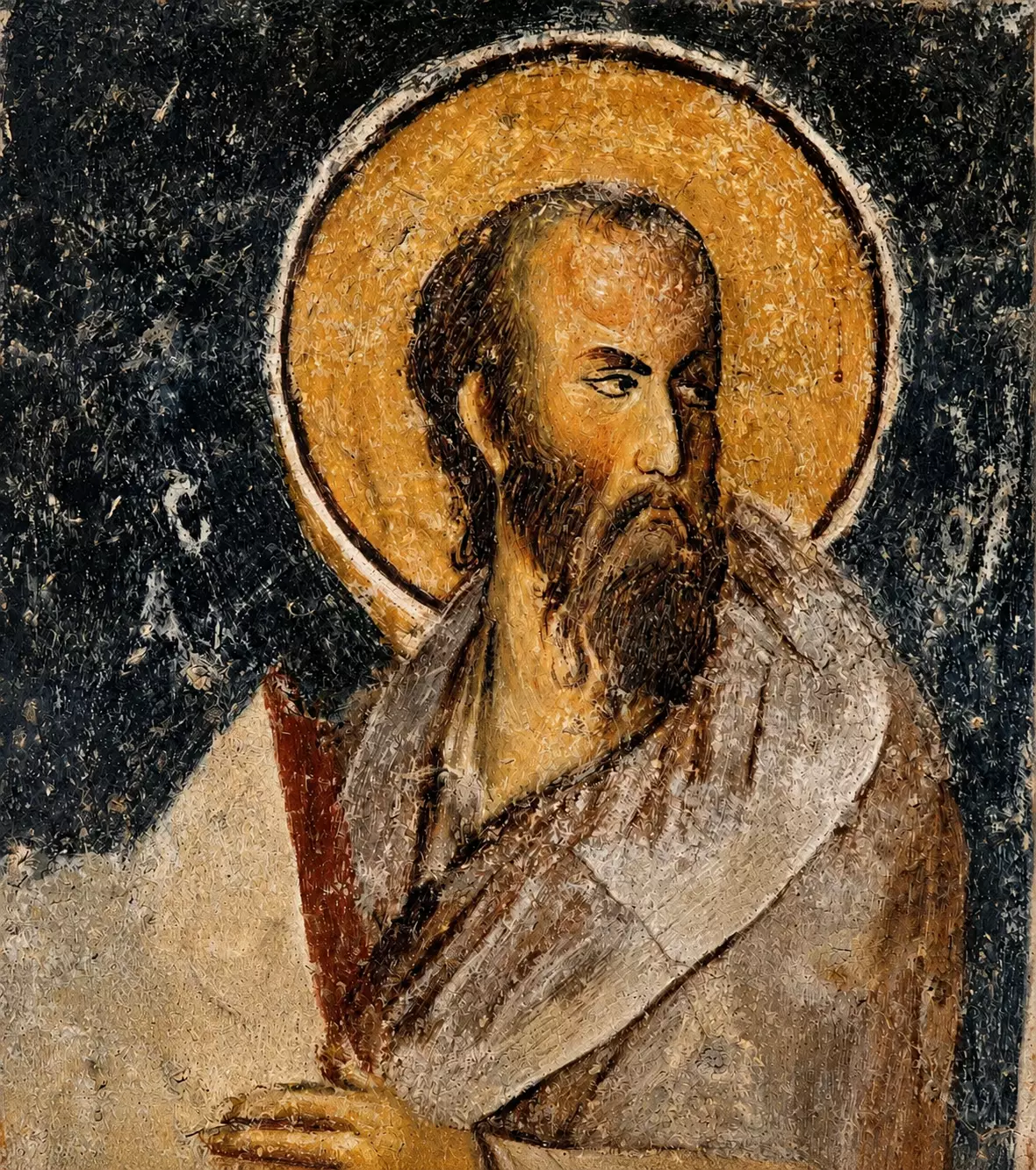
The Apostle Paul fresco at Mystras, dating from the opening decades of the fourteenth century, survives as a striking fragment of the painted decoration associated with the Brontochion Monastery. The figure belongs to the Church of the Hodegetria, commonly known as the Aphentiko, which became the monastery’s katholikon under the abbot Pachomios. Around 1310 the church was built, forming part of the ambitious architectural expansion of Brontochion, and it preserves some of the most important Late Byzantine painting at Mystras.
Paul appears at bust length against a dark blue field, his head enclosed by a broad ochre-gold halo. Time has heavily marked the surface. Abrasions, small losses, scratches and irregular pale areas interrupt the colour across the face, garments, halo and background, yet the essential structure of the figure remains exceptionally clear. The high forehead, receding hairline and long bifurcated beard follow the established Byzantine physiognomic type of the apostle, a type that had long distinguished him visually from Saint Peter.
Most compelling is the expression. The eyes are lowered and slightly turned away, while the head inclines gently from the vertical axis. Paul consequently acquires an introspective presence, restrained and thoughtful, without the emphatic frontality found in many monumental images of saints. The closed mouth, narrow nose and carefully articulated brow intensify this inward character, and something of the artist’s care for the sitter’s inner bearing survives even where the pigment itself has worn thin.
The Apostle Paul Fresco at Mystras and the Art of the Aphentiko
Unusually sophisticated, too, was the architectural setting to which the work belonged. The Hodegetria is an early and important example of the so-called Mystras type, combining a three-aisled basilican arrangement at ground level with a five-domed cross-in-square structure above. Marble revetment once enriched parts of the lower interior, while extensive painted decoration occupied the wall surfaces above it, so that architectural form, coloured stone and monumental imagery met within a single, closely integrated interior.
In the northwestern chapel, the context was especially significant. The chapel was created for the tomb of Pachomios, the abbot responsible for the development of the church, and its decoration therefore belonged to a space with a commemorative and funerary function. The surviving Apostle Paul should be understood within that wider pictorial environment rather than as an isolated devotional portrait, although the fragmentary state of the surrounding decoration now gives the image an almost icon-like autonomy.
Face, Gaze and Pictorial Modelling
Against the nearly black blue of the background, the warm flesh tones become the principal focus. The face is constructed from ochres, brown-red shadows and lighter passages placed across the forehead, nose and cheek. These transitions retain a degree of volumetric modelling characteristic of sophisticated Palaiologan work, while dark contour lines maintain the firmness of the facial structure; between line and tone, rather than through either alone, the features take shape.
Particularly expressive is the forehead. Broad and prominently exposed beneath the receding dark hair, it gives the head a distinctive vertical extension before the features narrow toward the beard. Below, the beard divides into two elongated sections, its dark brown mass crossed by finer, lighter strokes that establish the direction of individual locks. The treatment is economical from a distance, more intricate at close range.
The halo provides a warmer counterweight to the dark background. Its ochre-gold field is bounded by a pale circular line, still clearly legible despite extensive abrasion. Around it, the deep background creates a strong figure-ground separation and gives the head an almost isolated visual intensity.
Drapery and Colour
Across the shoulders lies a pale himation, now ranging from warm white to grey because of surviving shading, surface wear and losses. Broad areas of light are crossed by darker linear folds, some gently curved, others more angular as the garment passes across the chest. Beneath it, a narrow area of reddish fabric reveals the chiton and introduces the strongest saturated hue in the lower portion of the surviving fragment.
This restricted chromatic range—dark blue, ochre, brown, muted red and pale drapery—concentrates attention upon the head. Colour works through large contrasts rather than decorative abundance. The damaged surface has altered their original balance, of course; pale scratches now spread across the dark field and the halo, forming an accidental network over the painter’s original brushwork.
The quality of the Hodegetria decoration has long been associated with the artistic culture of Constantinople, and UNESCO likewise notes the strong relationship between the painting of Mystras and the art of the Byzantine capital. In the figure of Paul, such affinities are perceptible in the carefully individualized physiognomy, the controlled modelling of the face and the combination of monumental clarity with an unusually quiet emotional register. Even across the worn forehead and beard, one can still trace, in the finer surviving strokes, something of the discipline that guided the painter’s hand.