
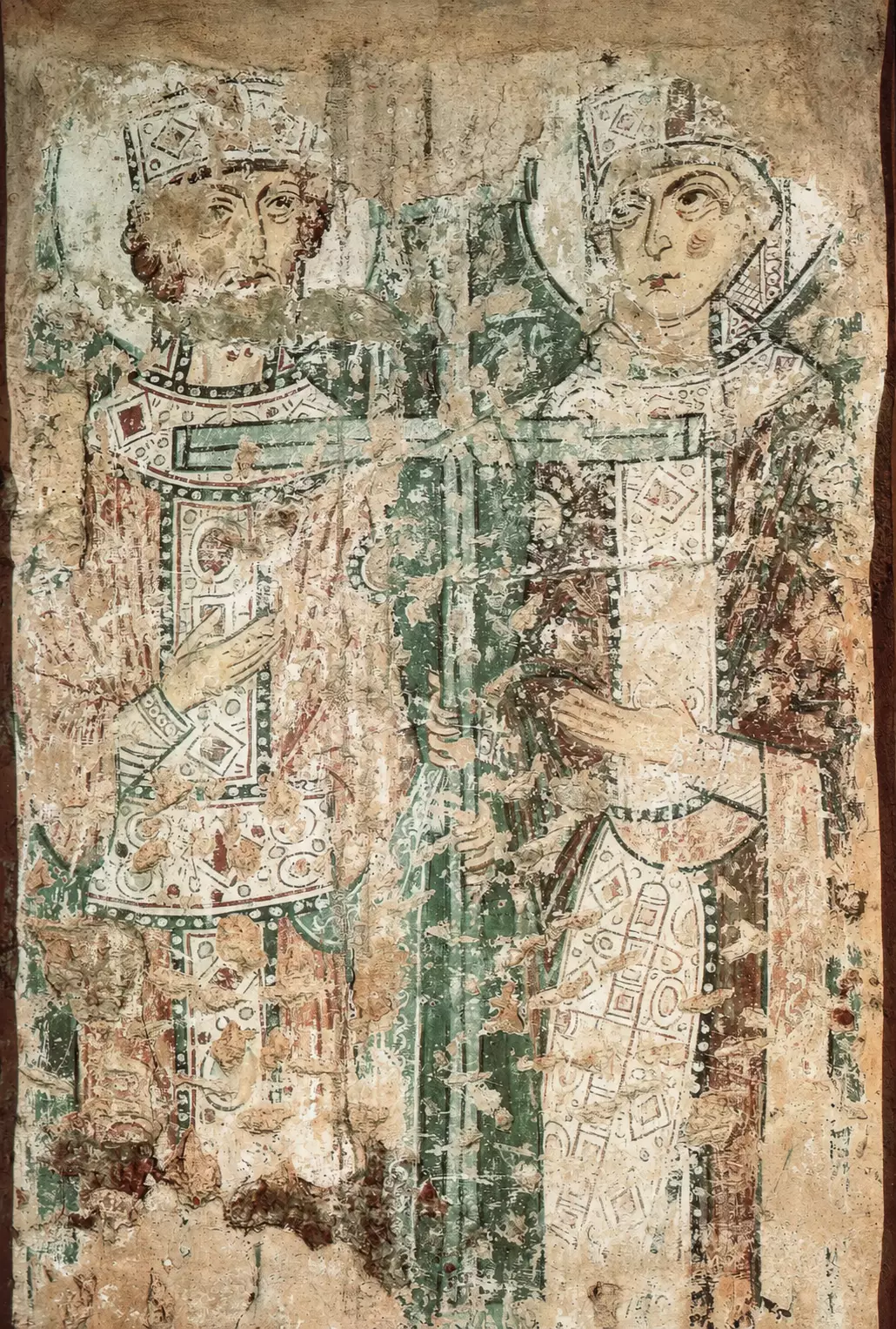
The Constantine and Helena fresco in Saint Sophia Cathedral at Novgorod is among the most striking survivals of the cathedral’s earliest monumental decoration. The two imperial saints stand frontally on either side of the True Cross, each grasping its tall vertical shaft, in the southern gallery traditionally known as the Martirievskaya porch. The cathedral itself was built in 1045–1050, within the first generations of monumental stone architecture in Rus’. The dating of this wall painting remains debated: V. N. Lazarev placed it in the second half of the eleventh century, while other publications have assigned it to the second half of the twelfth. That disagreement matters, since the image has sometimes been connected with the cathedral’s dedication and its association with the Feast of the Exaltation of the Cross.
Despite the damage dominating the surviving surface, the composition remains remarkably legible. Constantine and Helena rise as nearly full-length figures, their bodies enclosed by ceremonial garments covered with geometric ornament, borders and jewel-like motifs. Between them, the cross supplies a rigid central axis, and their hands meet around its shaft at different heights, binding the two figures to the same vertical structure and giving the otherwise static arrangement a quiet internal rhythm.
In the surviving passages, it is the faces that preserve the clearest sense of the painter’s manner. Large almond-shaped eyes, long noses and sharply controlled contour lines give both figures an alert, hieratic presence. Helena’s features survive with greater continuity, while substantial losses interrupt Constantine’s face and beard. Modelling is restrained: the painter relies on line, pale flesh tones and small accents around the eyes, mouth and cheeks, so that contour carries more descriptive weight than gradual transitions of light and shade.
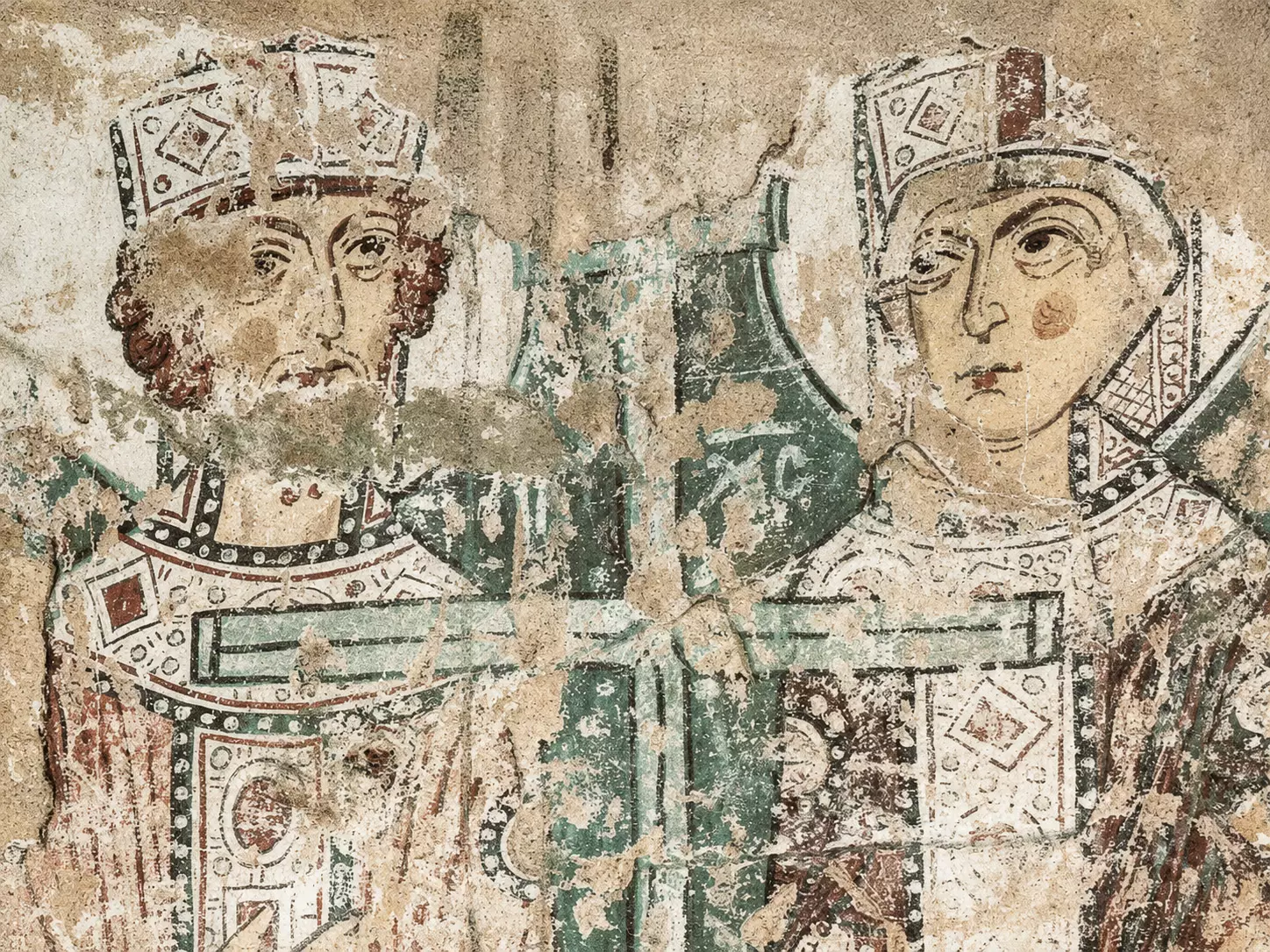
Constantine and Helena Fresco: Imperial Figures and the True Cross
Broad ornamental bands cross the upper body and descend vertically, filled with circles, lozenges and rectangular motifs, and their clothing is equally linear in its treatment. The crowns repeat this dense geometric vocabulary. Green, white, reddish brown and ochre remain visible across the damaged surface, though abrasion and extensive lacunae break the original colour relationships into isolated passages. Especially around the central cross, surviving green areas and exposed plaster form an irregular field through which the original design has to be visually reconstructed.
Although routinely called a fresco, technical research has complicated that description. Studies of the painting have identified extensive execution on dry plaster and have described a mixed or glue-based technique applied over a very thin lime preparation. The work therefore belongs securely to monumental wall painting, while the conventional term “fresco” remains useful as its established name. This technical character helps explain the graphic clarity of the surviving outlines and the unusually light appearance of parts of the painted surface.
Iconographically, the pairing of Constantine and Helena with the True Cross belongs to a well-established Byzantine tradition. Helena was associated in Christian tradition with the discovery of the Cross in Jerusalem, while Constantine became the imperial figure most closely linked with Christianity’s adoption and public authority within the Roman Empire. In Byzantine visual culture the two were consequently shown together as imperial saints, flanking or supporting the Cross in a formula that brought dynastic imagery into direct relation with the central sign of Christian victory.
At Novgorod, that formula acquired an additional political resonance. The conversion of Rus’ had drawn its ecclesiastical culture into sustained contact with Byzantium, and monumental church decoration became one of the principal means through which artistic forms, sacred subjects and ideas of rulership were transmitted and adapted. Saint Sophia itself was constructed within a Byzantine architectural framework, and the ceremonial frontality of Constantine and Helena, their sumptuous dress and their physical attachment to the Cross place imperial authority inside a sacred pictorial order. For patrons and viewers in medieval Novgorod, such an image offered a visual language already charged with the prestige of Constantinople.
Its present fragmentary condition has altered that language without erasing it. Across the figures, pigment loss, abrasions and exposed plaster interrupt garments and limbs, and the cross itself survives in broken segments. Yet the principal structure remains immediate: two crowned rulers, frontal and solemn, joined by the object they hold. The wall painting’s survival, precarious but intelligible, preserves an early stage in the transformation of Byzantine models within the artistic culture of medieval Rus’.
(The translation was edited by A. Orfanos.)