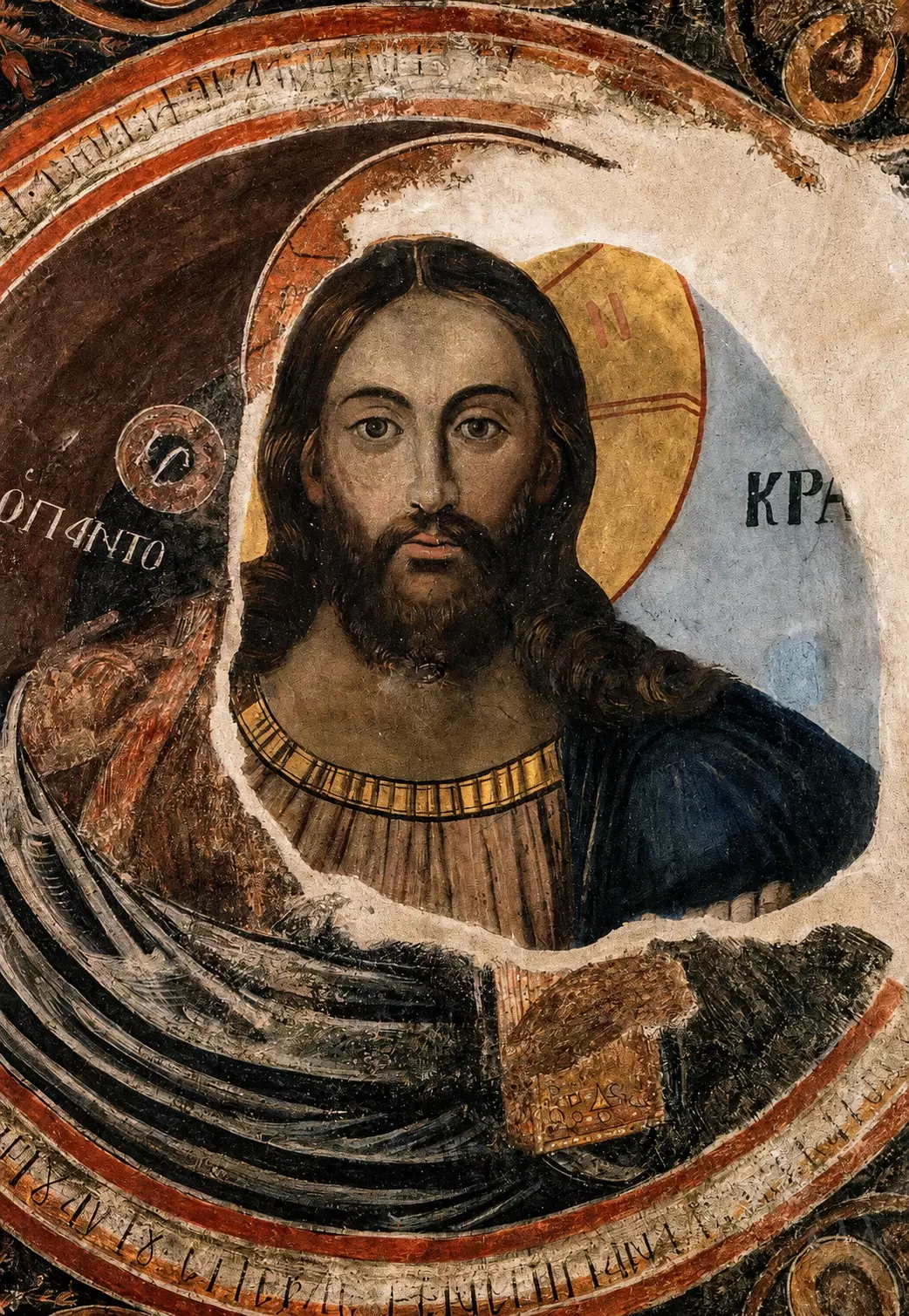
The Christ Pantokrator Chrysafa occupies the summit of the dome in the katholikon of the Monastery of the Forty Martyrs at Chrysafa in Laconia, forming the visual centre of a remarkably extensive Post-Byzantine wall-painting programme. The church was decorated in 1620 by Georgios Moschos of Nafplio, whose name is preserved in the dedicatory inscription and whose work belongs among the important seventeenth-century monumental ensembles of the Peloponnese. Almost the entire painted scheme is attributed to him by that same inscription.
Yet the Pantokrator visible today is also the product of a later moment. In 1879, the Cretan hierodeacon and painter Georgios Kalliterakis overpainted portions of the church’s decoration, including substantial areas that had suffered during the monument’s long history. Kalliterakis had studied at the School of Arts between 1868 and 1873, and his academic training introduced into his ecclesiastical painting features associated with nineteenth-century Western European classicism. Within the dome, consequently, a seventeenth-century iconographic conception survives through a painted surface partly reshaped more than two and a half centuries later.
Christ Pantokrator Chrysafa: Image, Dome and Iconographic Tradition
At the centre of the circular composition appears the bust-length figure of Christ, strictly frontal and directed toward the space beneath the dome. His head is framed by a broad ochre-gold cruciform halo. Dark hair, parted centrally, descends in controlled waves beside the face and continues into the beard, whose softly curling strands frame the lower part of the physiognomy. The large eyes meet the beholder with an unusually direct gaze. Around them, restrained tonal transitions define the eyelids, brows and upper cheeks; the narrow nose provides a strong vertical axis, while the mouth, small and carefully articulated, interrupts the otherwise continuous symmetry of the face.
The modelling deserves attention because it reveals the complicated material history of the painting. Across the forehead, cheeks and neck, gradual shifts between brown, ochre and muted highlights give the flesh a degree of volume quite distinct from strongly linear forms elsewhere in the surrounding decoration. Hair and beard are also developed through numerous individual strokes. With the face, hair and large parts of the garment counted among the zones affected by later overpainting, these passages accord with the documented nineteenth-century intervention. Overpainting, in this context, describes a later paint layer applied over an earlier painted surface and should be distinguished from conservation treatment or simple retouching.
Below the face, a broad dark mantle creates a heavy semicircular mass across the lower portion of the medallion. At the neckline, bands of ochre and dark linear accents articulate the underlying garment. A closed Gospel book appears close to the lower edge, its warm golden cover enriched with red and dark ornament. Damage interrupts parts of both the garment and the book, yet the basic disposition stays legible. Held close to the body rather than opened toward the congregation, the Gospel belongs to the established iconographic vocabulary of Christ Pantokrator and reinforces the compact, centralized character of the figure.
The Pantokrator at the Summit of the Church
The placement of Christ at the apex of the dome follows one of the most enduring arrangements of Byzantine and Post-Byzantine monumental painting. Within the hierarchical conception of the church interior, the Pantokrator occupies the highest central zone, while angelic powers, prophets and other sacred figures may be distributed through the registers below. This vertical ordering had become deeply embedded in Byzantine church decoration and continued, with local adaptations, throughout the Post-Byzantine period.
At Chrysafa, the central medallion forms part of a larger dome scheme in which archangels occupy the lower zone, while Saint John the Baptist, the Prodromos, appears in a separate compartment. Only fragments of these surrounding elements enter the present view, yet their proximity matters. Christ does not function as an isolated bust detached from the architecture; the medallion is embedded within concentric painted bands, inscriptions and neighbouring sacred figures, all adjusted to the curvature of the dome.
Around the Pantokrator, alternating reddish, pale and dark bands establish a strong circular rhythm. The architectural surface becomes part of the composition: line follows curvature, inscriptions bend around the circumference, and the massive frontal head remains fixed upon the central vertical axis. Even where losses expose pale areas of plaster, this underlying geometry stays surprisingly clear.
Georgios Moschos and the 1620 Decoration
Georgios Moschos belonged to a family of painters from Nafplio and worked with his brother Dimitrios during the first decades of the seventeenth century. Documentary research places Georgios’s activity at least between 1606 and 1638, while signed monuments demonstrate the importance of the Moschos workshop for monumental painting in the Peloponnese. The Chrysafa katholikon, completed and painted in 1620, constitutes one of his most substantial surviving undertakings.
Its iconographic programme is exceptionally rich. The sanctuary includes major compositions connected with the Incarnation and Eucharistic liturgy, while other parts of the church contain Christological, Marian and hagiographical cycles. Scholarly study of the ensemble has emphasized both the complexity of this programme and Moschos’s ability to work within inherited Byzantine schemes while giving individual figures considerable expressive force.
Within such a setting, the dome Pantokrator acts as the fixed point above a far denser narrative world. Stillness dominates. The frontal face, broad halo and nearly symmetrical fall of the hair suppress lateral movement, while the dark garment creates a weighty base for the head and Gospel. Around this calm centre, curved borders and surviving fragments of the adjacent painting generate a slower circular motion.
The 1879 Overpainting and the Visible Surface
Kalliterakis’s intervention complicates any stylistic reading based solely on the present appearance. His work belongs to 1879, a date documented for overpainting in the katholikon, and his academic education helps explain the more graduated facial modelling encountered in later passages of the decoration. The underlying conception—the placement of the Pantokrator, the bust-length format, the closed Gospel and the relation between the central figure and the surrounding dome programme—preserves the seventeenth-century structure associated with Moschos.
Time has added another layer. Surface abrasion, small losses and larger irregular areas of missing paint break the continuity of the medallion, especially around its upper and lower boundaries. Beside the halo and garment, the pale exposed zones produce abrupt interruptions. They also make the surviving paint layers more legible as material objects: darker original and later passages, ochre bands, black contours, isolated remnants of ornament, the worn, partly interrupted Greek inscription running around the medallion.
(The translation was edited by A. Orfanos)