Situated within the rich narrative fabric of the Philanthropinon Monastery, the extensive mural decoration exemplifies the sophisticated theological and spatial programming characteristic of Post-Byzantine ecclesiastical art. The unadorned architectural surfaces of the unified interior, when initially encountered by the painters, afforded the principal master of the workshop a rare structural liberty. This allowed the deployment of the iconographic program with remarkable narrative cohesion and lucid articulation. An ornamental band of floral stems, intricately woven into delicate, schematized patterns that subtly shift across the varying architectural planes, circumscribes the lower perimeter of the walls. Above this decorative dado, an imposing procession of full-length saints establishes a terrestrial hierarchy of martyrs, ascetics, and hierarchs. Elevating the viewer’s gaze, the subsequent two registers unfold the histories of the Virgin Mary and Christ; this continuous frieze circumscribes the nave with an almost unbroken topographic and chronological progression, maintaining a symmetrical distribution of the major narrative cycles across the available wall spaces.
The Christological cycle, initiating with the Nativity, dominates the upper registers. Traversing the childhood of Christ and his temptations in the wilderness on the western wall, the narrative proceeds along the northern and eastern walls, where a sequence of eight miracles and instances of public ministry unfolds.
Here, the specific panel under examination occupies a central programmatic position, illustrating the foundational moment of the apostolic mission. Christ’s manifestation by the Sea of Galilee is rendered as an enduring liturgical reality. This resonates deeply with the broader decorative scheme of the sanctuary, where the communion of these same apostles, alongside the Platytera in the apse conch and the Extreme Humility in the prothesis, highlights the sacramental core of the Orthodox faith, linking the nave walls directly to the sanctuary’s ritual function.
The Calling of the Apostles Fresco: Narrative Dynamics and Pictorial Execution
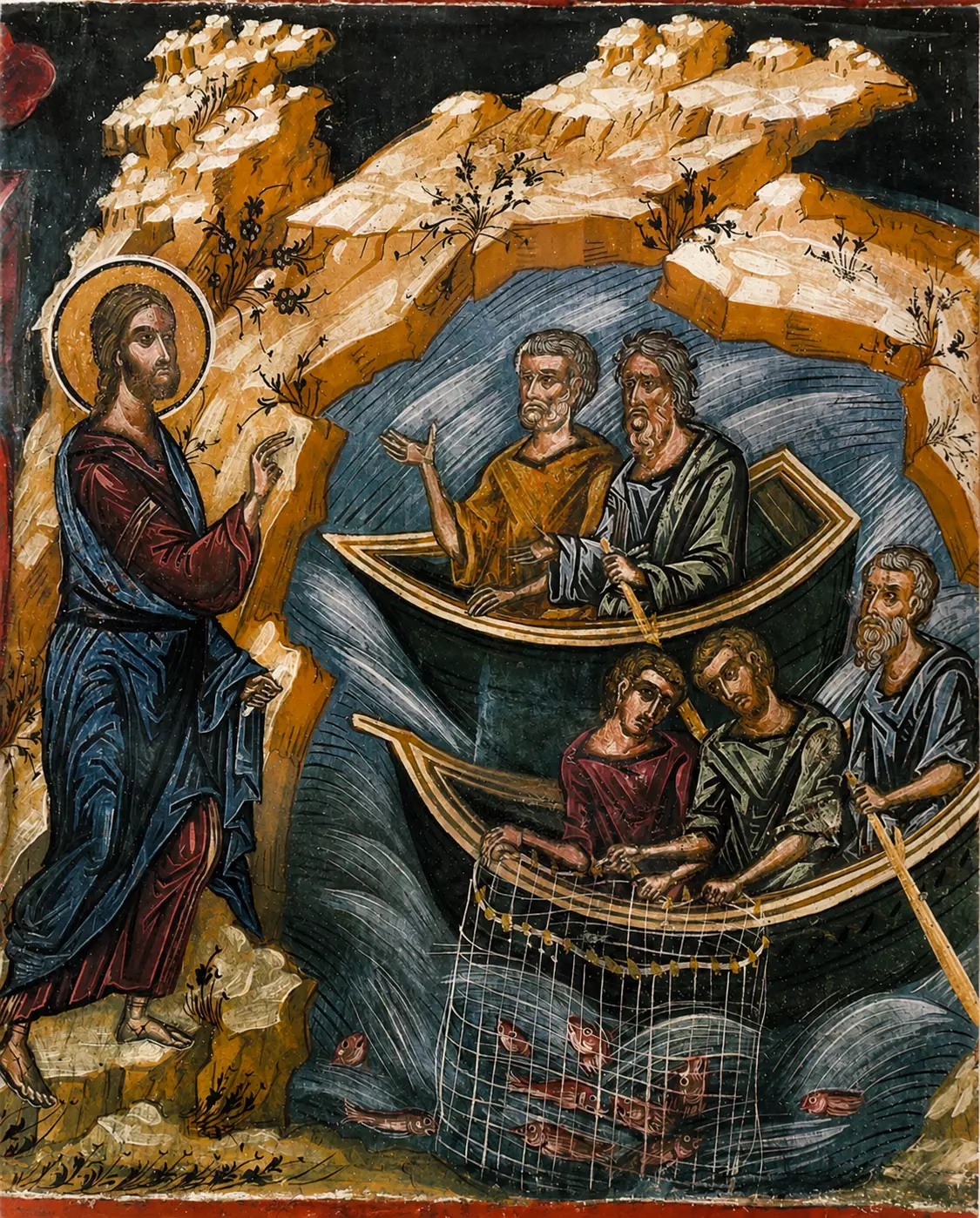
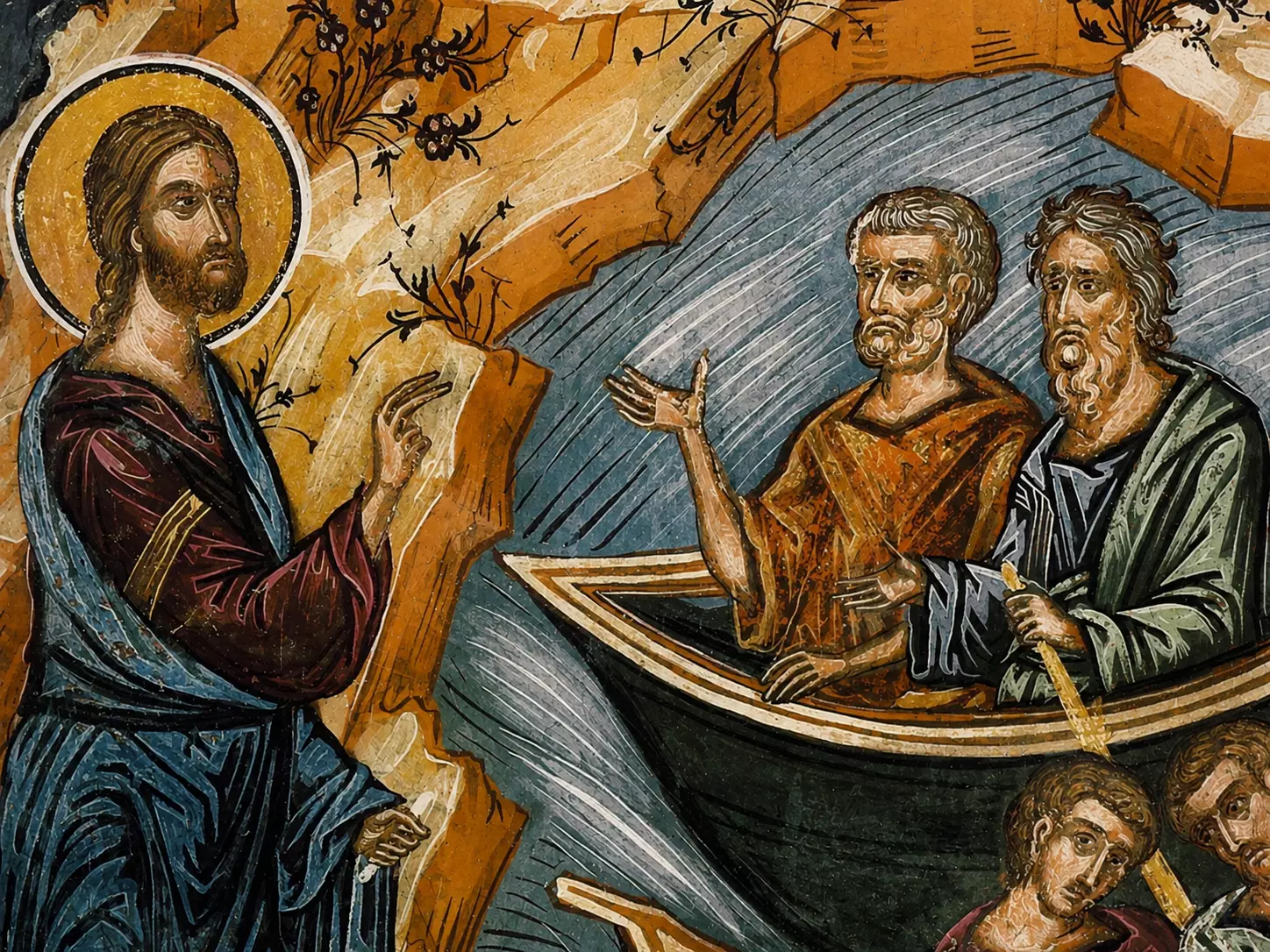
Projecting a profound sense of hieratic calm against the turbulent stylization of the natural world, the composition divides cleanly into divine and human spheres. On the rocky shoreline to the viewer’s left, Christ stands in a three-quarter view, anchoring the visual narrative. His posture, rigid and commanding, is stripped of superfluous motion. Clad in a deep purplish-red chiton beneath a heavily draped, luminous blue himation, he extends his right hand toward the water in the traditional gesture of speech and divine summons. The cruciform halo framing his head distinguishes him immediately from the rugged, undulating environment. It acts as a focal point of divine illumination that initiates the compositional energy.
The landscape itself—a hostile array of jagged outcroppings and swirling white and dark blue striations—parts around the two wooden boats containing the future fishers of men. In the first vessel, positioned closest to the shore, two figures react instantly to the divine command. The older apostle, traditionally identified as Peter by his short, curly white beard and hair, raises his right hand in sudden awe and apprehension. His gaze is locked unyieldingly upon Christ. His companion, Andrew, characterized by wilder hair and a longer beard, leans slightly forward while managing the oars. Their boat, rendered with a simplified, flattened perspective, pitches upon the surging waves, capturing the precarious nature of their earthly labor immediately prior to the call. To comprehend the spatial economy of such Post-Byzantine works, one must consider the broader evolution of the Macedonian and Cretan artistic vocabularies. The structural rhythm of these provincial wall paintings is frequently dictated by a careful balance between classical restraint and narrative intensity.
Chromatic Modulation and Architectural Integration
A second boat, partially overlapping the turbulent foreground and introducing a secondary focal plane, contains three fishermen hauling a heavy net teeming with the day’s catch. Two younger figures, the sons of Zebedee, James and John, labor alongside an older companion. Their muscular effort is conveyed through the taut lines of their arms, the inclination of their torsos, and the sharp, rhythmic folds of their short tunics. The net, depicted as a fine white grid against the abyssal dark of the water, acts as a visual metaphor for the impending spiritual harvest. Silver-scaled fish crowd within its confines, their forms painted with a remarkable degree of naturalistic observation that contrasts sharply with the abstract, linear treatment of the waves.
Between the principal figure of Christ and the fishermen, the rocky terrain rises in sharp, stepped formations. These are highlighted with stark white and ochre tones to simulate the harsh, fractured glare of Mediterranean light. Delicate, stylized floral sprigs emerge incongruously from the barren stone—a decorative convention that softens the severe geometry of the landscape while simultaneously filling the pictorial void characteristic of the period’s aesthetic preferences.
The painterly handling demonstrates an accomplished synthesis of linear precision and volumetric modeling. Flesh tones are built systematically upon a dark proplasmos, with warm ochre mid-tones and sharp, linear white highlights defining the facial features, the prominent cheekbones, and the intense, piercing gazes of the apostles. The drapery, particularly Christ’s himation, features deep, rhythmic folds delineated by heavy shadows, emphasizing the physical weight and corporeality of the figures despite their highly stylized environment.
The palette relies heavily on saturated earth pigments, juxtaposed against the brilliant blues of the sea and the Savior’s garments. This chromatic modulation creates a vibrant optical tension. The warm, luminous gold of the halos pushes the divine and saintly figures forward, separating them from the muted, cooler tones of the background architecture and landscape, keeping the entire narrative held in a state of pending action.
Programmatic Context and the Missing Cycles
While the Calling of the Apostles fresco anchors the early public ministry of Christ on the northern wall, the full comprehension of its theological weight requires an understanding of the broader monumental program, including its lacunae. It remains unclear whether additional wall paintings originally existed in the highest reaches of the northern and southern elevations. However, it can be considered almost certain that the pediments of the narrow walls were fully decorated. The Crucifixion and the Ascension, both compositions of paramount dogmatic importance, would undoubtedly have occupied prominent, elevated positions in these culminating architectural spaces.
The eventual replacement or overpainting of these specific scenes in 1542 on the corresponding tympana of the vault suggests an ongoing liturgical necessity to maintain the visibility of these central feasts. The absence of the Crucifixion in the primary lower register heightens the anticipatory nature of the ministry scenes. Christ’s authoritative gesture by the sea foreshadows the heavy burden of the cross that they will subsequently witness and carry. Ultimately, this depiction operates on multiple interpretive registers. As a narrative, it is direct and dynamic. As a component of the monumental decoration, it functions as a programmatic link connecting the Nativity and childhood scenes of the western wall to the arduous journey toward Jerusalem depicted further along the nave, utilizing the physical structure of the Philanthropinon Monastery as a three-dimensional theological canvas.
(The translation was edited by M. Taylor)