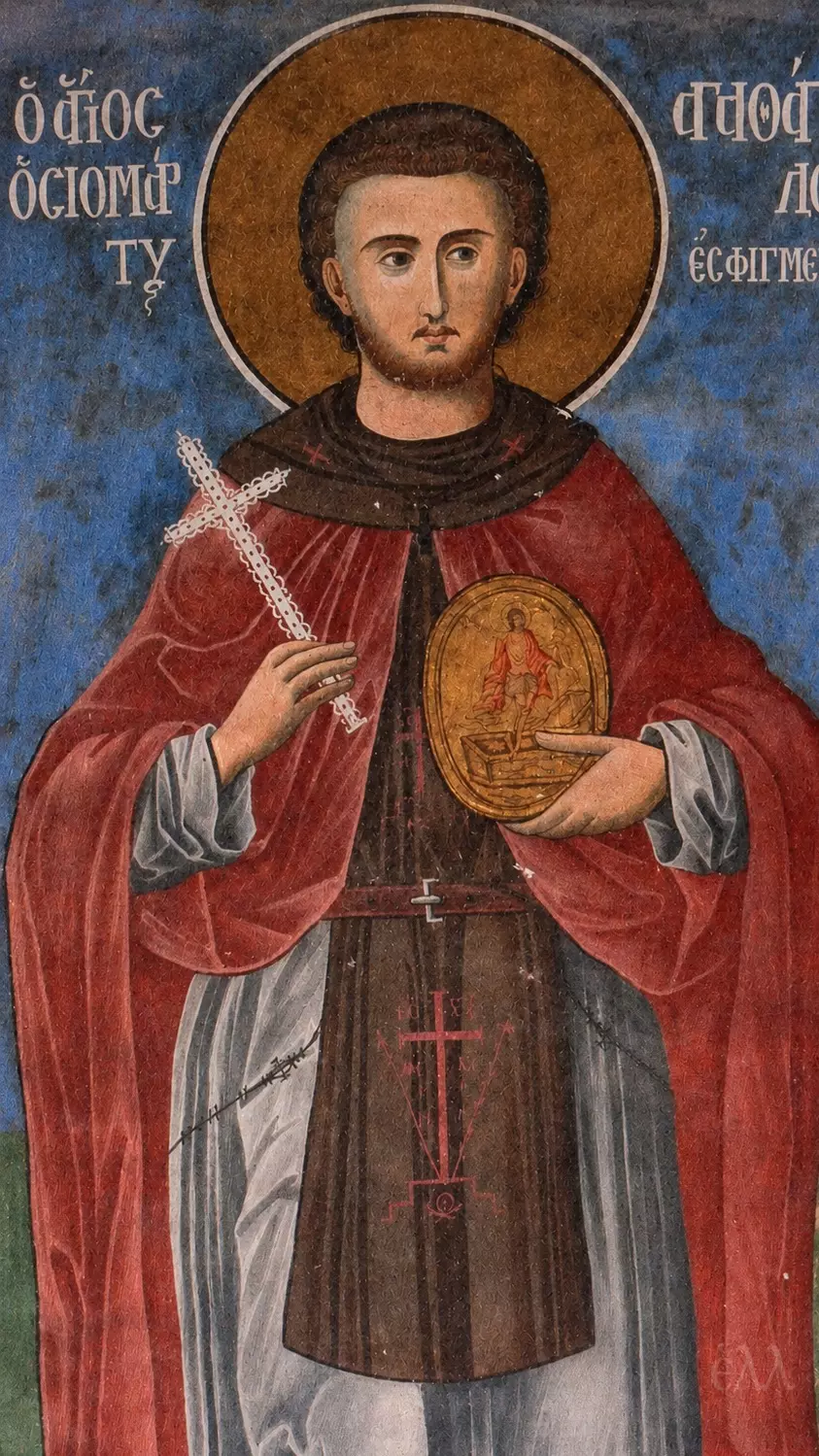
The wall painting of Saint Agathangelos of Esphigmenou in the katholikon of Esphigmenou Monastery presents the monastic martyr as a youthful, full-length figure. Against a deep blue ground, his red outer garment immediately establishes the chromatic structure of the composition, while the gold halo encloses a face of quiet gravity. The body remains frontal and still. His eyes, however, turn slightly aside, introducing a restrained movement into an otherwise firmly axial image.
Agathangelos wears a dark monastic habit beneath a voluminous red mantle. At the wrists, grey-blue sleeves appear, their sharply folded fabric forming a cool interval between the red garment and the warm tones of the hands. Decorating the lower section of the habit are a red cross and fine linear ornament. Such details remain clear, never overwhelming the severe simplicity expected of a monastic saint.
Two objects identify the particular character of the figure. In his right hand, the saint holds an elaborately formed white martyr’s cross. His left hand supports a small oval image of the Resurrection, in which Christ rises above the opened tomb. The miniature composition is remarkably detailed for an object contained within a larger wall painting: the figure of Christ, the sarcophagus, and the surrounding forms remain distinguishable, even though they occupy only a small part of the painted surface.
Saint Agathangelos of Esphigmenou and His Iconography
Born Athanasios in Ainos, Thrace, Agathangelos entered Esphigmenou Monastery and received his monastic name there. He died in Smyrna on 19 April 1819 and became known as one of the Orthodox new martyrs associated with the later Ottoman period. This connection with Esphigmenou accounts for the commemorative significance of his likeness inside the monastery that shaped the final years of his life.
The painter has translated this recent historical identity into an established iconographic language. Agathangelos does not appear within a narrative scene of imprisonment or martyrdom. Removed from episodic time, he stands with the same hieratic frontality used for revered monastics represented across centuries of Orthodox monumental painting. His martyr’s cross conveys his death through a single attribute; the Resurrection image beside it extends that same meaning, without turning to narrative or dramatic incident.
Several features preserve the individuality of a young man. Closely curled brown hair outlines the high forehead; a fine moustache and short, sparse beard soften the lower face. The almond-shaped eyes, narrow nose, and small mouth are delineated with controlled lines, yet the flesh modelling gives the cheeks and neck a limited degree of volume. The expression conveys a solemn quiet, restrained rather than severe. A slight uncertainty lingers within the sideways gaze, and this lends the physiognomy an unusual inwardness.
The Halo, Inscription, and Blue Ground
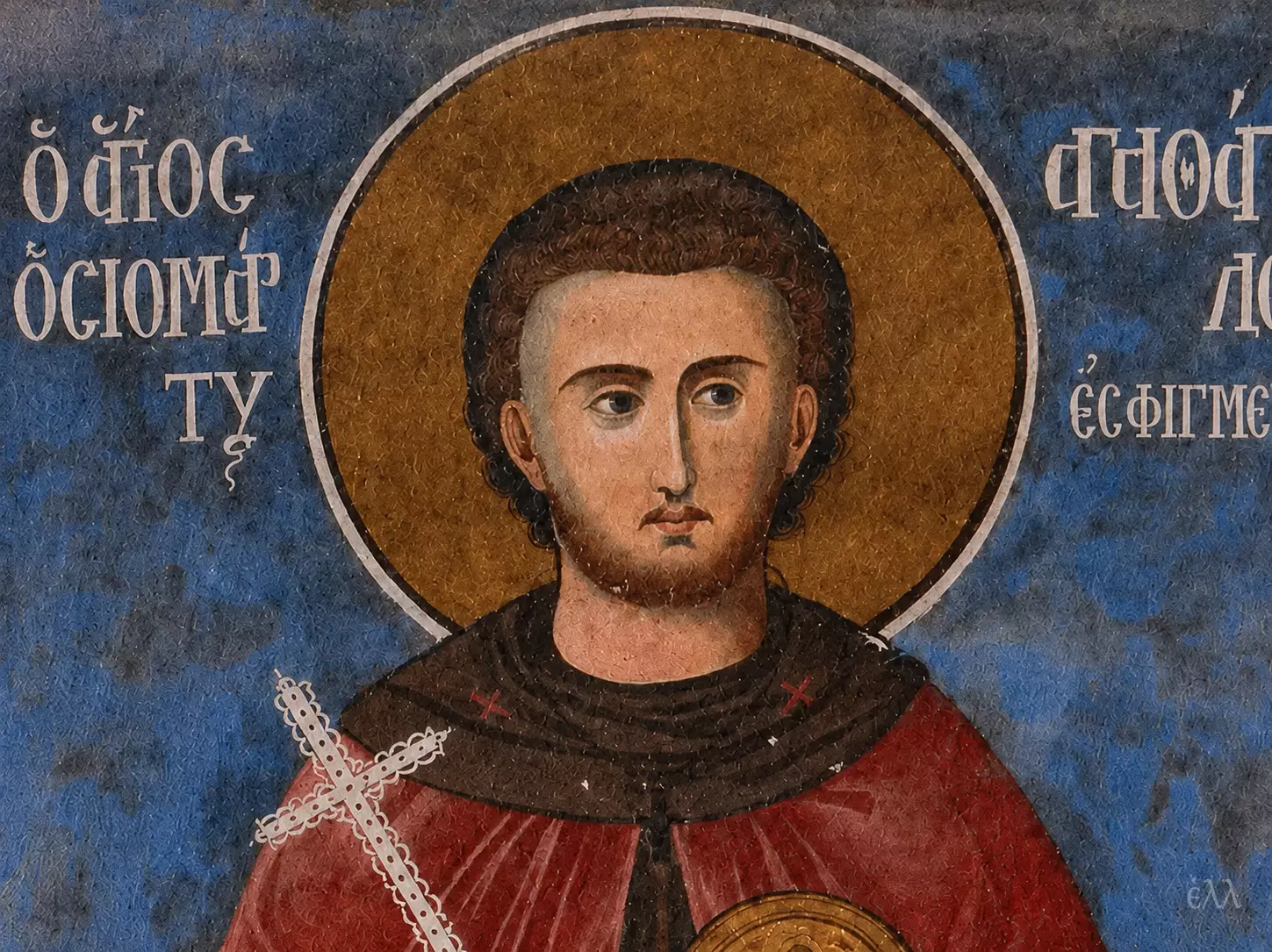
In the portrait detail, his head occupies almost the entire visual field. A broad gold halo, bordered by dark and pale concentric lines, separates the warm flesh tones from the saturated blue background. The contrast is strong, though carefully balanced. Between the gold, which fixes the sacred status of the figure, and the saturated blue, which supplies depth, the dark curls settle as a narrow transitional band.
Fragments of the white identifying inscription survive on both sides of the halo. They name him as the holy monastic martyr Agathangelos and connect him explicitly with Esphigmenou. Text and image consequently work together. The inscription establishes identity, and the cross together with the Resurrection icon give that identity visual expression.
As a work of Post-Byzantine painting, the image demonstrates the continuing adaptability of Athonite artistic tradition. A holy man whose life belonged to the nineteenth century could be incorporated into the inherited monumental programme through familiar pictorial conventions: the frontal stance, the blue field, the gold nimbus, the identifying inscription, and a small group of attributes. Yet the youthful face prevents him from becoming wholly impersonal. Within the katholikon, Agathangelos is venerated as a canonical monastic martyr, yet the community of Esphigmenou also remembers him as one of its own.
(The translation was edited by P. Alexiou.)