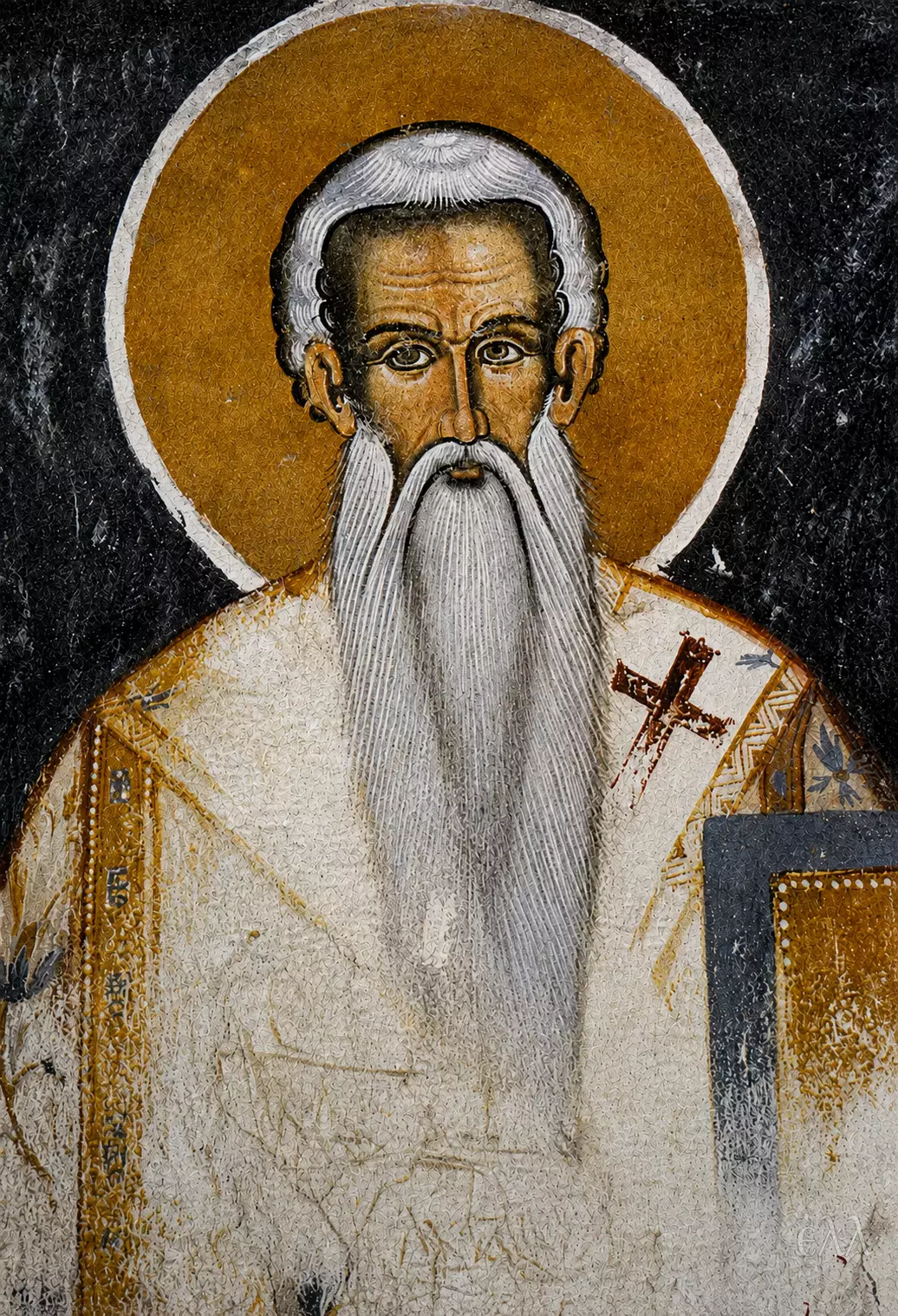
The Saint Theodosios of Trebizond fresco belongs to the painted decoration completed in 1765 for the exonarthex of the katholikon at Philotheou Monastery on Mount Athos. Executed by the brothers from Korçë, the image presents the fourteenth-century metropolitan as an elderly holy hierarch, standing frontally against an almost black field.
Its place within a larger Post-Byzantine decorative scheme matters.
The figure is not conceived as an independent likeness, although the treatment of age is unusually insistent; it forms part of a monastic assembly of saints whose fixed presence accompanies the passage through the outer narthex. Against the dark ground, the ochre-gold halo and white vestments produce a sudden, compact brightness.
Saint Theodosios of Trebizond Fresco: Face and Hieratic Presence
The painter has organized the saint around a strong vertical axis. His narrow face, long nose and immense beard descend through the center of the composition, while the broad curve of the halo stabilizes the head. Frontality gives the figure its hieratic stillness, yet the physiognomy is far from generalized. Horizontal furrows cross the high forehead; the cheeks are hollow, the ears prominent, and short dark strokes gather beneath the eyes. With graphic precision, white highlights trace the brows, nose and facial ridges. The direct gaze is severe without becoming agitated, while small differences between the eyes, together with the compressed mouth, prevent the symmetry from turning inert.
The hair is arranged in pale, rhythmic locks over a darker underlayer. Below it, the beard divides into two long sections before merging into a dense fall of fine white lines. This prominent feature corresponds strikingly to the surviving description of Theodosios in the monastery’s manuscript office for the saint, which records a beard reaching to his belt and characterizes him as elevated in conduct, humble in disposition and highly learned in canonical order. Such agreement does not make the wall painting a portrait in the modern sense. It does show how written memory could sharpen an established iconographic type, giving a bishop saint recognizable bodily traits.
Episcopal Vestments and the Closed Gospel Book
His rank is articulated through episcopal dress. A white omophorion, edged with ochre ornament and marked by dark crosses, lies over the pale vestment; much of its surface has lost definition, though the principal contours remain legible. The restricted palette binds costume, hair and beard into one luminous mass. At the saint’s left side, a closed Gospel book rises vertically, its dark border setting off a warm ochre cover with small pearl-like dots. The book is both an attribute of episcopal office and a compositional counterweight to the long beard. No expansive gesture interrupts the pose, and authority resides instead in stillness, in the frontal body and its carefully controlled lines.
From Kastoria and Constantinople to Trebizond
Born around 1300 at Korissos near Kastoria, the historical Theodosios travelled as a young man to Constantinople, serving the Great Church before his ordination as deacon and priest. He later entered Philotheou Monastery and became its abbot. His career then took an abrupt turn: raiders abducted him from the Athonite coast and sold him into slavery in Bithynia. After regaining his freedom, he returned to Constantinople and became abbot of the Monastery of Saint George of Mangana. Around 1368 he was appointed metropolitan of Trebizond, an office he held within the Empire of the Grand Komnenoi until his death in 1391. These stages, preserved in the saint’s biographical tradition, explain his enduring importance to Philotheou.
The monastery church seen today had been rebuilt in 1746 after the collapse of an earlier structure. Its exonarthex paintings followed nineteen years later, extending older institutional memory into a newly constructed setting. Surviving Byzantine documents associated with Philotheou attest to the monastery’s long history of patronage and protection. Within this accumulated past, the 1765 image has a precise local resonance: Theodosios appears as metropolitan, former captive and, above all, one of Philotheou’s own abbots. The worn painted surface has darkened and abraded, but the measured face remains sharply present.
(The translation was edited by M. Taylor.)