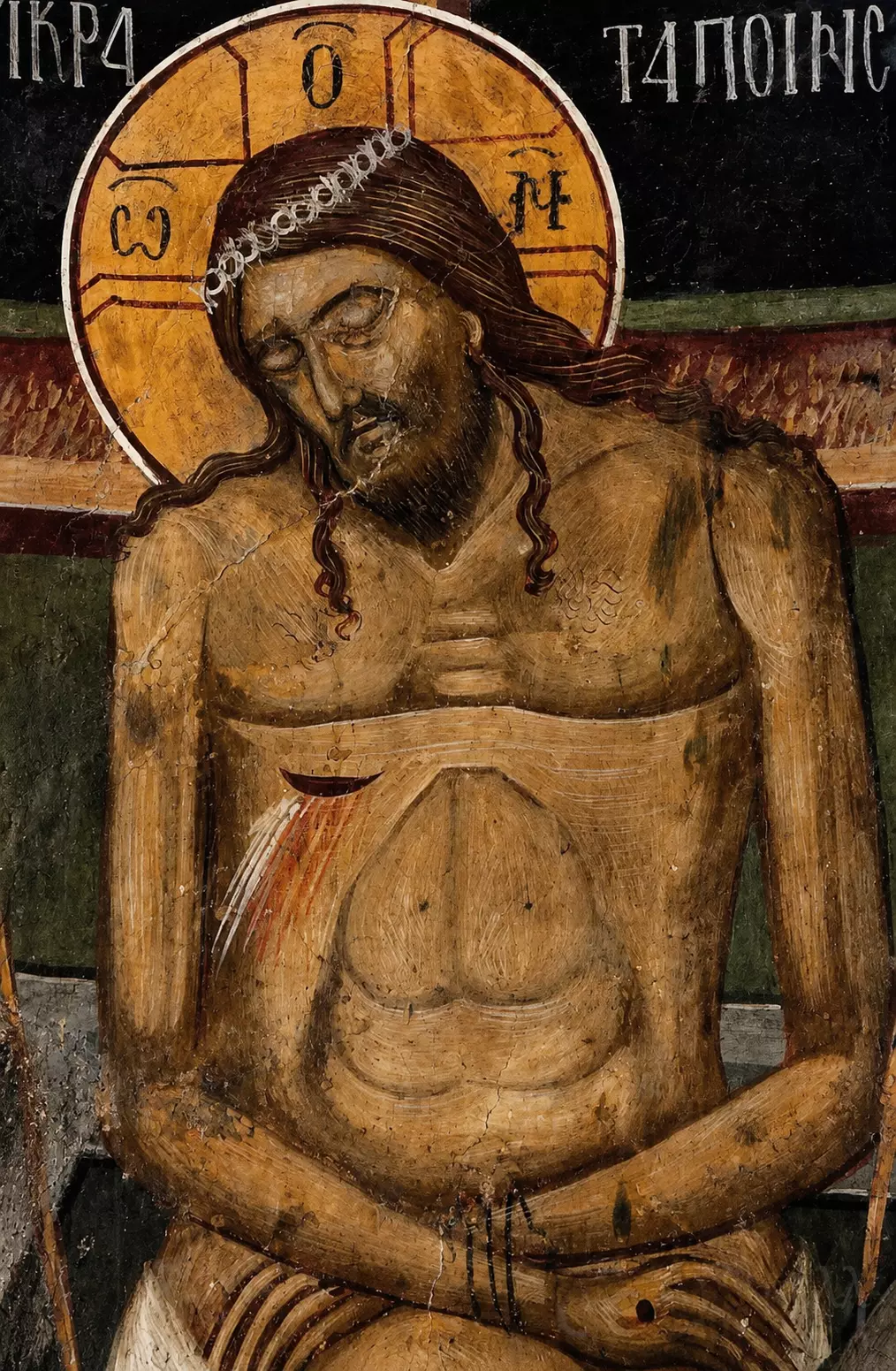
In 1620, the painter Georgios Moschos of Nafplio represented the dead Christ in the prothesis of the katholikon of the Monastery of the Holy Forty Martyrs at Chrysafa in Laconia. The subject is the Akra Tapeinosis, or Extreme Humility, an iconographic type also widely known in Western scholarship as the Man of Sorrows. Within Moschos’s extensive painted programme, the image occupies a small architectural space, yet its concentration is exceptional: Christ alone, upright and half-length, the head inclined towards his right shoulder, the eyes closed, the hands crossed before the body and the wound of the spear exposed on his right side (John 19:34). The 1620 decoration of the katholikon is documented as Moschos’s work, and recent scholarship has treated the Chrysafa ensemble as a major point of reference for his artistic personality and for seventeenth-century post-Byzantine wall painting in the Peloponnese.
The iconography itself reaches much further back. The type of the dead yet vertically presented Christ had already taken shape in Byzantium by the late eleventh century and acquired several variations during the centuries that followed. At the monastery, Moschos reduces that long visual tradition to a remarkably austere formulation. No surrounding mourners interrupt the figure, and neither the Cross nor a clearly articulated tomb dominates the surviving composition. What remains before the eye is the wounded body itself.
Akra Tapeinosis by Georgios Moschos: The Body as the Centre of the Image
Christ’s figure is constructed around a movement of descent. The shoulders sink, the head bends heavily to his right, the eyelids close beneath long dark contours; lower down, the crossed arms form another descending barrier across the abdomen. Yet the body remains upright. Inherited from the Byzantine iconographic type, that contradiction gives the Akra Tapeinosis much of its visual force. Death is unmistakable, although the figure has not been arranged horizontally as in the Lamentation or Entombment. It exists within an image that compresses several moments of the Passion into one static presence. In established examples of the type, the combination of closed eyes, lowered head, wounds and vertical presentation allowed the dead Christ to be contemplated independently of a continuous narrative scene.
Moschos gives that compressed image unusual corporeal weight. The chest is broad, the abdomen gently rounded, the shoulders substantial. Thin, repeated brushstrokes describe the musculature without attempting anatomical naturalism in a Western seventeenth-century sense. Across the torso, warm ochres are crossed by olive-brown shadows and lighter linear passages; the modelling remains closely tied to contour and controlled changes of tone. The result is a body at once tangible and deliberately removed from ordinary physical observation. Its surface has been simplified into large areas, then reactivated through fine strokes, small accents and the dark lines that define the arms, breast and abdomen.
Against this restrained flesh modelling, the wound becomes a chromatic interruption. On Christ’s right side a narrow dark-red opening is followed by descending traces of blood, their vertical direction cutting across the broader horizontal rhythms of the torso and waist cloth. The painter does not enlarge the injury or treat it dramatically. Its importance comes from isolation. Almost nothing competes with it. The hands, brought together lower down, establish another area of stillness: elongated forearms cross one another in front of the body, while the fingers are defined with sparse, linear precision. Gesture has ceased; what remains is arrangement, an image of complete immobility.
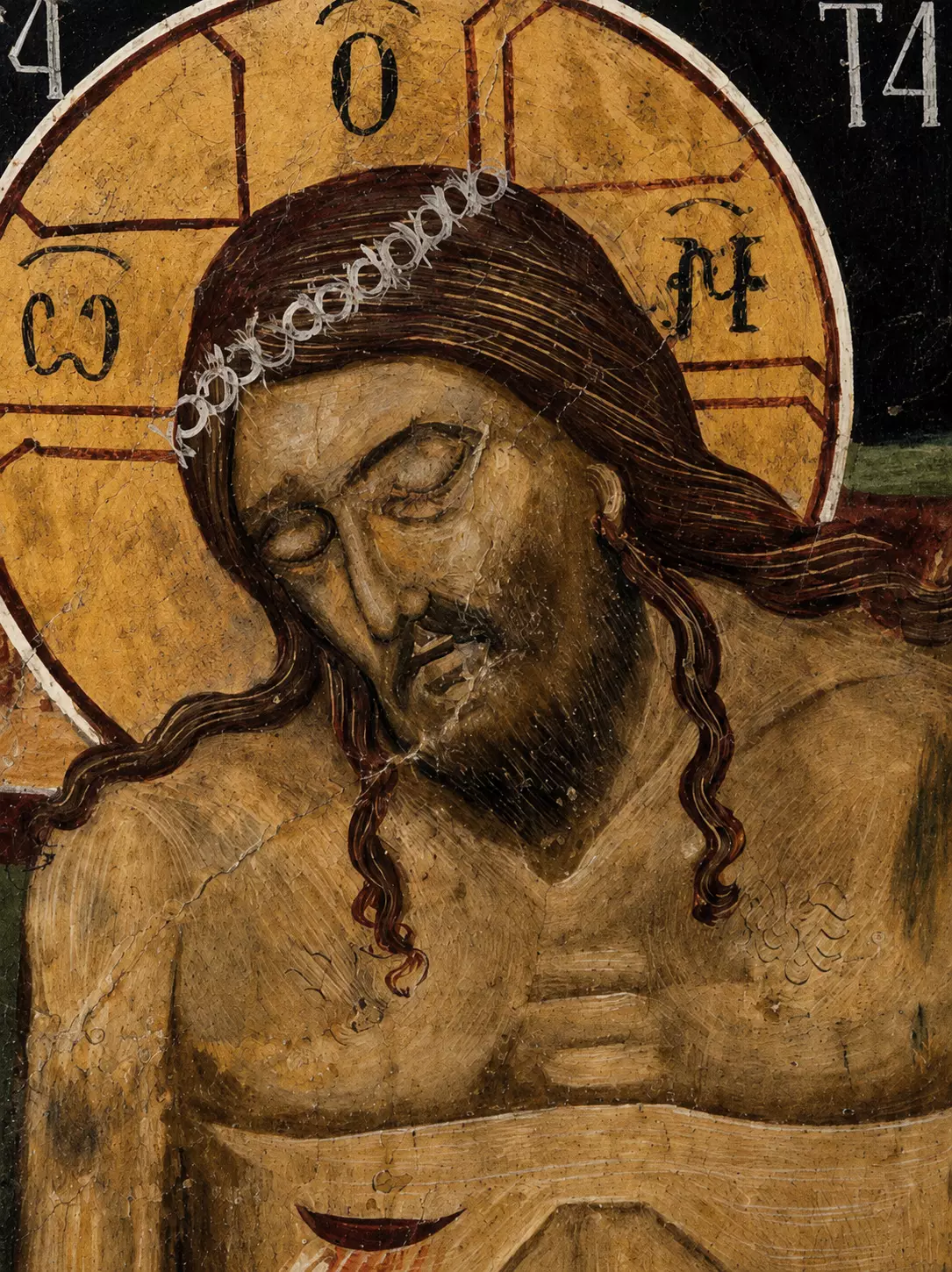
The face carries the greater emotional density. Moschos avoids theatrical distortion. The brow is lowered, the nose long and sharply modelled, the mouth small and closed, the beard gathered into a dark compact mass around the lower face. From either side descend locks of hair in strongly marked curves. In the closer view, a web of fine highlights and deeper brown-green shadows becomes visible around the eyelids, forehead and bridge of the nose. The painter has allowed asymmetry to work for him: because the head inclines to Christ’s right, one side of the face falls into greater visual compression while the other opens towards the cheek and beard. The sorrow of the image is conveyed through weight, inclination, closed features, silence.
Behind the head is the large cruciform nimbus, articulated in warm golden ochre and outlined sharply against the dark background. The Greek letters associated with the divine name remain visible within its arms. Its geometric stability is important. Circle, cross, bowed head: three different structures overlap in a very confined area, and Moschos allows none of them to dissolve into the others. The nimbus stays frontal even as the face turns and falls away from its axis. That tension holds the head within an unmistakably iconic framework while permitting a much more vulnerable human expression to develop inside it.
Colour elsewhere has been drastically restrained. Dark green and reddish-brown bands pass behind the shoulders, the background above approaches black, and the pale cloth at the waist provides the principal counterweight to the exposed flesh. There is little spatial recession. The figure presses towards the surface, occupying nearly the whole available field, while the dark surrounding areas make the shoulders and halo appear even larger. Such compression is particularly effective in the architecture of the prothesis, a space already closely associated with the preparation of the Eucharistic gifts. By the later Byzantine period the Man of Sorrows had entered sanctuary and prothesis decoration, creating a visual relation between the dead body of Christ and the liturgical setting in which the Eucharistic offering was prepared. The placement of examples of this imagery in the prothesis became increasingly established from the later medieval period onward.
For the Chrysafa painting, location forms part of the image’s meaning. Moschos incorporated the figure into a monumental iconographic programme conceived for a specific ecclesiastical interior rather than producing an isolated devotional panel that might be moved between settings. The new monastic complex had developed at its present site during the opening decades of the seventeenth century, with the new foundation dating from 1615 and the katholikon receiving its painted decoration in 1620. The prothesis image belonged from the beginning to this larger ordering of architecture, liturgy and painting.
That programme also marks an important stage in Moschos’s career. Research on the painter and his brother Dimitrios records activity extending over roughly four decades, concentrated predominantly in monuments of the Peloponnese. Georgios emerges especially clearly from around 1610 onwards as the signer of large mural ensembles, while further paintings have been attributed to his workshop through stylistic and comparative study. The Chrysafa katholikon is among the works through which his individual visual language can be examined most fully. In this respect, the Akra Tapeinosis is valuable beyond its subject: the disciplined contours, strongly differentiated shadows, economical modelling and preference for concentrated expressive gestures belong to an artistic practice that was capable of carrying Byzantine iconographic forms into the seventeenth century without turning them into inert repetitions.
The period itself offered conditions for such large undertakings. Scholarship on the Chrysafa ensemble has connected the artistic activity of Moschos and contemporary Peloponnesian workshops with economic development already under way from the second half of the sixteenth century, as well as with the importance of Nafplio as an artistic centre and point of transmission. Tradition and contemporaneity therefore meet inside the painting in an uneven, productive way. The iconographic structure is old; the painterly articulation belongs to Moschos and to the post-Byzantine environment in which he worked.
Time has left another history across the surface. Fine fissures pass through the halo, face and chest; small abrasions and losses interrupt several contours, while surviving pigment preserves remarkably delicate transitions around the eyes and nose. Conservation has made such passages more legible after earlier interventions and overpainting had obscured parts of the work. These marks do not neutralise Moschos’s design. In several areas they make its underlying economy still clearer: a dark contour beside the nose, one pale stroke above the eyelid, the curved line of a lock of hair, the thin red descent from the wound.
At the centre remains Christ, stripped of narrative surroundings and nearly of space itself. The bowed head carries the principal movement; the crossed hands, the stillness. Around him Moschos has preserved only what the image requires to sustain its identity—the cruciform halo, the wounded body, the traces of blood, the inscriptional field. The Akra Tapeinosis, in this 1620 wall painting, becomes a composition of severe reduction, deriving its intensity from that very economy.
(The translation was edited by E. Alexandraki)