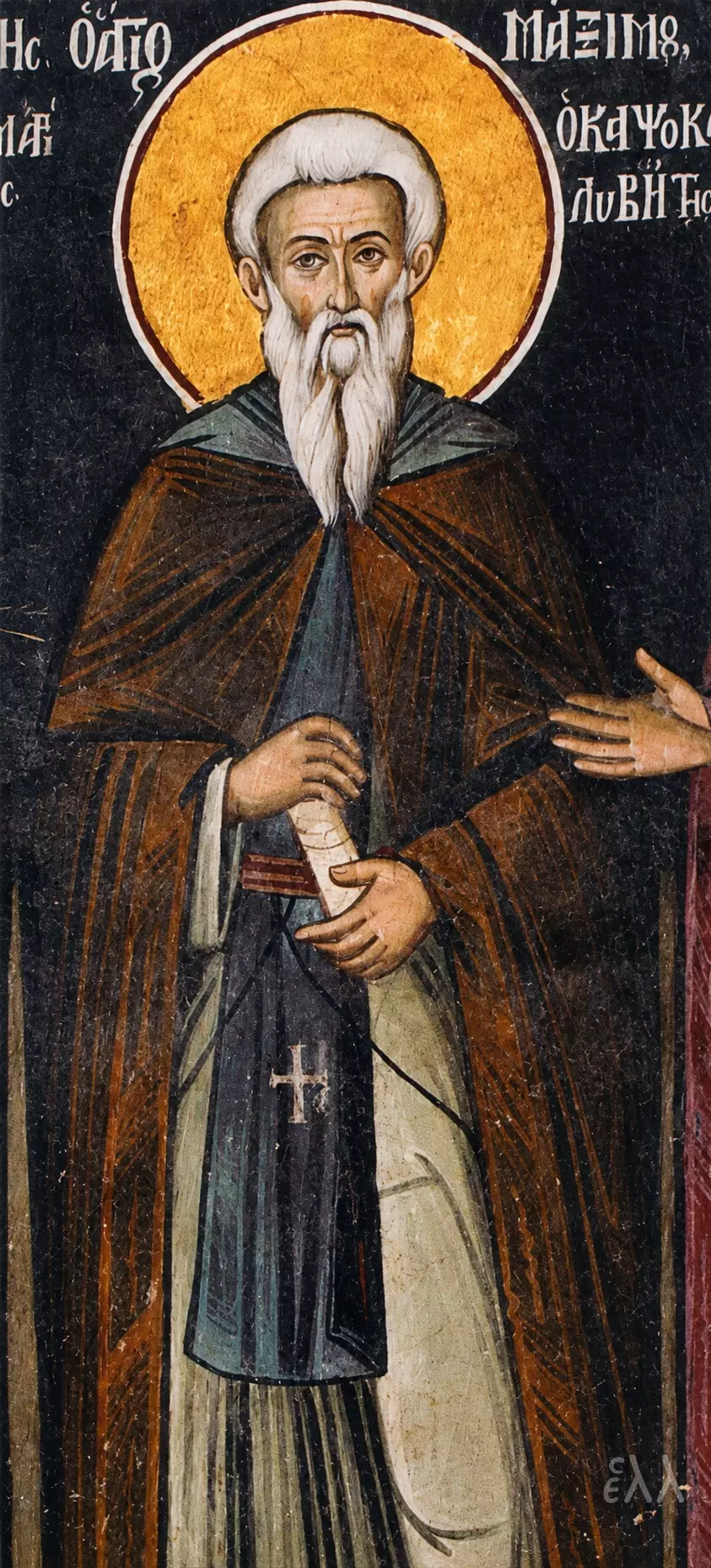
Contemporaries called him Kafsokalyvites because, whenever a shelter began to feel like a possession, he set fire to it and moved on. A fresco in the narthex of the katholikon at Xiropotamou Monastery, on Mount Athos, renders that fourteenth-century hermit as an old man whose face carries the visible weight of the practice: deep furrows, a straight and unflinching gaze, a beard gone entirely white. Painted around 1783 by a workshop of itinerant painters from Korytsa — among them Konstantinos, Athanasios and Naoum — the portrait belongs to the decorative campaign carried out after the katholikon, rebuilt between 1761 and 1763, was renewed through the efforts of the scholar-monk Kaisarios Dapontes.
The Saint Maximos Kafsokalyvites Fresco within the Athonite Narthex Tradition
Post-Byzantine painting on the Holy Mountain preserved, with notable consistency, the typological repertoire it inherited from earlier centuries, and portraits of Athonite ascetic fathers habitually occupy the narthex — the space where a visitor first encounters the monastery’s history before passing into the naos. The Saint Maximos Kafsokalyvites fresco belongs to precisely this arrangement, forming part of a sequence of hermit-saints, not an isolated devotional panel; close to the saint’s proper left shoulder, at the edge of the painted field, the hand of a neighbouring figure is still visible, evidence that the composition originally continued along the wall in a row of comparable portraits.
The saint wears two superimposed mantles. An outer garment in a reddish-brown, almost rust-coloured tone, built up from dense, parallel striations of pigment describing the recurring folds of coarse ascetic cloth, covers a second mantle in a slate-blue or grey-green hue, visible chiefly at the shoulders and collar. Beneath both, a darker undergarment appears at the chest, marked with a small painted cross — an allusion to the analavos worn by monks who have received the great schema, the highest grade of monastic profession, and so a detail whose iconographic weight exceeds its decorative interest. Both hands, held at waist height, support a rolled scroll bound with a reddish cord, a conventional attribute for ascetics remembered through written teaching or through hymns composed in their honour. Above the head, an inscription in angular white capitals against the dark ground identifies the figure, following lettering conventions typical of eighteenth-century Athonite workshops.
The Face and Halo in Close View
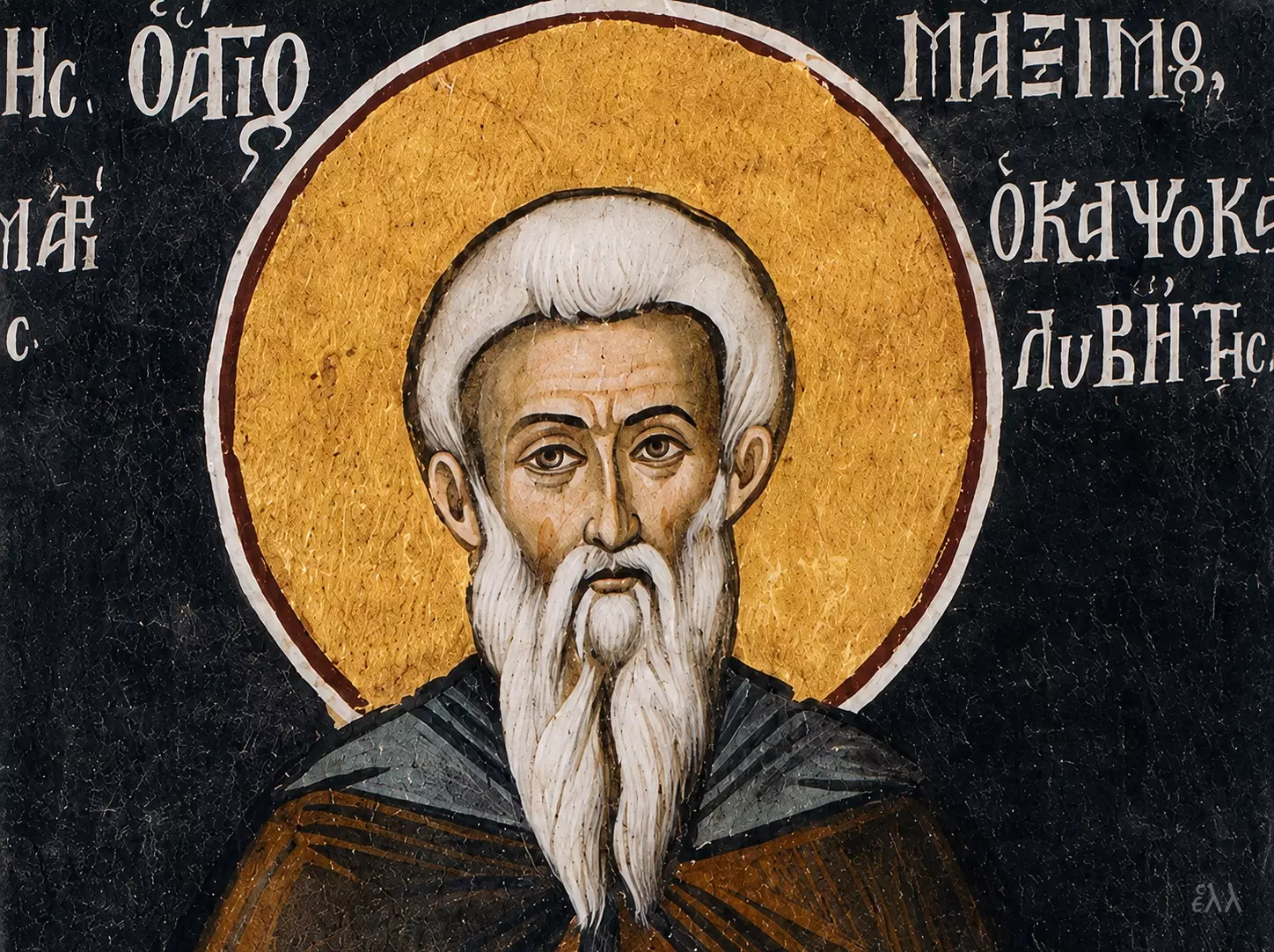
Seen at close range, the physiognomy resolves into a great many small, deliberate touches. Reddish accents mark the cheekbones against an otherwise pale, ochre-toned flesh; the eyebrows are drawn with a slight asymmetry that lends the gaze an unusual intensity, almost confrontational for a devotional image of this kind. The beard, forked at the chin in the manner conventional for elder ascetics, is built from separate strands of white pigment laid over a greyish underlayer, so that individual locks remain distinguishable, never merging into a single mass.
The halo is painted in a deep yellow ochre that approaches, without quite becoming, the appearance of gold; fine cracking across its surface records the aging of the plaster — the pigment itself shows no comparable loss — and the field is framed first by a dark reddish band and then by a narrower white line, a combination recurring throughout Byzantine and post-Byzantine wall painting as a means of setting sanctity visually apart from the surrounding dark ground. At this distance the inscription becomes easier to follow, which matters for anyone tracing the movements of the painting guilds active on Mount Athos during the eighteenth century, among them the group from Korytsa responsible for the katholikon’s decoration in 1783.
Maximos Kafsokalyvites himself belongs to the fourteenth century, a hermit associated with the hesychast milieu of Mount Athos and remembered, in the textual tradition surrounding him, for an itinerant existence spent largely outside any fixed community. His epithet records the practice, described in his vita, of destroying the temporary shelters he built for himself so that no single dwelling could become an attachment. The Xiropotamou fresco situates that memory within the visual language of eighteenth-century Athonite monumental painting, where physiognomic particularity of this order — furrowed skin, individualised beard, a gaze fixed directly on the viewer — was reserved for a category of holy figure whose sanctity depended on age and physical privation instead of the drama of martyrdom or the trappings of ecclesiastical office.