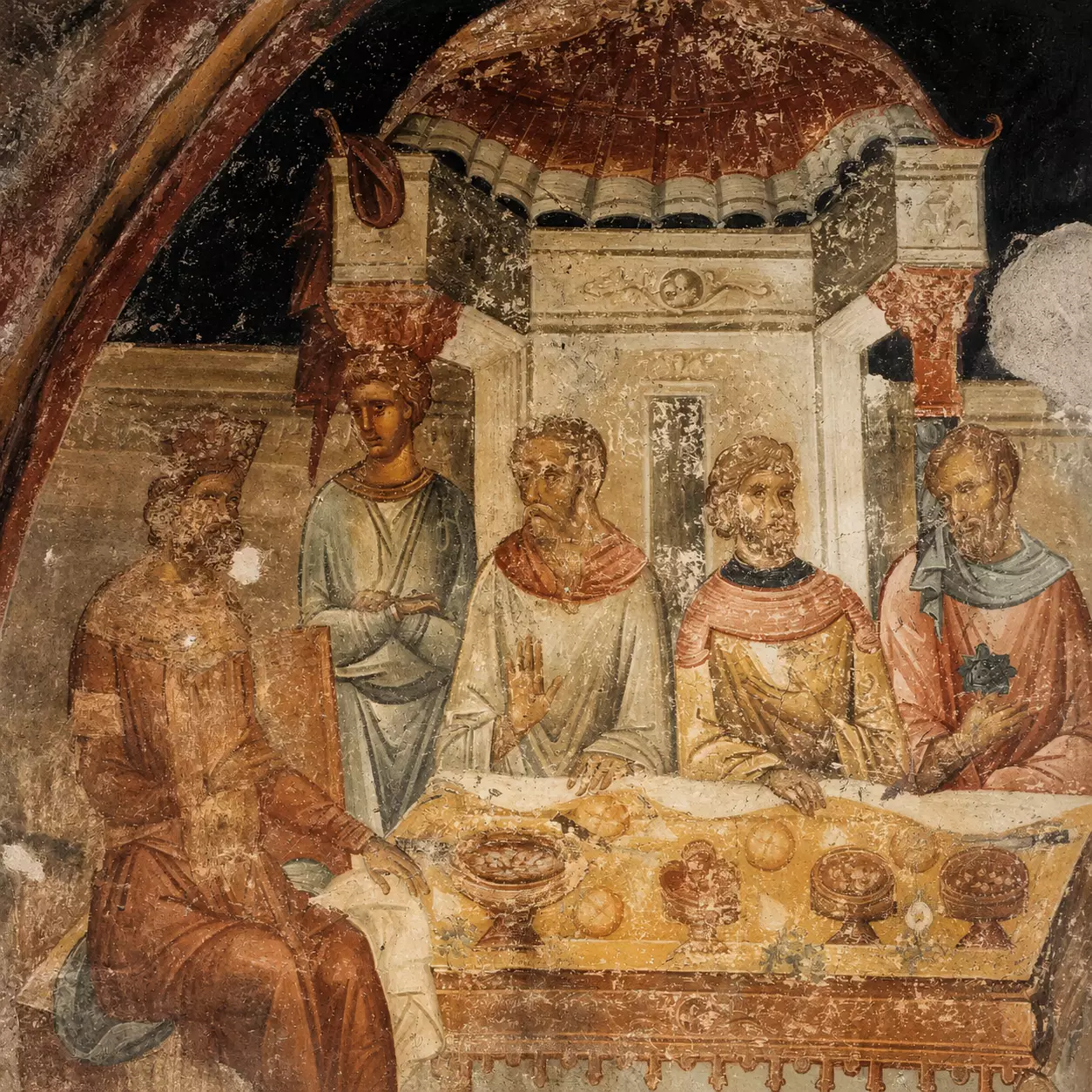
A crowded table, not a dancing girl, occupies the center of this Palaiologan fresco, and the choice says something about how the anonymous painter understood the story he had been asked to illustrate. The scene belongs to the narrative cycle devoted to Saint John the Baptist that once extended along the northern arm of the ambulatory attached to the Church of the Holy Apostles in Thessaloniki, inside a modest chapel dedicated to the Prodromos. Dated to the years around 1310–1320, the work is attributed to the hegoumenos Paul and the team of painters who continued the church’s decoration after the sponsorship of Patriarch Niphon, removed from the patriarchal throne in 1315, ceased to fund the mosaics of the main building. The nave glitters with tesserae; the ambulatory depends on pigment and dry plaster, a shift owed to economy, without any accompanying loss of ambition in execution.
The artist passes over the dance itself, the episode most versions of this subject prefer to dramatize, and settles instead on the moment before it, when Herod and his companions still sit at table. Bowls, small loaves, footed vessels, and a shallow dish holding a reddish preparation crowd the white cloth, arranged with a density that speaks to how closely Palaiologan ateliers had studied the rendering of food within monumental painting elsewhere in Thessaloniki. Losses run through the composition: patches of plaster have fallen from the roofing, from the drapery of the seated king, and from the architecture above, exposing the masonry joint beneath in places. Enough of the surface survives, even so, to follow the staging of a courtly reception with a precision that borders on the documentary.
Setting the Scene: Herod’s Banquet Fresco
A vaulted canopy roofed in tile, its bands of terracotta and ochre catching what light the setting allows, frames the five men beneath it. Slender colonnettes carry the roof on capitals still legible near the top edge of the composition despite considerable wear, and a small medallion set into the architrave hints at further ornament now too abraded to read with confidence. The architecture stops short of portraiture; it operates as a convention long favoured by Palaiologan artists, a compact shorthand for interior, palatial space that spares the painter the labour of describing a building in full. Above the dark, flat ground at the upper left, a heavy red curtain has been gathered into thick folds, pulled open as though for the benefit of whoever stands before the wall today. Behind the canopy nothing is visible: no landscape, no sky, only a black field that isolates the diners and keeps the eye on the table and the men seated around it.
Five men occupy the space, all turned toward the same exchange, and none yet betrays any premonition of what the feast will bring. At the left edge, partly lost behind the picture’s border, sits Herod, distinguished by a tall, elaborate headdress and an orange tunic; a white cloth is thrown across his couch, and a hand comes to rest at the edge of the table. Beside him stands a figure wrapped in a grey-green mantle, hands joined and holding some slender object between them, the gaze lowered in an attitude closer to reflection than to festivity. At the centre of the group a bearded man in a white tunic and an orange-toned mantle lifts a hand, fingers spread in the open gesture of speech, as though answering something just said or introducing a new remark into the conversation. Two more bearded figures complete the row: one wears a garment of golden yellow beneath a pink mantle, the other a rose-coloured tunic under a blue-grey overgarment fastened at the chest with a dark clasp. Their faces share the same gravity as the others, and the calm of the whole group sits in some tension with the story the viewer already knows is coming.
Colour stays close to a warm, earthbound register: orange, ochre, rose, and a cooler grey-green reserved for the single standing figure, set against the black ground and the red of the drawn curtain. Faces are built up with a summary modelling, warm underlayers carrying a few added highlights, work consistent with production under modest funding and a tight schedule. Drapery falls in soft, rounded folds; the sharp, calligraphic line associated with the more ambitious Constantinopolitan manner of the same decades is largely absent here, and the effect sits heavier, closer to the ground, though not without its own conviction of volume. The palette and brushwork suggest a workshop accustomed to covering large surfaces economically, adapting a vocabulary current in the capital to the scale of a small chapel and a limited budget.
Depictions of Herod’s banquet belong to a well-established stage within cycles devoted to the life of the Baptist, generally preceding the dance of Salome and the beheading that follows it, and painters across the Byzantine world varied substantially in how much of the narrative they compressed into a single field. Here the choice falls on restraint: a static company gathered around a table, composed with the frontal solemnity and measured gesture typical of Palaiologan monumental painting at its more conservative registers, even as the animated turn of heads hints at the greater naturalism associated with early fourteenth-century Thessalonian workshops. The absence of any surviving inscription identifying the participants individually leaves headdress, seating, and dress to carry the burden of distinguishing the king from his court.
The Baptist cycle to which this scene belongs occupied one of several chapels opening off the ambulatory that wraps around three sides of the Holy Apostles, a building whose mosaic decoration, financed initially through Niphon’s patriarchate, ranks among the finer achievements of early Palaiologan art in Macedonia. Frescoes of comparable date survive elsewhere along the same gallery, together forming a programme considerably less studied than the mosaics of the nave, despite offering valuable evidence for how a single Thessalonian workshop moved between subjects, media, and levels of finish within one building campaign. Placed within a modest side chapel, away from the main body of the church, the Feast of Herod would have been seen chiefly by those with reason to linger near the Prodromos altar, a smaller and more intimate audience than the crowds gathered beneath the domes of the nave.
Little documentary evidence survives to clarify how the division of labour worked between hegoumenos Paul’s team and whatever artists may have assisted elsewhere in the ambulatory, and the frescoes of the Prodromos chapel have received comparatively modest scholarly attention next to the mosaics of the naos. What is clear is the date bracket the historical circumstances impose: work on the mosaics stopped once Niphon’s patronage ended in 1315, and the fresco decoration of the chapel, this composition among it, belongs to the years immediately surrounding that interruption, carried out with whatever resources the church could still muster after the patriarch’s fall.