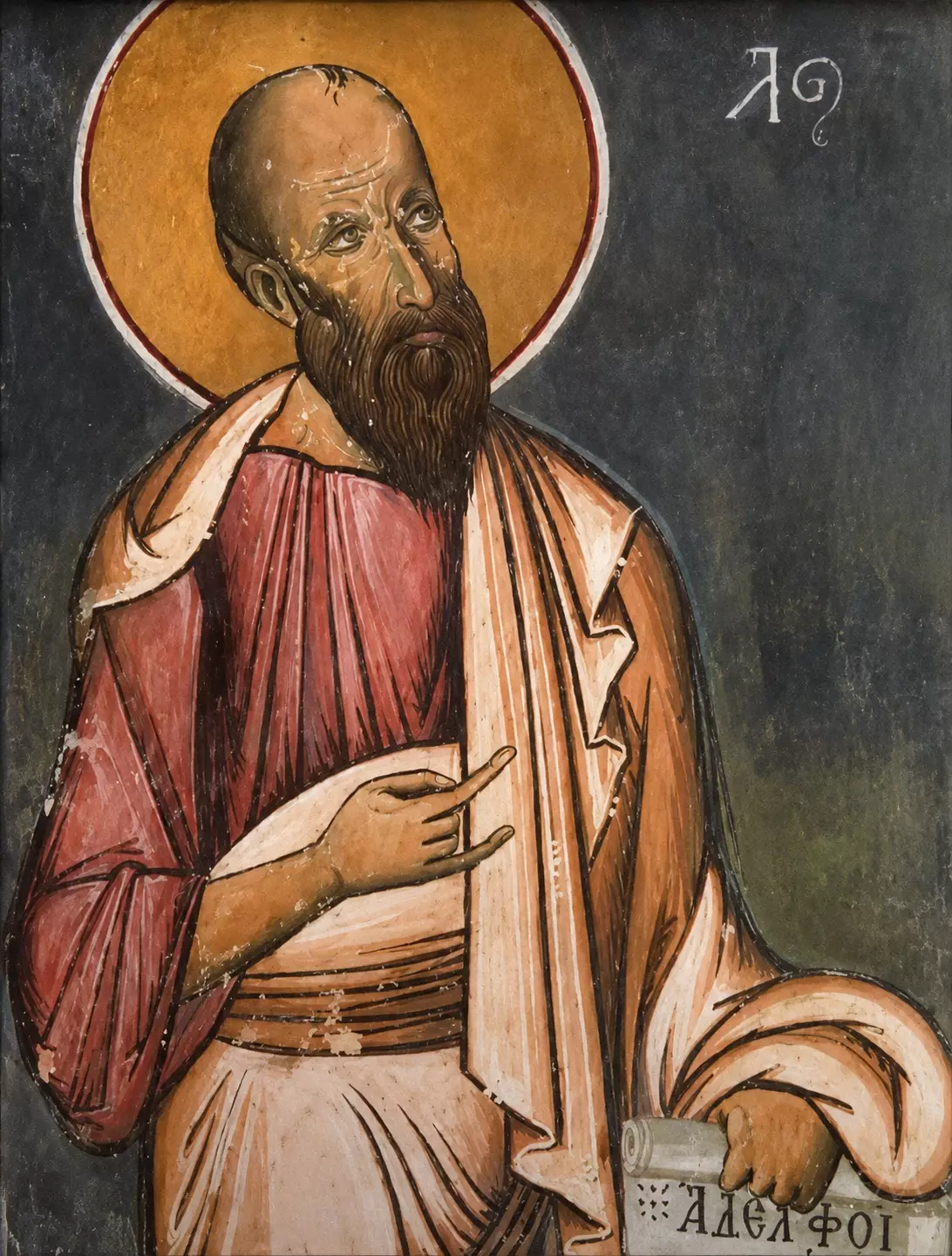
The wall painting of the Apostle Paul at Panagia tou Arakos, executed as part of the great campaign of 1192 at Lagoudera in Cyprus, gives unusual weight to a single word: ΑΔΕΛΦΟΙ. It appears on the opened portion of the scroll held in the apostle’s left hand and immediately connects the painted figure with the language of the Pauline epistles, in which the address to the “brethren” repeatedly introduces or redirects the apostle’s argument. Paul himself rises against a dark blue-grey background, his golden nimbus sharply isolated from it, the body wrapped in red, ochre and pale cream drapery.
The dating belongs to unusually firm documentary ground. A dedicatory inscription associates the 1192 decoration with Lord Leon, son of the Authentes, whose patronage extended over much of the church. The identity of the painter is less secure. Earlier scholarship connected the Lagoudera paintings with Theodore Apseudes, the artist named in the Enkleistra of Saint Neophytos near Paphos in 1183; Panayotidi’s study regarded the work at Panagia tou Arakos as a later and more mature phase of the same painter. More recent scholarship has treated the matter with greater caution. In her extensive examination of the monument, Chara Konstantinidi designates the artist responsible for the 1192 campaign as the “Painter of Leon,” keeping the attribution distinct from an established signature — a distinction Konstantinidi’s study extends further by separating this phase from the earlier decoration of the apse.
Apostle Paul at Panagia tou Arakos: Form and Gesture
Paul is shown almost frontally, although the head turns and rises slightly towards his right. That small displacement is enough to disturb complete frontality. The eyes follow the movement upwards; the eyebrows arch steeply, the forehead contracts into several curved furrows, the narrow planes beside the nose are crossed by fine linear highlights. Attention therefore gathers first in the face, not in the comparatively broad mass of the body below.
Following the established Byzantine identification of Paul, his physiognomy combines a high, largely bald forehead with dark hair surviving around the sides of the head and a long pointed beard — yet the painter does not reduce these elements to a schematic emblem. The beard divides into numerous narrow, curling strands, while short strokes of lighter colour articulate the forehead, cheeks, temples and bridge of the nose. Some of these strokes are almost calligraphic; others break their course or change direction, producing the restless surface characteristic of late twelfth-century painting. Volume is present in the face, certainly, but line keeps reasserting itself over that volume.
A similar tension governs the clothing. The deep rose-red tunic falls in long vertical folds across the torso; above and beside it, the mantle shifts through ochre, pale cream and brown. Its folds do not simply record the weight of cloth — they turn, narrow, widen, double back, then gather around the apostle’s left forearm in a broad loop. Late Komnenian painting often pushed drapery towards this heightened linear activity, and the paintings of Lagoudera belong to one of the most conspicuous Cypriot expressions of that tendency, the figure remaining monumental despite the agitation of its surface.
The hands introduce a different rhythm. Paul’s right hand, visible on the left side of the composition from the viewer’s perspective, is raised across his chest in a gesture associated with speech or teaching, the fingers separating deliberately to give the movement a measured rhetorical character. His left hand, on the opposite side, supports the inscribed object.
That object deserves precise identification: it is a scroll, not a codex. Its rolled cylindrical end can be seen within Paul’s left hand, while the lower sheet is opened sufficiently to display the inscription ΑΔΕΛΦΟΙ. Nothing of the bound-book construction proper to a codex is visible here. Small as it may appear, the distinction matters, since scrolls and codices occupy different places within the visual vocabulary of Byzantine representations of apostles, prophets and ecclesiastical authors.
The word itself also changes the character of the figure. Without it, Paul could still be recognised through physiognomic convention; with it, identity becomes textual as well as visual, the apostle presented as author and teacher, his painted body carrying the beginning of a written address outwards towards those standing before him.
The Face of the Apostle Paul
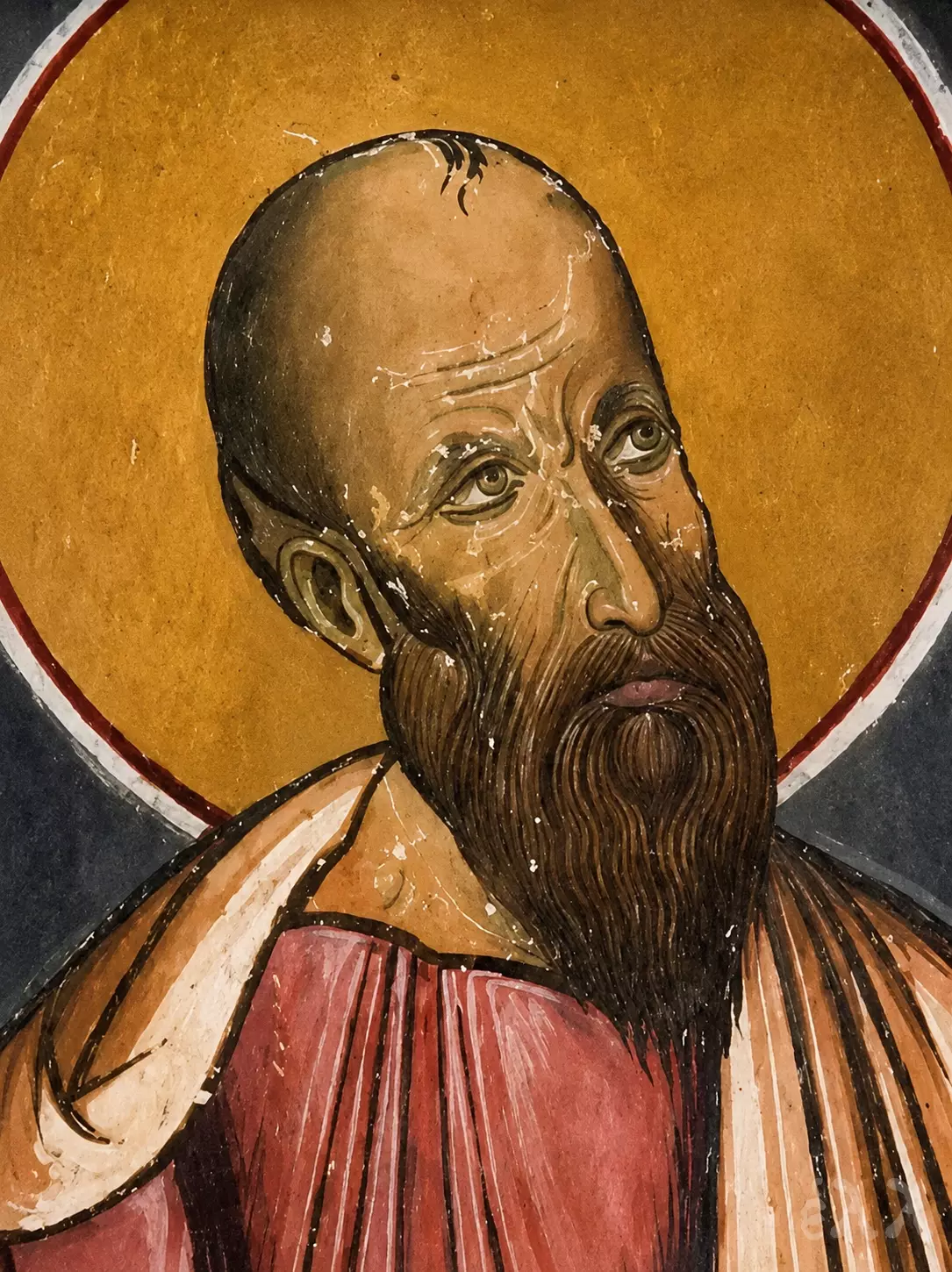
Seen in isolation, the head reveals how little the painter depended upon smooth tonal transition. The forehead is broad and illuminated unevenly; narrow highlights trace its convex surface, while darker brown modelling collects around the eye sockets, temples and lower cheeks. The nose is long and sharply constructed, terminating above a small, compressed mouth whose reddish tone briefly interrupts the surrounding browns.
Paul does not look directly outward — this is the more striking feature of the face. His pupils rise towards his right, and the slight upward inclination of the head reinforces the movement, an expression that can suggest concentrated thought or inward attention, though the painting itself gives no reason to force a single psychological reading onto it. Lifted eyes, tense brows, a closed mouth, a face crossed by emphatic lines: this is what can actually be described with confidence.
The golden halo supplies the largest unbroken colour field around the head. Against the dark background it creates a strong figure-ground contrast, while its circular boundary encloses a physiognomy made almost entirely from restless particulars: wrinkles, hairs, highlights, incisions of shadow. Large form and minute line coexist here without cancelling one another, and it is in that coexistence, more than in any single feature, that the painting at Lagoudera makes its case for the apostle’s authority — a recognisable sacred type rendered with an intensity of observation rarely matched elsewhere in the Cypriot Komnenian repertoire.