
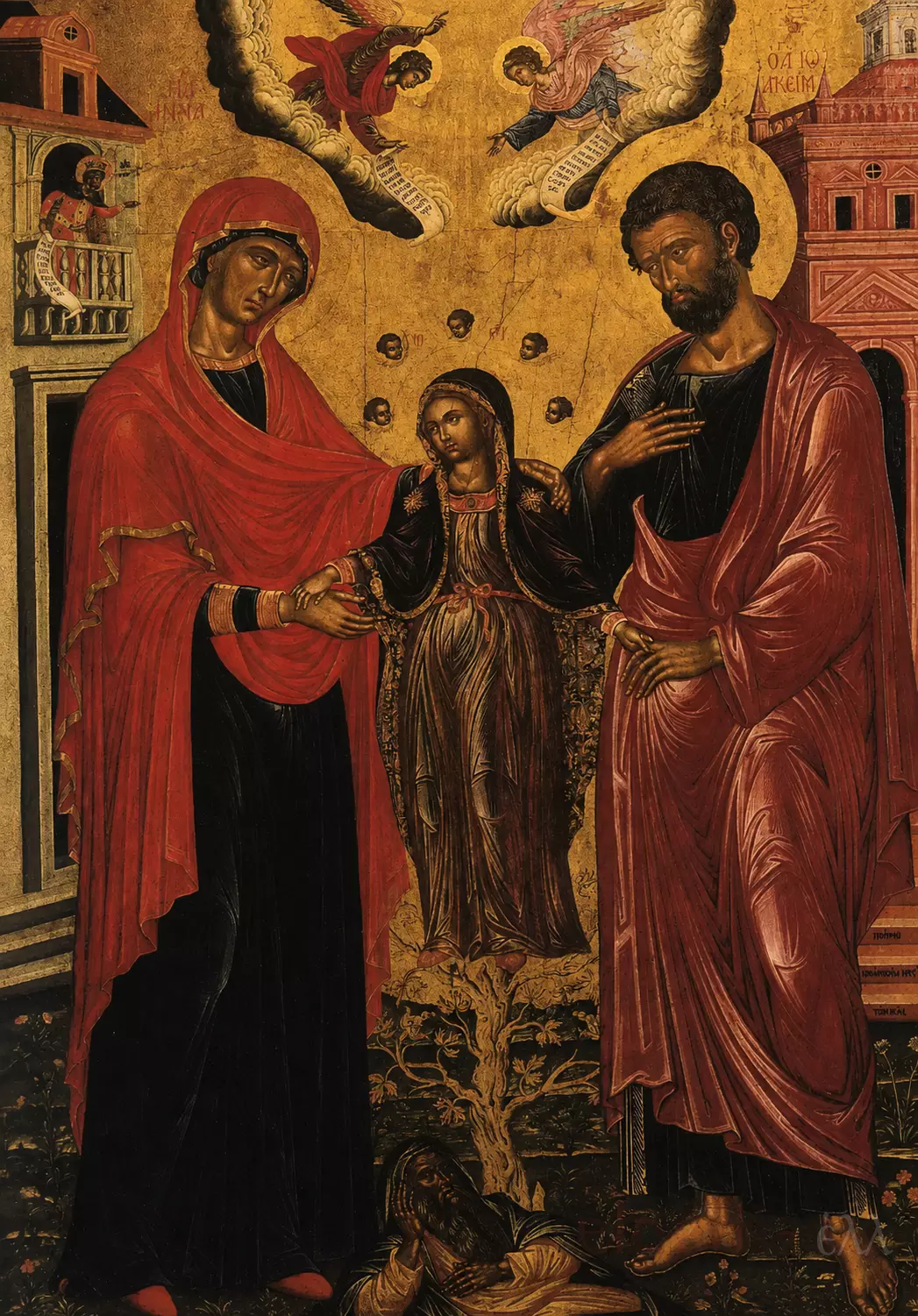
Emmanuel Tzanes painted The Tree of Jesse in 1644, creating a large Post-Byzantine panel icon in tempera on wood, approximately 183.8 × 126.4 cm, now preserved at the Hellenic Institute of Byzantine and Post-Byzantine Studies in Venice under accession number AMI 69. The work is also known as The Vine of the Virgin, a title that draws attention to its unusual concentration on the ancestry and childhood of the Virgin Mary.
At the centre stands the young Mary, diminutive beside her parents, Saint Anne and Saint Joachim. Their monumental figures rise against an uninterrupted gold ground, while a tree ascends from the reclining Jesse at the lower edge and reaches the Virgin’s feet. Above, angels emerge from curling banks of cloud with open scrolls; between the principal figures, small angelic heads punctuate the gold field. Architecture occupies the margins: a dark structure with a balcony at one side, a tall reddish building at the other. Every major element — parent, child, tree, prophet, angel, building — takes its place around a firm vertical axis, and the result, for all its density, remains remarkably legible.
The date is especially significant, since Tzanes was still associated with his native Crete when the icon was produced; after the Ottoman conquest of Rethymno in 1646 he moved to Corfu, and in 1655 established himself in Venice, where his later career included service as priest of San Giorgio dei Greci. More than 130 works have been associated with his surviving production.
The Tree of Jesse: genealogy, composition and Post-Byzantine painting
The subject has its distant source in the prophetic image of a shoot emerging from the root of Jesse (Isaiah 11:1), traditionally understood within Christian art as a genealogy leading through David toward Christ. In Tzanes’s version, however, the visual emphasis settles decisively upon the Virgin and her immediate family. Jesse lies below the central axis; the tree grows from him and rises toward Mary, who occupies the genealogical stem between Anne and Joachim. The icon therefore adapts the established Tree of Jesse imagery into a distinctly Marian formulation, explaining the alternative title The Vine of the Virgin.
Saint Anne, Joachim and the young Virgin
Large and almost architectural in scale, Anne and Joachim frame their daughter from either side. Anne is enveloped in a broad red maphorion whose folds descend in long curving lines before opening toward the centre. Beneath it appears a nearly black garment, giving the red an unusual chromatic force against the gold. Answering it across the composition, Joachim’s mantle unfolds in a lighter, more salmon-red register, laid over a dark tunic with finely articulated linear decoration.
Between these two masses of colour, Mary seems delicate and highly ornamented. Her dark outer garment carries intricate floral and gold details, while the lighter vertical folds of her dress draw the eye downward toward the tree. Her scale belongs naturally to childhood, yet the painter gives her a compositional importance far greater than her physical size. Anne reaches toward her; Joachim places a hand at her shoulder. The three bodies are linked through gesture, making the family group almost continuous.
Stillness governs the figures, and there is little spontaneous motion, especially in the bowed heads of Anne and Joachim and the controlled position of their hands. Their elongated proportions reinforce this measured rhythm. Mary turns slightly within the enclosing structure, her face more alert and youthful, while her parents assume expressions of solemn concentration. Across the panel, emotional communication is conveyed through inclination, touch and the direction of the gaze.
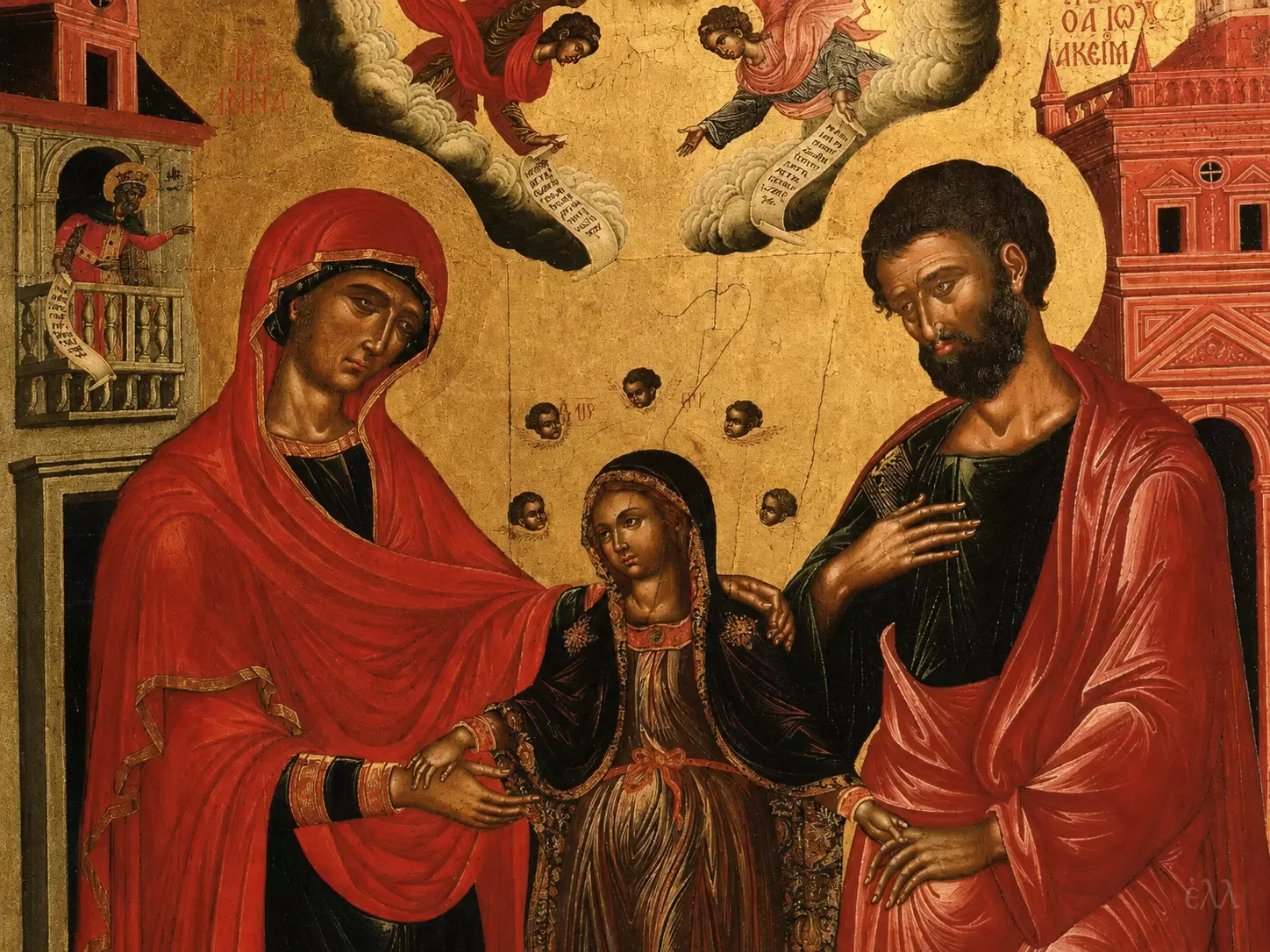
At close range, the modelling of the faces shows Tzanes working within the inherited vocabulary of Cretan icon painting while allowing greater softness into the transitions between shadow and highlight. Dark underpainting establishes the facial structure; warmer passages emerge across the forehead, cheeks and neck, with thin highlights defining the bridge of the nose, brow and surrounding planes. Joachim’s beard and hair, densely worked and carefully separated from the flesh, introduce another level of surface detail. The controlled terminology appropriate to such features belongs to the established language of Byzantine and Post-Byzantine icon painting.
Gold ground, architecture and pictorial space
Across almost the entire upper field, gold suppresses any conventional horizon. The sacred figures inhabit a pictorial space governed by placement and scale, with the architecture functioning as a lateral frame. On one side, the small balcony scene forms an image within the image: a figure appears beneath an architectural opening, accompanied by a scroll. On the opposite side, the tall red building rises in sharply delineated stages, with small apertures, geometric ornament and a domed or roofed upper structure.
These buildings introduce a different visual register. Their stacked façades, decorative mouldings and attempts at recession recall the wider exchange between Cretan painters and Italian visual culture, although Tzanes keeps them firmly subordinate to the icon’s central hierarchy. Never developing into an independent perspectival environment, the architecture presses close to the surface, compressed between the figures and the edge of the panel.
Above the family group the pictorial space changes again. Two angels descend through thick, curling clouds, each carrying an open scroll. Their bodies bend diagonally toward the centre, breaking the severe verticality established by Joachim, Mary and Anne. The clouds are modelled as compact rhythmic forms, darker toward their edges, while the angels’ garments introduce pale rose, red and grey-blue passages into the otherwise warm upper field.
Around Mary’s head float five smaller angelic heads, their arrangement deliberately irregular — some higher, some lower, separated by substantial areas of gold. They help bridge the difference in scale between the child and the two full-length angels above her, yet they also intensify the concentration of celestial imagery immediately around the young Virgin. A fine network of age-related cracks remains visible across the gold field, especially in the central area, part of the material history of the painted surface.
Jesse, the flowering tree and the lower register
At the bottom of the panel, the reclining Jesse forms the physical beginning of the composition. He occupies little space compared with Anne and Joachim, his body compressed along the lower edge, hands gathered near his chest and head turned upward. From his position rises the slender tree, first as a comparatively natural trunk and then as a more decorative structure beneath Mary’s feet.
Branches, leaves and flowers spread around the central stem. Small blossoms also appear throughout the dark ground beside the feet of the standing figures, creating a lower zone very different from the abstract gold above. Ornament, vegetation, patterned garments: several surfaces begin to echo one another, and the floral details of Mary’s clothing answer the plants at her feet, while the tree itself passes visually from earthly vegetation into genealogy.
This lower passage also reveals the scale of the two adult figures with unusual clarity. Anne’s dark garment descends almost uninterrupted to the ground. Joachim’s mantle divides into broad, emphatic folds before revealing his dark lower garment and bare feet. The figures retain the hieratic extension familiar from Cretan painting, although the drapery possesses greater descriptive complexity, particularly in the sharply illuminated folds of Joachim’s mantle and the wide red planes surrounding Anne.
Emmanuel Tzanes between Crete and Venice
The icon belongs to a moment shortly before displacement transformed the painter’s life. Born in Rethymno around 1610, Tzanes worked first within the Cretan tradition; following his departure from Crete he was active in Corfu before settling permanently in Venice. His later position at San Giorgio dei Greci placed him within one of the most important institutions of the Greek Orthodox community in the city, amid sustained contact between Greek painters, Venetian artistic practice and imported prints.
In The Tree of Jesse, elements associated with this broader artistic environment already coexist with a strongly preserved icon tradition. Ornament becomes abundant, architecture acquires greater descriptive interest, and faces show careful tonal modelling; garments expand into elaborate patterns, and the subsidiary narrative details invite prolonged viewing. Yet the organization of the sacred figures still depends upon gold ground, hierarchical placement, controlled gesture and a frontal visual authority inherited through centuries of Eastern Christian painting — such exchanges between inherited Byzantine forms and Western artistic currents formed an important field within later Post-Byzantine production.
The physical scale of the icon contributes strongly to this effect. At more than 1.8 metres high, the three central figures acquire a presence closer to monumental painting than to the small portable icon. Their bodies almost fill the panel from top to bottom; the upper angels and lower Jesse occupy the remaining zones, leaving very little pictorial space without figure, architecture, inscription, vegetation or cloud. The gold background provides the necessary interval between these tightly organized forms.
Tzanes also identifies his authorship within the work. The recorded Greek signature names Emmanuel Tzanes as priest and gives the year 1644, documentary evidence of unusual value in reconstructing the chronology of his career. The date places the panel only two years before his departure from Crete, with the flowering tree rising through its centre and the painted signature preserved on the same wooden surface.