
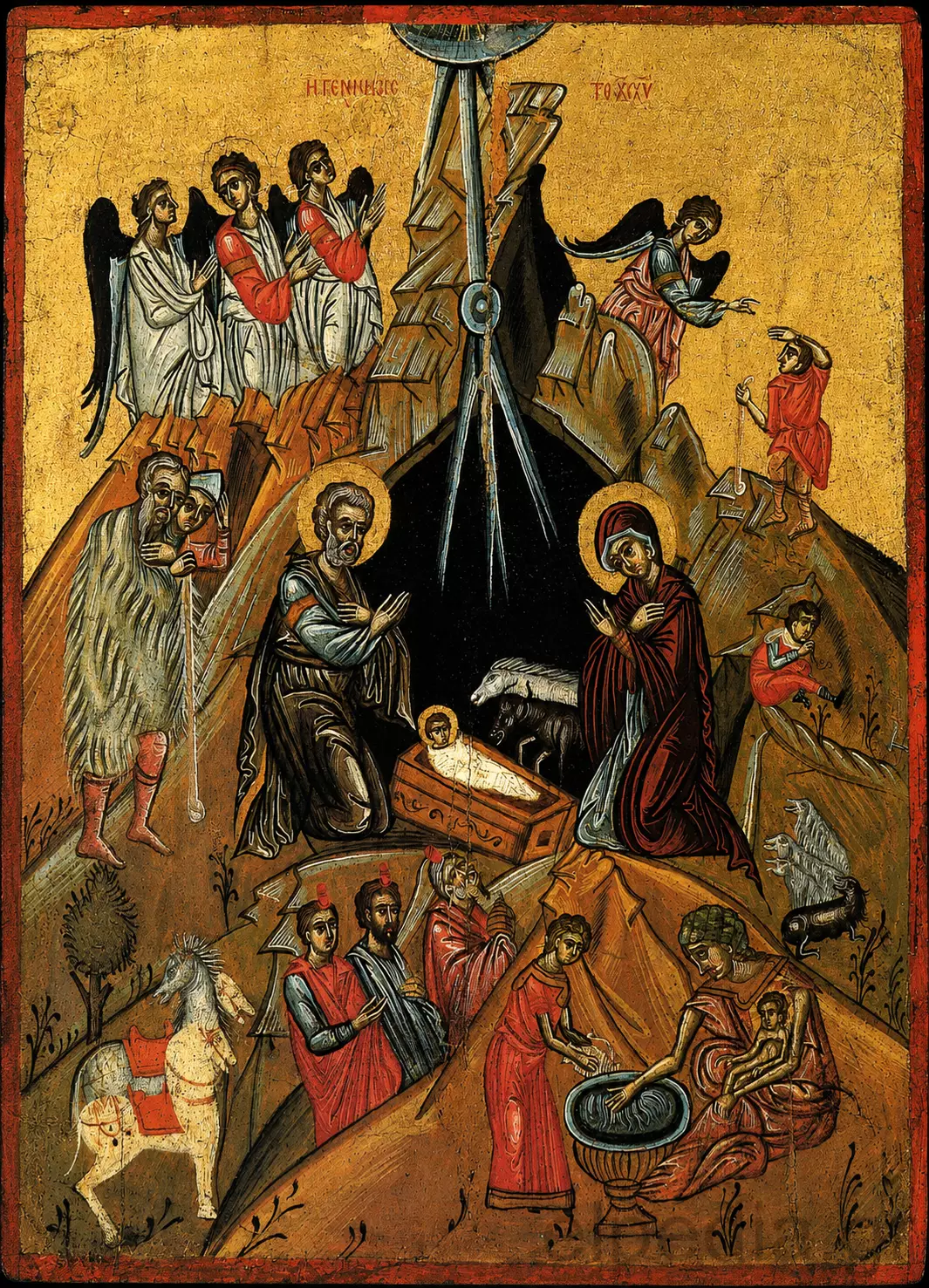
The 18th-century Post-Byzantine icon of the Nativity stands as a visual testament to the aesthetic and social shifts of its era. Originating from the Venerable Archconfraternity of Purification in Livorno, Italy, this composition captures the evolution of iconographic types during a period when Eastern traditions engaged in an open dialogue with Western influences. The work reveals the synthetic skill of the anonymous artist in managing traditional form while incorporating a modern narrative that steps away from the rigidity of earlier epochs.
The central cave defines the spatial arrangement, housing the figure of the Virgin Mary in a posture of kneeling adoration before the divine infant. The dark depths of the cave contrast directly with the luminous colors of the garments and the rocky landscape. Breaking away from the stiff linearity of Palaiologan models, the painter adopts a freer rendering of drapery folds and figures’ postures. Each scene framing the main event integrates into a unified space, illustrating how religious icons served as multi-layered visual narratives for the congregation.
Warm ochre tones dominating the background replace the traditional solid gold leaf, imparting a grounded warmth to the whole. Light no longer emanates solely from an uncreated background; instead, it is organized through color gradations across the rocks and faces. This iconographic choice reflects the broader movement of the period, as art sought new expressive avenues by adapting Byzantine schemes to the aesthetic demands of diaspora communities.
Architectural Composition and Framing of Figures
An analysis of the central axis reveals the composition’s asymmetrical balance. The Virgin Mary does not recline upon the familiar red couch; she is depicted kneeling, hands crossed over her chest. A deep red maphorion drapes her figure, underscoring human humility before the newborn resting swaddled in the manger. Three radiant rays of light descend from the celestial semicircle, cutting through space to meet the child. This movement of light, piercing the cave’s shadow, guides the viewer’s gaze.
At the base of the image, secondary narrative scenes unfold. To the left, Joseph sits in contemplation, head resting on his hand. Opposite him, an elderly shepherd clad in sheepskin speaks to him, introducing psychological tension into an otherwise serene landscape. A white horse with a red saddle stands nearby, adding a realistic detail to traditional iconography.
To the right, the bathing scene emphasizes Christ’s human nature. Two women—one holding the infant and the other pouring water into the basin—are depicted with natural movements. Their garments, rendered in rich folds and vibrant reds, impart vitality to the scene. This iconographic approach aligns closely with the social structures of the time, where organizations like the Archconfraternity of Purification commissioned such works to foster spiritual and community cohesion.
Spatial Harmony and Spiritual Narrative
The rocky landscape rises in tiers, its peaks forming natural steps that act as a theatrical backdrop rather than a realistic spatial representation. In the upper left, four angels in prayer gaze toward the star, their uniform faces and white tunics with red bands creating a rhythmic cadence. Opposite them, another angel announces the birth to a young shepherd playing a pipe on a rock ledge.
The contrast between celestial messenger and humble shepherd—alongside sheep drinking water at the corner—highlights the dual nature of the event. The angel’s raised hand cuts through the air toward the youth, who turns his head upward, pausing his music. His dog, a dark silhouette absent in more archaic models, reinforces the rustic, pragmatic tone of the depiction.
The artist’s palette relies heavily on earthy shades, stepping away from monochrome gold backgrounds to anchor the scene. Small trees and bushes sprout from dry rocks, symbolizing the renewal of creation. Confident brushwork and strong shading render the facial features clearly, bypassing the harshness of earlier centuries.
Drapery folds on Christ’s swaddling and the women’s garments add decorative richness, while the bronze basin reflects light across the lower right area. The midwife testing the water temperature captures a maternal, protective moment that ties the historic event to universal human experience. Through soft contours, expressive gestures, and light breaking through central darkness, the icon balances the human and the divine.