
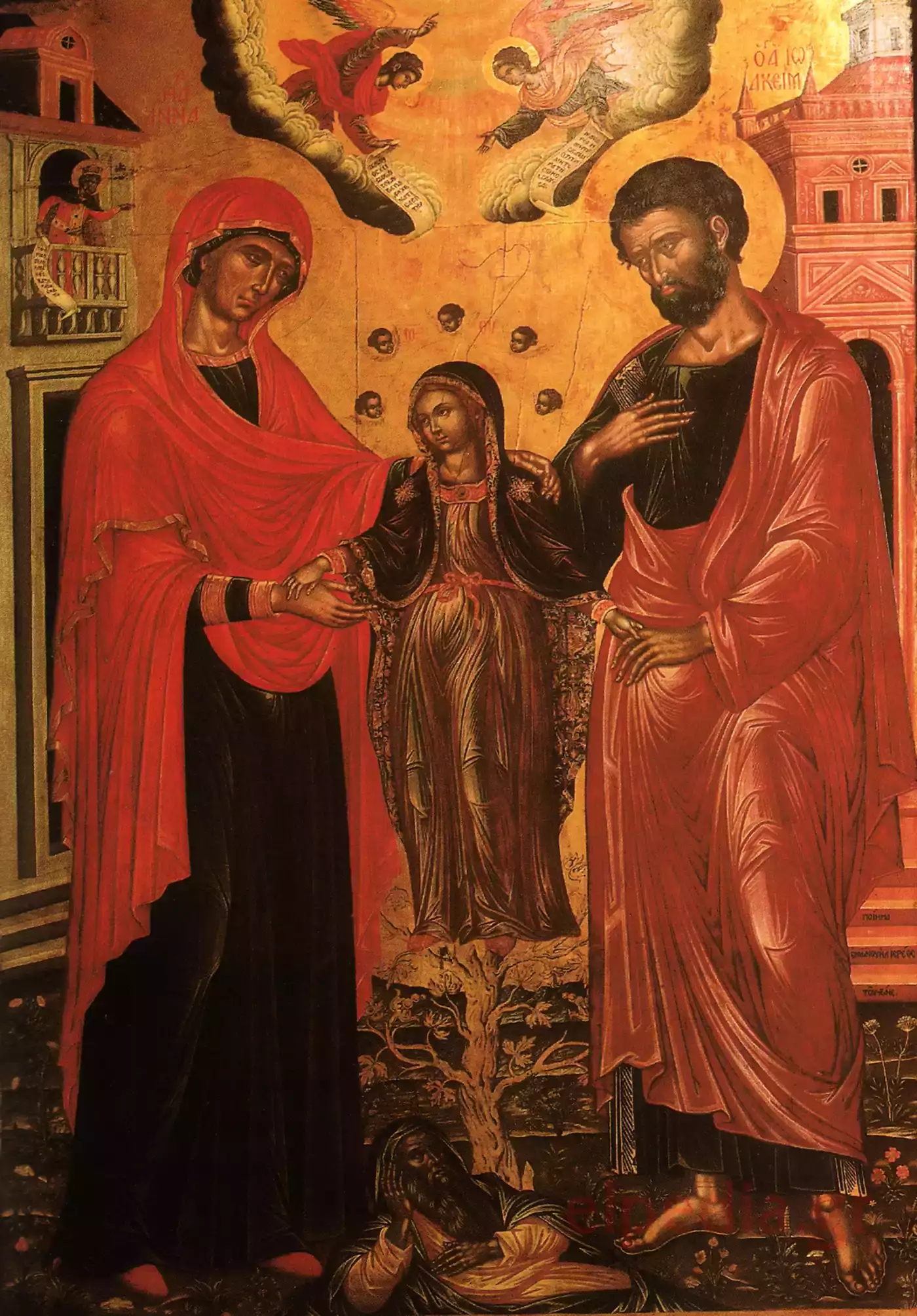
In the Hellenic Institute of Byzantine and Post-Byzantine Studies of Venice there is preserved a wooden icon with a gold ground, signed in 1644 by the Cretan painter Emmanuel Tzanes. It is the Tree of Jesse, known in the international bibliography also as “The Vine of the Virgin“, a work measuring approximately one hundred and eighty-four by one hundred and twenty-six centimetres, recorded in the collection of the Institute under the number AMI 69. At the centre of the composition stands the young Mary between her parents, Saint Anne and Saint Joachim, in a pictorial rendering of that genealogy from which, according to the prophecy of Isaiah, the branch of salvation was to spring forth. Tzanes, born in Rethymno around 1610, spent the greater part of his life in Venice, where he served as priest at the church of Saint George of the Greeks, leaving behind him a body of work exceeding one hundred and thirty icons. His generation, and its attested relation to the Venetian workshops and the Flemish engravings of the period, is bound up with questions that contemporary research examines at length concerning post-Byzantine painting and the flow of ideas between the eastern and the western tradition. The icon does not function only as an object of veneration. It constitutes evidence of an age in which the Greek community of Venice sought ways to preserve its identity within a milieu artistically dominated by other aesthetic principles, a fact that the Tree of Jesse records with rare clarity.
The Tree of Jesse: Composition and Technique in Tzanes‘s Icon
Gold, unbroken, well-nigh inexhaustible, is the ground upon which Tzanes sets his scene. There is no landscape in the classical sense, nor any horizon mediating between the earthly and the heavenly. Two buildings with Italian references, one on the left with a balcony where a figure with a scroll may be discerned, one on the right with a tower-like façade and the inscription of Joachim‘s name, frame the central triad and indicate, indirectly, the urban, almost Venetian, conception of space that had already penetrated the painter’s workshop. Above the heads of the three principal figures, two angels upon folded clouds hold open scrolls bearing prophetic texts, while about them scattered heads of cherubim thicken the composition without weighing it down. Saint Anne holds her daughter with one hand, Joachim rests his palm upon his daughter’s shoulder, and between them the young Mary, her gaze turned downward, appears more like a small statue in a reliquary than a child. This stillness is no weakness on the painter’s part. It is a choice, for immobility here functions as a language of hierarchy and not as an absence of vitality.
At the base of the composition, there where the surface of the wood is most worn by time, a recumbent figure may be discerned, the head turned, the hair unkempt, from which springs the trunk of a tree that rises vertically as far as the feet of the Theotokos. It is that ancestor from whom, according to the well-known iconographic convention, the flowering of the genealogy begins, an image borrowed from the western tradition of the arbor Jesse but adapted here to the vocabulary of the Cretan school. Flowers and leaves clothe the branches, giving the whole a decorative appearance, almost embroidered, recalling the fabrics of the period rather than the austerity of the older Byzantine models. The garments of the three figures move between two principal poles of colour, the deep red of the mantles and the dark, almost black, of the inner tunics, with golden lines delimiting the folds in the manner that Tzanes had learned from the Byzantine technique of chrysography. Neither shadow nor light in their classical sense. Only gradations of tone that suggest volume without fully describing it, a convention that the seventeenth-century viewer recognised at once as a language of sanctity.
Saint Anne: The Red Maphorion and the Mother’s Gaze
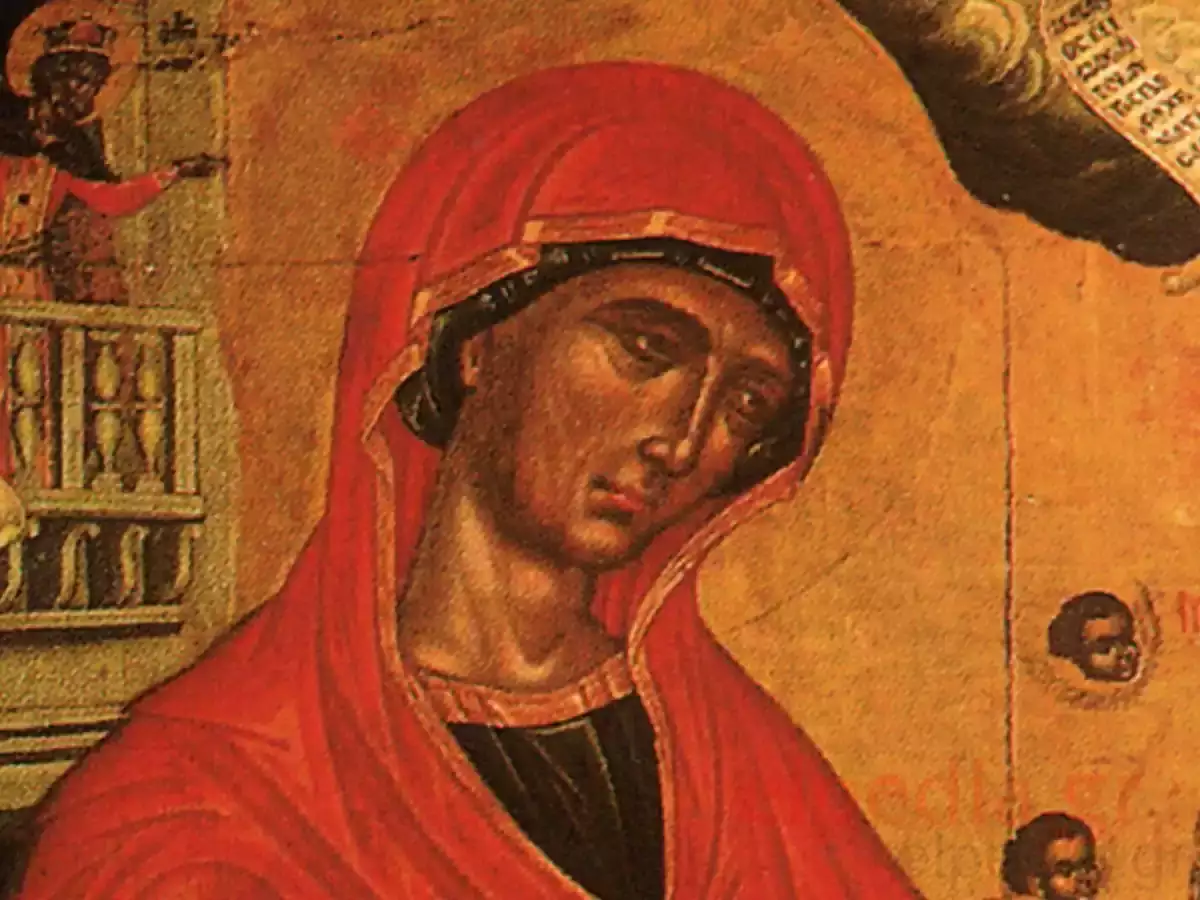
The face of Saint Anne bears the same features that Tzanes repeats in many of the female figures of his oeuvre, elongated, with a pronounced line at the nose and a sidelong gaze, almost detached from the scene unfolding about her. The head-bound red maphorion, with a golden decorated border, falls in heavy folds about the face, creating a frame that isolates her features from the gold ground behind her. Her hand, with long and slender fingers, touches that of her daughter in a gesture that is not so much tenderness as ritual transmission, almost as though conveying something more than affection. Behind her, the building with the balcony where a small figure with a scroll stands points to a prophetic presence, perhaps David or Isaiah himself, an element that reinforces the prophetic dimension of the whole composition without exhausting it pictorially.
Saint Joachim: The Physiognomy of a Patriarch
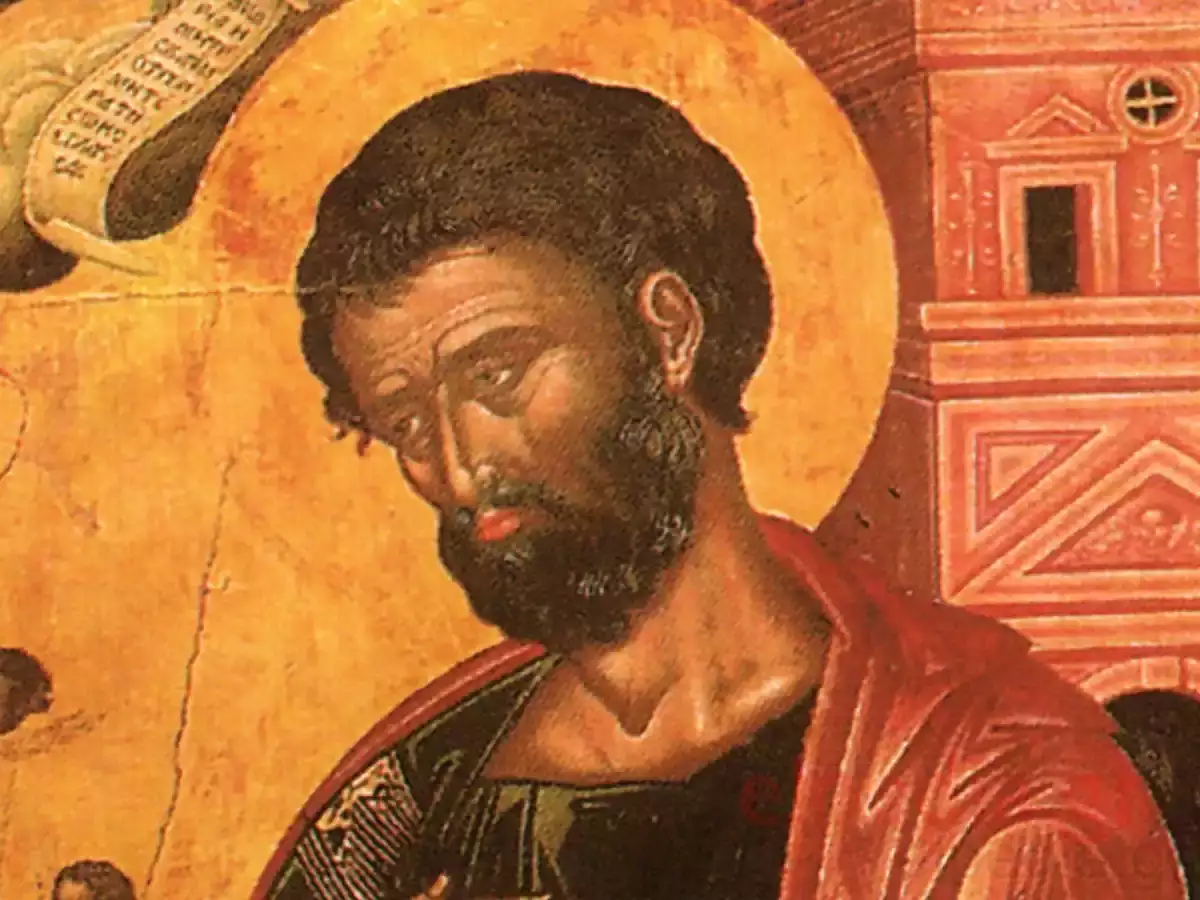
Opposite Anne, Joachim has a thick, greyish-brown beard, curled hair framing the forehead, and a heavy gaze, almost weary, turned downward with an expression that one might read as contemplation or as simple old age. His red himation, richer in folds than that of his wife, allows a dark-coloured tunic to show beneath it, with a decorative band at the sleeve, a detail that betrays the painter’s attention to the fabrics of his time. His right hand, brought before the breast in an almost rhetorical stance, resists the general stillness of the scene in a manner that lends the figure a certain inward movement. Behind him, the tower with the inscription of his name functions more as an identifying label than as an architectural element, a convention usual in late Cretan iconography, where the letter completes and confirms the image.
The Young Theotokos at the Centre of the Tree
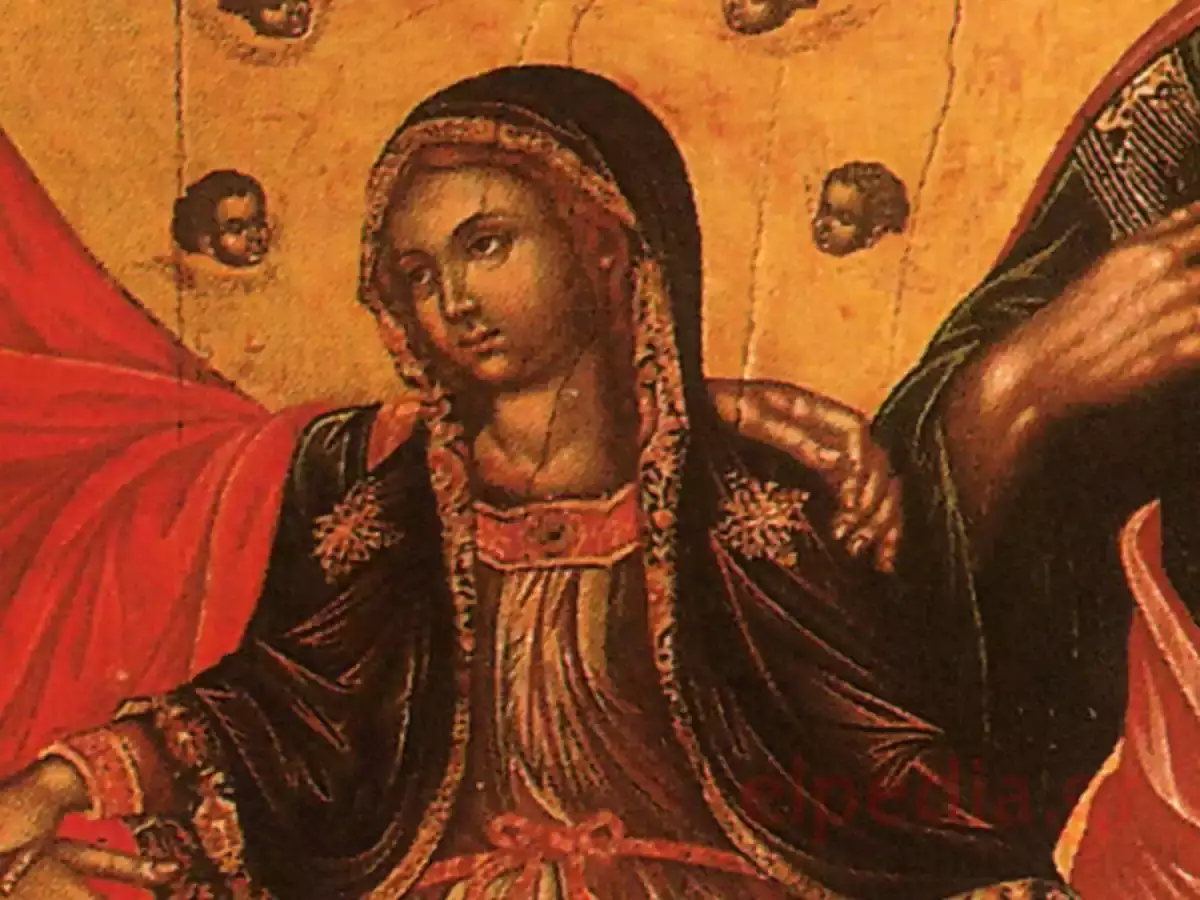
Between her two parents, the young Mary wears a garment with a flowered, almost embroidered ornament, girded at the waist with a red band, a detail that distinguishes her from the austerity of the garments usually attributed to the adult Theotokos. Her face, smaller and rounder than those of her parents, nonetheless preserves the same gravity of gaze, as though she had already assumed the weight of the role that falls to her. She is not a child at play. She is a child who knows, or at least so the iconographic convention would have it, a conception that Tzanes conveys with small but decisive touches, the head slightly bowed, the hands in an almost prayerful stance. Her feet rest upon the very point where the trunk of the tree terminates, rendering her, visually and symbolically, the fruit of that long genealogical chain which begins with the dark, almost forgotten figure at the base of the composition.
Tzanes‘s choice to render this subject was no accident within the context of the Greek community of Venice, where similar compositions of the Tree of Jesse were repeated by other painters of the same generation, such as the later Victor, a fact that shows how widespread the subject was in the workshops of the Cretan and the early Heptanesian school during the seventeenth century. The two schools shared not only techniques but also iconographic models that travelled together with the artists themselves between Crete, Corfu and Venice.
This icon does not ask of the viewer to recognise only a religious narrative but also a historical moment of encounter between two worlds. The gold ground points directly to the Byzantine tradition, while the architecture in the background, the treatment of the fabrics and the attention to physiognomic detail betray an artist who had already assimilated aspects of Venetian painting without abandoning the language of his fathers. The Tree of Jesse, as Tzanes composed it in 1644, stands today as one of the most representative examples of this double lineage, testimony of a community that learned to paint its identity between two traditions without betraying either of them. In the face of the young Mary, between her parents, there is condensed, in the end, the very idea of continuity, that continuity which never entirely ceases, even when the persons who carry it change place, language and style.
(This is a translation from the Greek text; the translation was made by K. Pappas.)

