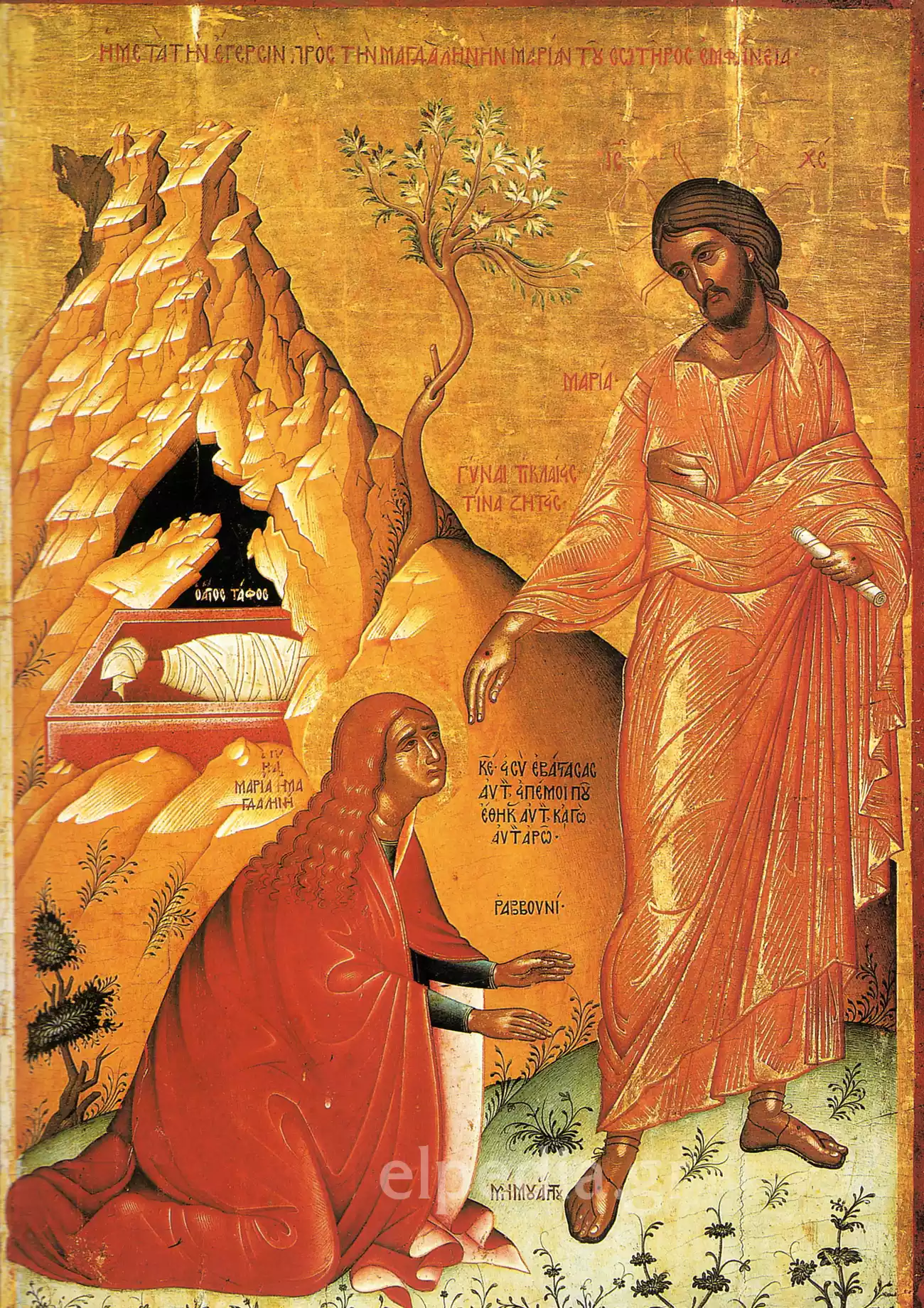
An anonymous painter of Crete fashioned, somewhere about the middle of the sixteenth century, a small portable icon which is preserved today in the Icon Museum of Dubrovnik and bears the biblical title Touch Me Not. Its theme is drawn from the Gospel of John, from the moment of recognition, when the Risen Christ appears to Mary Magdalene outside the empty tomb and forbids her touch. So few boards, so small in dimension, concentrate so dense a theological and historical burden. In the person of this anonymous craftsman meet the strict geometry of Byzantine tradition and the dramatic, anthropocentric gaze which the Italian Renaissance brought with it, without the one annulling the other.
The generation of painters active at that time in Candia did not copy models passively. It organised its labours into guilds after the Venetian pattern, exported icons throughout the whole of the Mediterranean, and gradually shaped that idiom which would later come to maturity in the person of Domenikos Theotokopoulos. This rapid flowering of the Cretan School was bound up closely with deeper religious, social and political shifts which island society was undergoing under Venetian rule.
At the centre of the composition stands a bodily paradox which the iconography itself is called upon to manage with precision — namely, how a gesture of prohibition is to be rendered without the tenderness of the moment being destroyed. The Cretan icon Touch Me Not resolves the matter through the language of colour, of distance and of gaze, not through words. A work of religious devotion beyond doubt, but also a testimony of a society which stood between two cultural worlds, in the years of Venetian rule.
The Icon Touch Me Not: Composition, Figures and Details
The Overall Composition: The Empty Tomb and the Golden Background
Above the figures, an inscription in capital lettering declares the theme of the scene — the appearance of the Saviour to the Magdalene after the Resurrection — like a title incised upon the very gold background. This background does not function as mere decoration. It abolishes every sense of a landscape with a natural horizon and transforms the scene into an event outside time, into an eternal present.
To the left, amid rocky masses which rise with hard, angular folds, the cave of the tomb opens. Within it may be discerned the white grave-cloths, carefully folded, a testimony to the absence of the body which they once wrapped. A slender tree, most probably an olive, rises between the tomb and the two figures, its branches spread as though visually joining the two extremities of the composition. On the ground, small flowers break the monotony of the green colour, a detail which the painter had no need to include, yet included nonetheless, perhaps because the spring of nature was bound to converse with the spring of the Resurrection. The diagonal arrangement of the figures — Christ above and to the right, the Magdalene below and to the left — creates a tension which is not resolved visually, which remains in suspense, exactly as does the theological meaning of the scene.
The Risen Christ: Garment, Movement and Distance
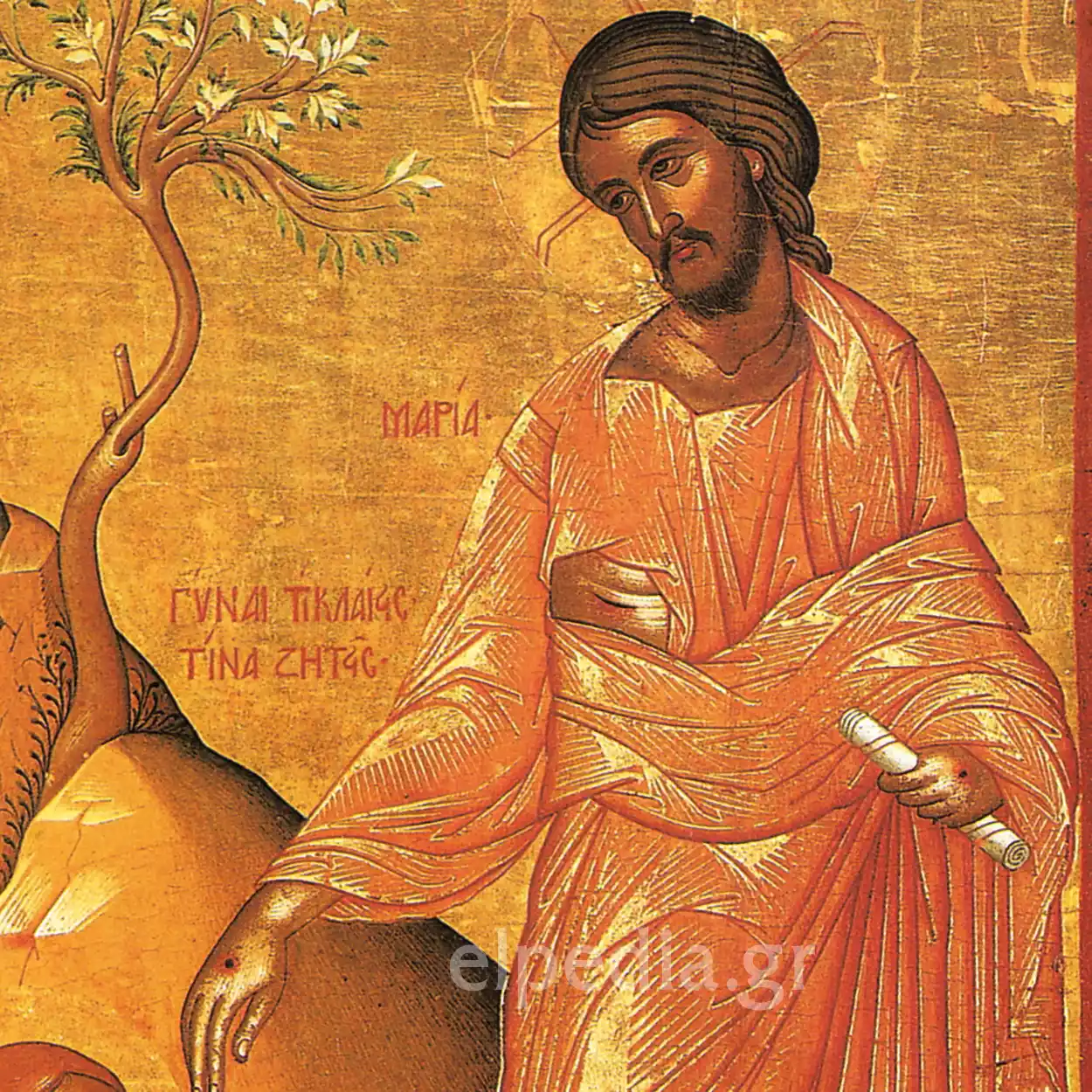
Christ wears a mantle of warm reddish orange, with white lines of illumination running thick upon the fabric, a technique known in Byzantine painting as assist, employed here with a boldness that approaches flame. The face, with its dark wavy hair and small beard, preserves that grave serenity which characterises the risen Christs of Cretan tradition, while a slight inclination of the head towards the Magdalene softens the severity of his gesture. In one hand he holds a scroll, symbol of teaching and of victory over death. The other extends downward, not in an embrace, but in an air of restrained prohibition which never arrives at complete rejection. Beside him, inscriptions set down her name and the words of the Gospel: “Woman, why weepest thou? whom seekest thou?” (John 20:15). His torso remains turned away, almost ready to withdraw, while the gaze turns back. Two contrary movements within the one body, which the Cretan manner handles with rare economy of means.
The Kneeling Magdalene: Passion, Gaze and Gesture
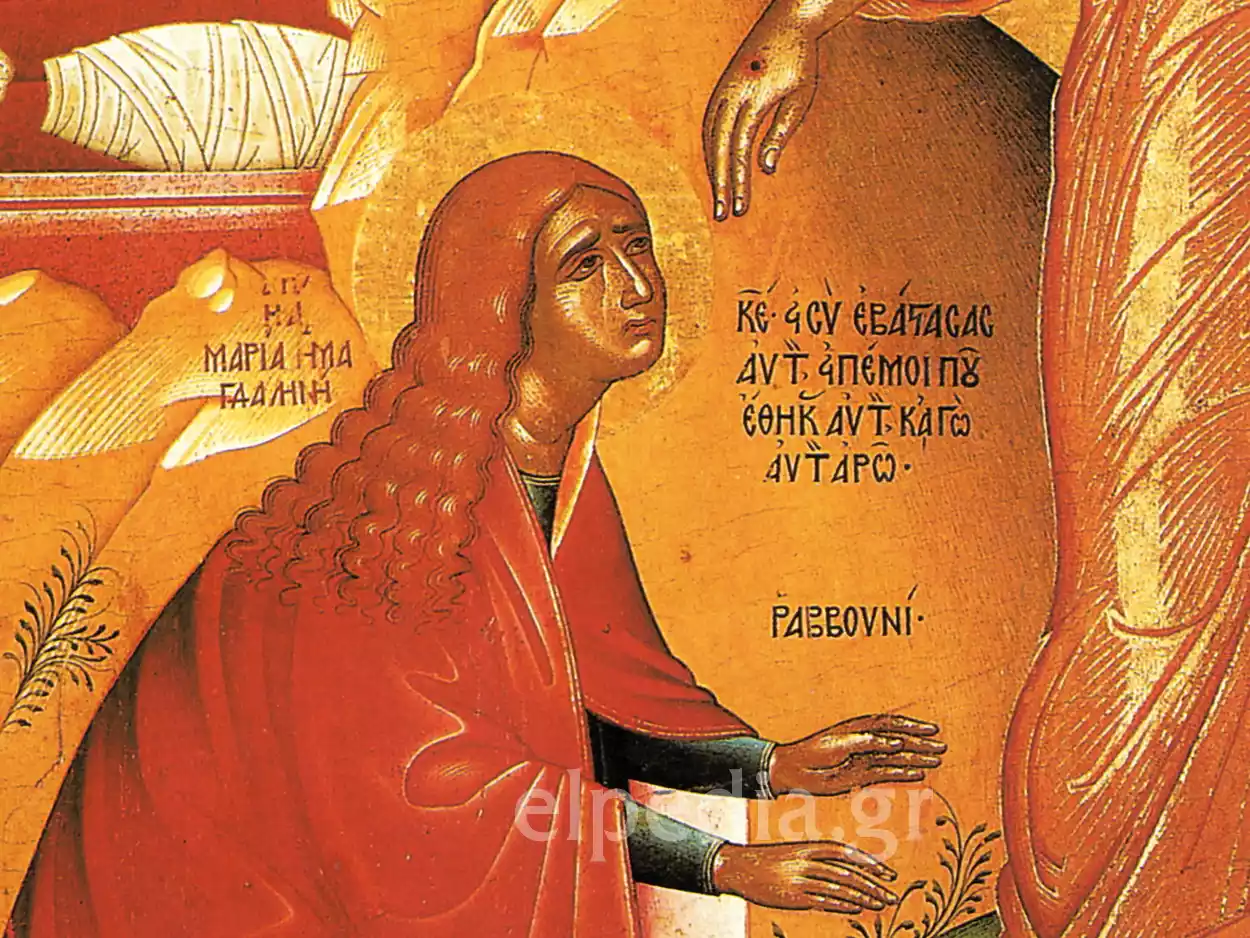
Kneeling, with a deep red mantle falling heavy about her shoulders, the Magdalene leaves her long, wavy auburn hair uncovered, a detail which in Byzantine iconography rarely accompanies female saintly figures and here serves as a reminder of her former, sinful life before her conversion. Her face is turned upward, her eyes wide open, almost beseeching, and both hands extended towards Christ yet without touching him, a movement frozen just short of completion. Beside her, inscriptions name her Saint Mary Magdalene and render the dialogue of the Gospel — the moment when she supposes Christ to be the gardener and asks where he has carried the body — while a single word, “Rabboni” (John 20:16), signals the recognition. Golden lines run through her garment also, less dense than those of Christ, like an echo of light which unites her with him without making her his equal. The weight of her body, almost fallen forward, conveys the whole tension of a longing which is not yet permitted to be satisfied.
This dramatic management of distance, between a body which draws near and another which holds itself back, is no isolated stylistic find. It belongs to a wider tendency of sixteenth-century Cretan painting, in which the psychological tension of the faces acquires a weight unprecedented for Byzantine tradition, preparing the ground for the great, ecstatic compositions which Theotokopoulos would later paint in Spain.
The journey of this particular icon from Crete to the shores of the Adriatic was no accidental occurrence but part of a dense commercial and religious network which linked the ports of the Venetian dominion. Workshops of Candia produced portable icons in series, destined for churches and private persons throughout the whole of the Mediterranean, from Venice as far as Ragusa, present-day Dubrovnik, where this icon at last found shelter.
Behind every such work lies hidden not only the hand of a painter but an entire system of production, circulation and commission, which testifies how closely bound religious art was to the economy and society of the age. The insistence upon detail, the assist which blazes upon the garments, the inscriptions which accompany each figure with the precision almost of a legal document — all this reveals painters trained to work swiftly yet without sacrificing quality. The icon endured five centuries, through wars, changes of ownership, passages from hand to hand, and has come down to us with its gold almost untouched, its faces still holding that same, unfinished movement towards one another.
(This is a translation from the Greek text; the translation was made by K. Pappas.)

