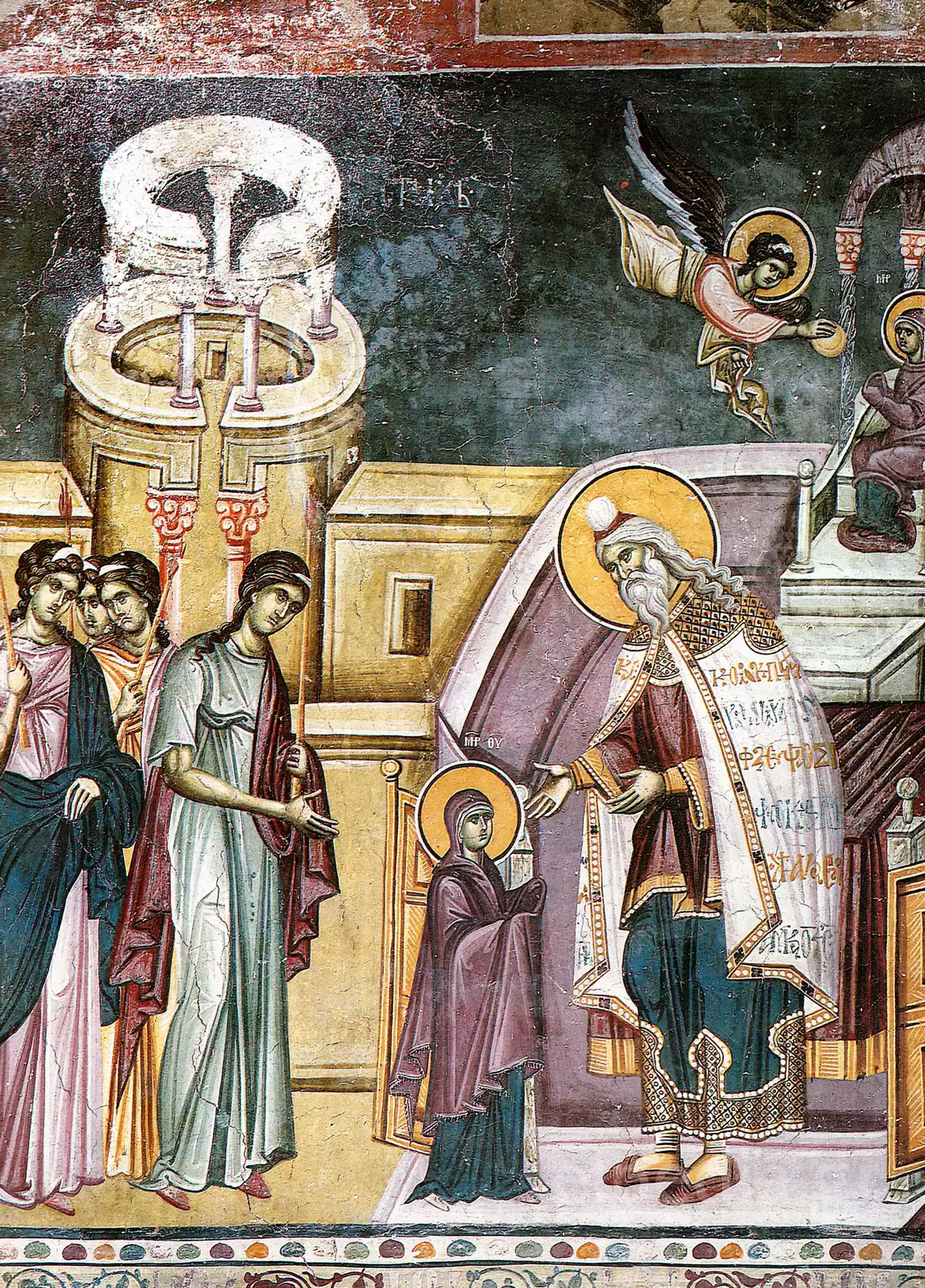
A small girl, with a gravity that far exceeds her age, stretches out her hands towards an elderly priest with a white beard and a stern gaze. This scene depicts the Entrance of the Theotokos into the Temple, one of the central episodes of the iconographic cycle of the life of the Virgin, and covers a section of wall in the small, elegant Church of the King, the chapel dedicated to Saints Joachim and Anna within the Monastery of Studenica, in present-day Serbia. Built and painted around 1313 to 1314, under the patronage of the Serbian king Stefan Uroš II Milutin, the church houses the work of two painters from Thessaloniki, Michael Astrapas and Eutychios, whom the monarch had already employed at other royal foundations of his.
The subject derives from apocryphal texts, chiefly the Protevangelium of James, and relates how Joachim and Anna, childless for years, having at last obtained a daughter after a vow to God, brought her, at only three years of age, to the Temple of Jerusalem to dedicate her. There she was received by the priest Zachariah, father of the future Forerunner, who, according to tradition, was inspired to lead her even into the Holy of Holies, a place into which no one but the high priest had the right to enter.
Quite a few specialised studies have been written on the historical context of the church’s erection and its exact dating, since the final years of Milutin’s reign constitute a period particularly productive for the ecclesiastical architecture of Raška. The composition under examination does not merely follow an established iconographic formula. It bears the dramatic movement of the bodies, the melancholic faces, and the dark bluish background that the fourteenth century imposed in place of the older, flat golden ground. Moreover, the church itself, small in its dimensions yet rich in decoration, houses on its neighbouring walls the portraits of Milutin himself together with his wife Simonis, something that shows how closely royal power was bound up here with the religious narrative.
The Composition of the Entrance of the Theotokos: Faces, Gestures, Architectural Structures
In the left-hand portion of the fresco advances a small procession of female figures, the attendant virgins, with almost identical steps but differing shades in their garments. In the centre, between them and the priest, stands the small Mary, with a halo and a purple mantle, her name declared beside her head by the abbreviated monogram MR THY. The elder who receives her, clothed in a white sakkos embroidered with red pseudo-inscriptions and golden decorative bands, inclines his body slightly towards her, his hands extended in a gesture of reception that has nothing forced about it.
Behind and above the two central figures rise buildings of gold and ochre, stacked one upon another in a manner that obeys no real perspective, yet creates the impression of an urban, almost theatrical setting. A ciborium with a white fluted dome and red, twisted columns with anthemion capitals dominates the upper left portion of the composition, a trace, most probably, of the holy table of the Temple of Jerusalem itself as imagined by the painters of the fourteenth century. On the right, an angel with open wings flies towards a seated figure upon a pedestal with railings, offering her something round and golden that could be bread.
This detail refers to a later episode of the same cycle, when Mary, already a young girl within the Temple, was fed, according to tradition, by an angel. Its coexistence with the scene of the reception shows how freely the painters of the period combined different moments in time upon the same wall, without being especially concerned with the strict chronological sequence that a modern narrator would require. The deep grey-blue of the sky, in place of the older flat gold, lends the whole an atmosphere that is almost nocturnal. The figures still retain something of the elegant elongation and the slightly broken posture of the body that distinguishes Palaiologan painting from the earlier Byzantine models, which were more rigid and frontal. Michael and Eutychios, the same artists who had already worked at the Peribleptos of Ohrid and who would later work at the Ljeviška Virgin of Prizren and at Saint George in Staro Nagoričane, bring here something of that knowledge to faces with heavy eyelids, small mouths, and a pronounced plasticity in both face and garments. Scholars often consider this workshop the most sought-after of Milutin’s royal court, responsible for a series of monumental ensembles across the whole of present-day North Macedonia and Serbia, with shared stylistic features that permit its recognition even where the signature is absent.
The Candle-Bearing Virgins
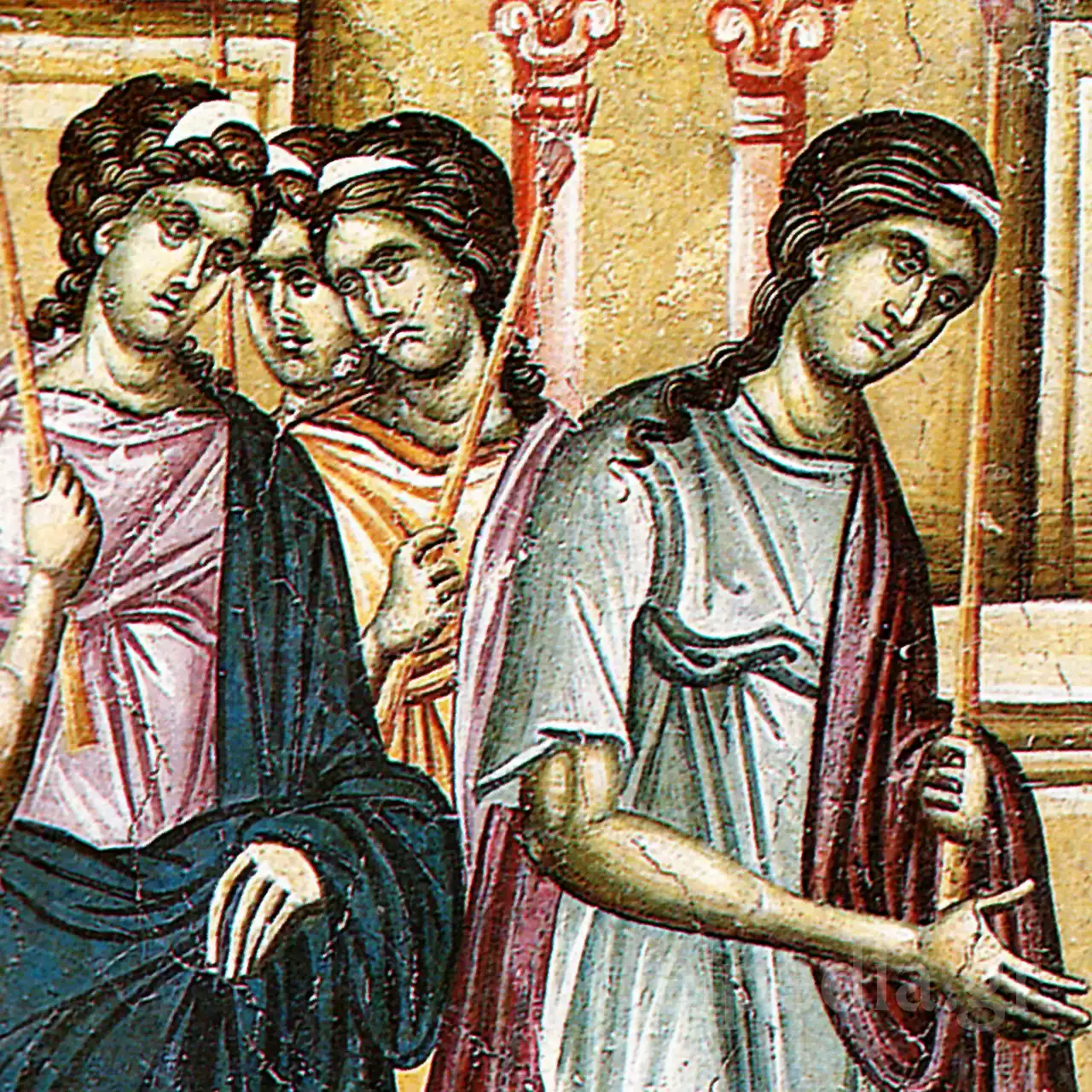
Four young women, with white ribbons in their hair and long, slender rods in hand, compose the retinue of the small Theotokos. Three of them, crowded one behind the other, wear tunics in pink, deep blue, and ochre, their faces almost identical in expression but slightly different in the turn of the head. The fourth, ahead of the rest, stands out with her light green tunic and her deep red mantle, her hand stretched forward in a gesture that seems to accompany words now lost.
These slender rods are not mere decorative elements. According to the apocryphal narrative, the Hebrew girls were given lit candles so that they might accompany the small Mary on her way to the Temple, lest she turn her gaze back towards the paternal home she was leaving. The painters rendered their gesture with a slight asymmetry: some stand more upright, others incline the head, and this small dissimilarity keeps the composition free of any static repetition. Similar groups of candle-bearing virgins appear also in other contemporary monuments of the period, always, however, with a different number of figures and a different arrangement, a feature that shows how this type had not become fixed into a strict copying pattern but left the painter room for personal choice.
The gaze of the three rear figures is directed discreetly forward, as though they were witnessing the scene of the handing-over without actively taking part in it, a role more testimonial than protagonistic. This choice, seemingly small, allows the viewer to read at once which is the principal action of the composition and which the secondary figures that merely frame it.
The Reception by the Priest Zachariah
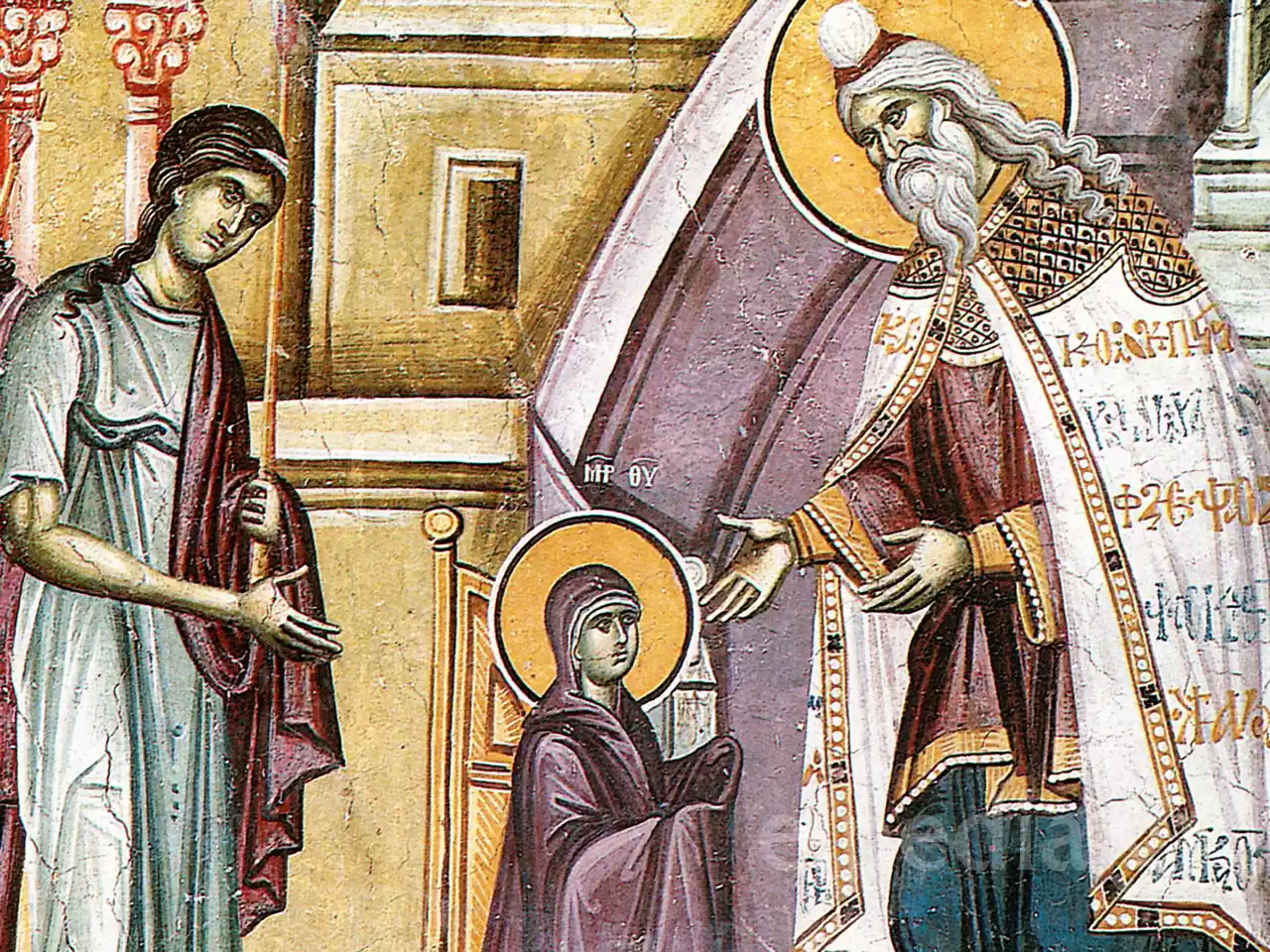
The face of the priest, with its long wavy beard and white conical cap beneath the halo, bears something of the tension of a man who knows what this moment means, long before the small Virgin herself understands it. His sakkos, with the red bands of pseudo-inscriptions running vertically, belongs to that category of liturgical vestments which the Palaiologan painters rendered with a care that reaches almost to the faithful reproduction of actual cloth. The small Mary, her hands wrapped discreetly within her mantle, does not yet touch the hands of the elder. This distance, small but clear, holds the composition in a moment of waiting, just before the act of handing-over is completed. It never ceases to impress how differently the painter treats the two bodies, the one voluminous and full of folds, the other minuscule and almost rigid, as though he sought to underline, through the very form, the contrast between spiritual authority and childlike innocence.
Zachariah, father of John the Forerunner according to the later tradition, represents here the priestly order of the Old Testament which yields its place to that which is about to come. Behind him, the first of the virgins, in the green garment, stands as a bridge between the group of attendants and the central pair, her hand half-open in a gesture that no one manages to interpret with certainty. Among the three, priest, child, and attendant, an invisible triangle of gazes and hands is formed, holding together the entire right-hand side of the composition, without needing any additional line or boundary to underline it.
The Monastery of Studenica, with its two principal catholica built of white marble, houses today one of the most complete ensembles of Byzantine and Serbian fresco painting surviving from the thirteenth and fourteenth centuries, recognised also as a World Heritage monument. The cycle of the life of the Virgin in the Church of the King is considered by many scholars the most mature achievement of Michael and Eutychios, their technique here approaching the sensitivity of the portable icon more closely than anywhere else in their known work. The sacred painting did not remain unaltered through the centuries that followed. Destructions, fires, and later conservation interventions, especially during the sixteenth century, left their mark on portions of the ensemble, without, however, seriously altering the scene we have examined here.
The interest of the Entrance of the Theotokos at Studenica is not exhausted in its historical value as evidence of a workshop of painters that worked across multiple royal foundations of Milutin. Every detail, from the bearing of the attendant virgins to the silent tension between the small Mary and the elderly priest, testifies to a way of thinking upon the icon that does not mechanically repeat earlier models. It reads them anew, with a fresh eye, full of movement and tension, with the hand of the green-clad virgin remaining, even today, half-open in a gesture that no one ever managed to complete.
(This is a translation from the Greek text; the translation was made by K. Pappas.)

