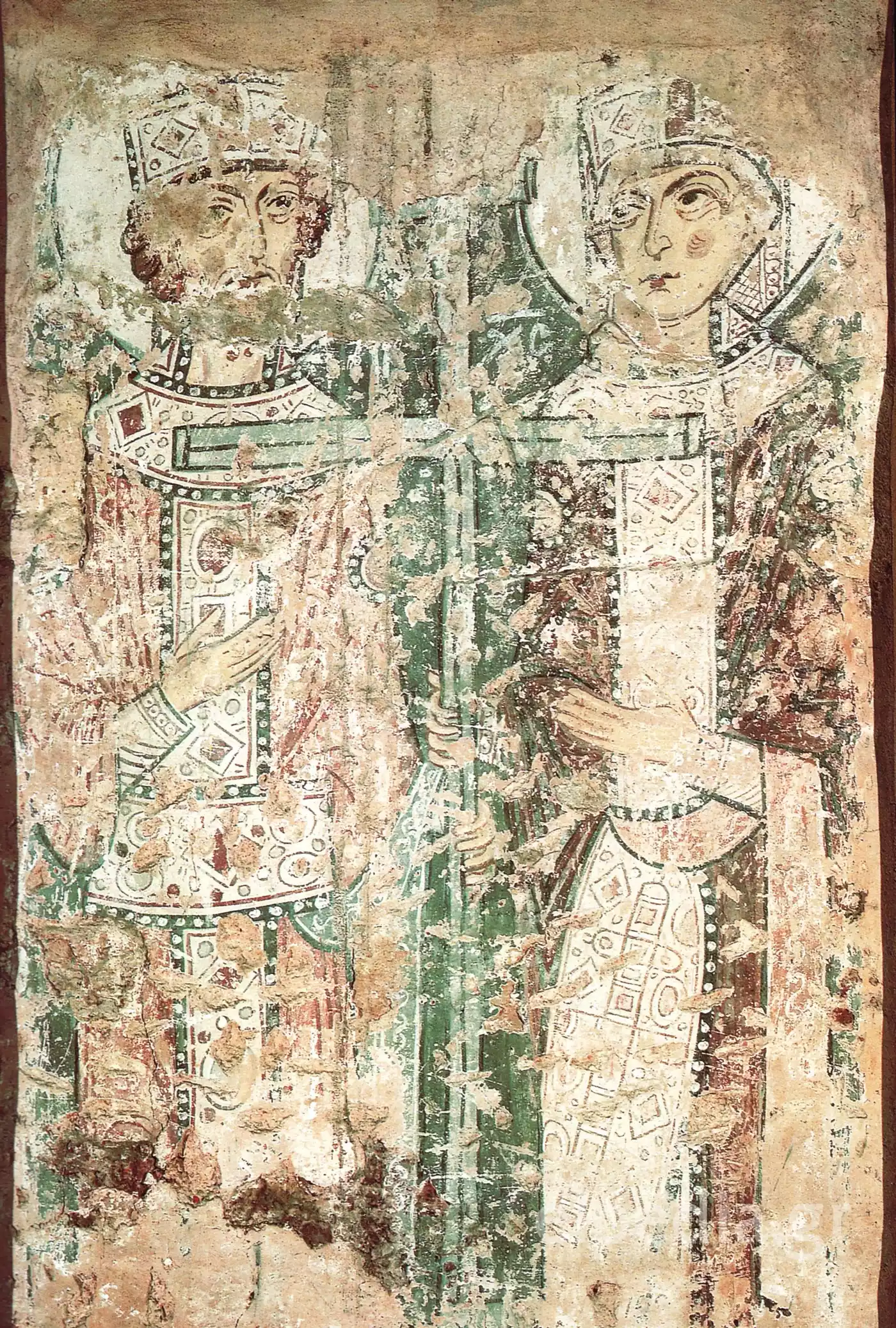
In the southern passage of the cathedral of Hagia Sophia, in Russian Novgorod, an anonymous painter of the twelfth century depicted the Emperor Constantine the Great together with his mother, Saint Helena, standing, frontal, both holding the Holy Cross. This is one of the few authentic pictorial testimonies to have survived from the original decoration of the church, built in the eleventh century by Prince Vladimir Yaroslavich. The plaster has suffered serious damage over the course of nine centuries, yet the black outline of the drawing still retains, in the places that have endured, something of the severity of the original conception. The transfer of such models from Constantinople to the expanses of Russia constitutes one of the most fascinating chapters of Russian painting, a current of artistic and political influence that left an indelible mark on the art of the Rus’.
The choice of these particular figures for so conspicuous a position within the church is closely bound up with the need of the new rulers to borrow models of power from an older, God-given empire. Constantine and Helena, founders of a Christian empire and discoverers of the Cross itself, offered the most perfect possible model to a world that had only just embraced the new religion. Within this passage, known also as the Martyrius Passage, the two-figure composition stands above the tombs of clerics and below an older composition of the Deësis, remnants of an ensemble that time has all but entirely decimated.
The Fresco of Constantine and Helena in the Martyrius Passage
The composition is governed by strict symmetry, organised around the vertical axis of the cross which both figures hold with their hands raised. On the left stands the Emperor, with a thick beard of reddish-brown hue and a gaze that does not seek the gaze of his mother, but looks straight ahead, towards the viewer, towards something beyond him. His crown, tall and square, is covered with lozenges and circles in alternation, an imitation of precious stones which the pictorial technique of the age preferred to render through linear shapes rather than through chiaroscuro. Beside him, Helena wears a corresponding head-covering, a heavy veil falling to the shoulders, with two hanging ornaments, the so-called prependoulia, framing her face after the model of the Augustae of Constantinople.
The technique follows the established Byzantine model of fresco painting, with three successive layers of plaster that ensured a stable, smooth surface for the final design. The ground behind the figures, as was customary in Byzantine painting before the gold background of mosaic came to prevail, would originally have been painted in a shade of azure, the colour of the sky, which pointed to an abstract, timeless space of divine presence. What we see today, the dark-yellowish patina that dominates the whole surface, is the product of centuries of oxidation, damp, and repeated interventions, not the original intention of the painter. Despite the damage, traces of colour survive in several places: the green of the background behind the figures, dull now yet recognisable, and the ochre of the faces, where once there would have been light reddish touches upon the cheeks, according to the customary practice of rendering flesh in Byzantine fresco painting. The halo can still be discerned behind the heads of both, although time has destroyed most of its surface, leaving only a faint, yellowed line.
A question persists, however rarely it is explicitly posed: why did two figures of the Eastern Mediterranean, who never set foot on Russian soil, come to dominate one of the most public entrances of a church built thousands of kilometres away? The answer has less to do with the veneration of these particular saints than with a deeper political need.
The princes of Kiev and Novgorod, having only recently accepted Christianity from Byzantium in the tenth century, sought ways to bind their own power to a model of sacred imperial legitimation that Constantinople had already perfected over centuries. Constantine and Helena, as the first Christian rulers and discoverers of the Holy Cross, offered the ideal model of power bound indissolubly to divine favour.
The Dedication of the Church and the Role of the Cross
The cathedral of Hagia Sophia in Novgorod was built between 1045 and 1050 by Prince Vladimir Yaroslavich, son of Yaroslav the Wise, replacing an earlier wooden church of Bishop Joachim of Chersonesus. It was consecrated by Bishop Luka Zhidyata around 1050, on the day of the feast of the Exaltation of the Holy Cross, the fourteenth of September.
This coincidence illuminates the choice of these particular figures for so conspicuous a position: their presence near the entrance clearly reflects the feast to which the building itself had been dedicated. Certain Russian scholars have even advanced the hypothesis that the design was originally intended for execution in mosaic, a luxury eventually abandoned in favour of the more economical fresco, perhaps on account of cost or the lack of skilled mosaic craftsmen so far from its centres of production. The hypothesis remains unconfirmed.
The position of the composition within the space reinforces this reading: whoever entered by the southern doorway, the most usual approach to the church in the Middle Ages, would first behold these two figures before proceeding towards the main body of the church and the space of the Divine Liturgy. The image thus functioned as a threshold, a first reminder that entry into the house of God passed through the history of an empire that had received the cross as a symbol of power.
The image is not an original conception of the Novgorod painter. In the southern vestibule of Hagia Sophia itself in Constantinople, a tenth-century mosaic shows Constantine offering his city to the Virgin and Christ, beside Justinian, who offers the church itself. The model of the emperor as donor and guardian of the faith had already had centuries of life behind it when it arrived, through designs and copies, in the northern lands of the Rus’. In Novgorod, Constantine offers, together with his mother, the Cross itself, a gesture more directly bound to the theological meaning of the feast to which the church was dedicated.
Novgorod painting, as it developed in the second half of the twelfth century, combined Byzantine severity with a more popular, almost naïve expressiveness that stands apart from the models of Kiev. In the figures of Constantine and Helena, however, the severity remains entirely Byzantine, without a trace of that local vitality which would later come to dominate works such as the frescoes of St George at Staraya Ladoga. This element supports an early dating, the craftsmen of the church having remained, to a great extent, Greek, or directly trained upon Greek models. The survival of this particular fresco owes much, too, to the historical fortune of the city itself. Kiev, where equally early and significant works were created, was utterly destroyed by the Mongols in 1240, sweeping away with it the greater part of early Russian painting. Novgorod, by contrast, found itself far enough north to escape the invasion, and so developed over the following decades into the principal cultural centre of the Russian land, heir and continuer of a tradition that elsewhere had been violently extinguished.
Faces, Crowns, and the Language of Detail
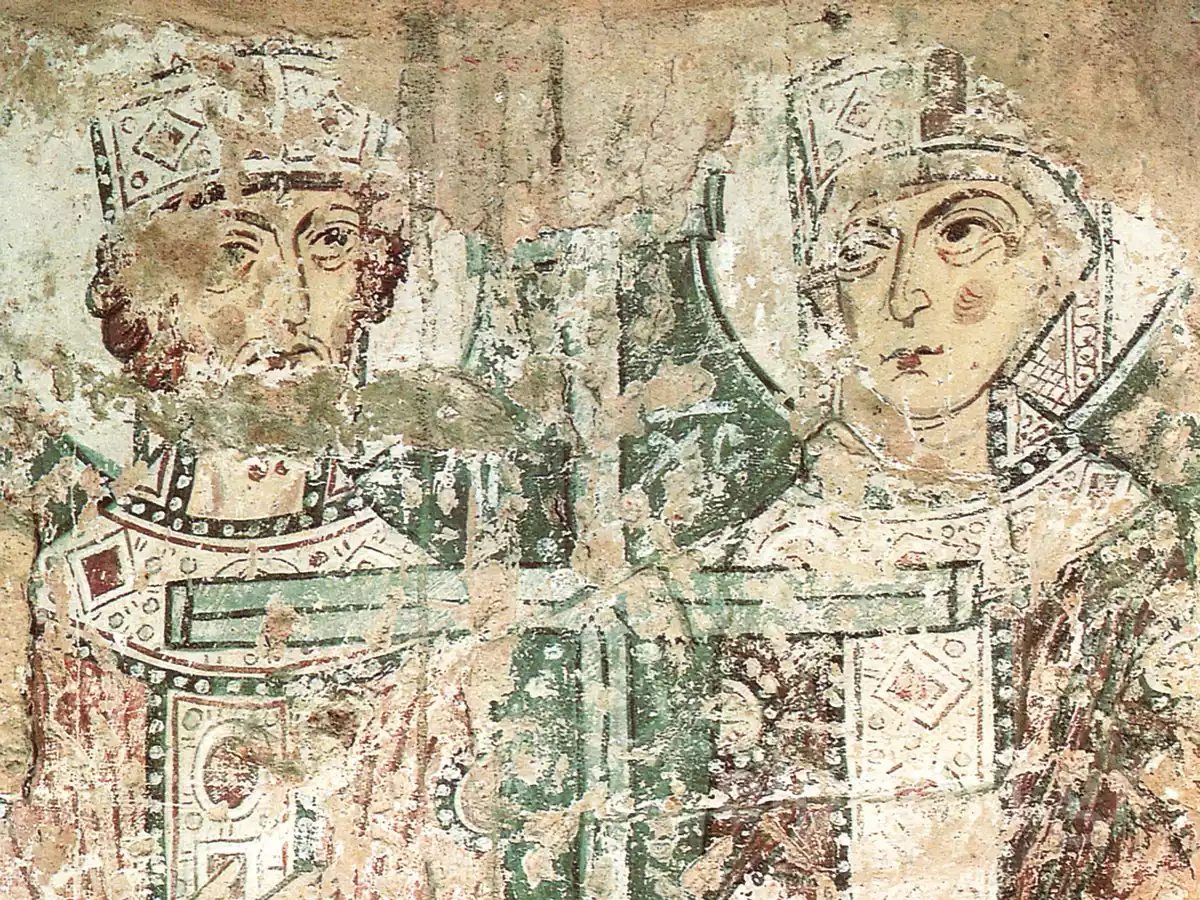
A closer approach changes everything. In closer view, the two faces reveal details that escape entirely from a distance: the deep, almost heavy gaze of the Emperor, with his large almond-shaped eyes outlined by a thick black line, and the thin, raised eyebrows that reinforce the sense of a permanent, inexpressive vigilance. His nose is long and straight, the mouth small, almost pursed, features that recur, with minimal variation, in the face of Helena also. She, however, possesses something different: two red patches upon the cheeks, traces of the conventional technique of rendering flesh, which required a light reddish hue to enliven the pale ground of the skin.
The garments, as the detail reveals, are not a mere decorative repetition of geometric shapes: each lozenge is surrounded by a series of small circles imitating sewn pearls, a system of ornamentation that the court art of Constantinople had established since the time of Justinian and which the painters of the provinces copied, often without ever having seen the original material, only through drawings and fabrics that travelled as gifts or as merchandise.
This survival is explained technically. The black drawing, usually of burnt ochre or of charcoal, bonded chemically with the plaster far more stably than the more delicate, organically derived colours of the final highlights, those, that is, which gave the face its ultimate vividness. The outline endured longer than the colour, and so today we see more of the drawing than of the painting. The study of such frescoes interests today less the historian of religion and more the historian of art and culture: they constitute testimonies to how images, designs, and ideas of power circulated in an age without printing, without photography, with the hand of the painter and his memory as the sole means of transmission. Every lozenge on the garment, every proportion in the face, every detail on the crown constitutes a trace of a journey that began in Constantinople and ended, through unknown intermediate stations, upon a wall of northern Novgorod.
The two figures, as damaged as they are imposing, function today more as document than as cult image: they record a moment in which art became a vehicle of political thought, in which a wall on the northern frontier of the then-known world had to speak the same language of power as the vaults of Constantinople. The Martyrius Passage, its name after Archbishop Martyrius now identifying it more than any inscription, holds this testimony beneath layers of lime and centuries of interventions, beside the tombs of clerics whose names no one now remembers. It is little, but it is all we have from those first years of the church.
(Translated from the Greek text; translation by K. Pappas.)

