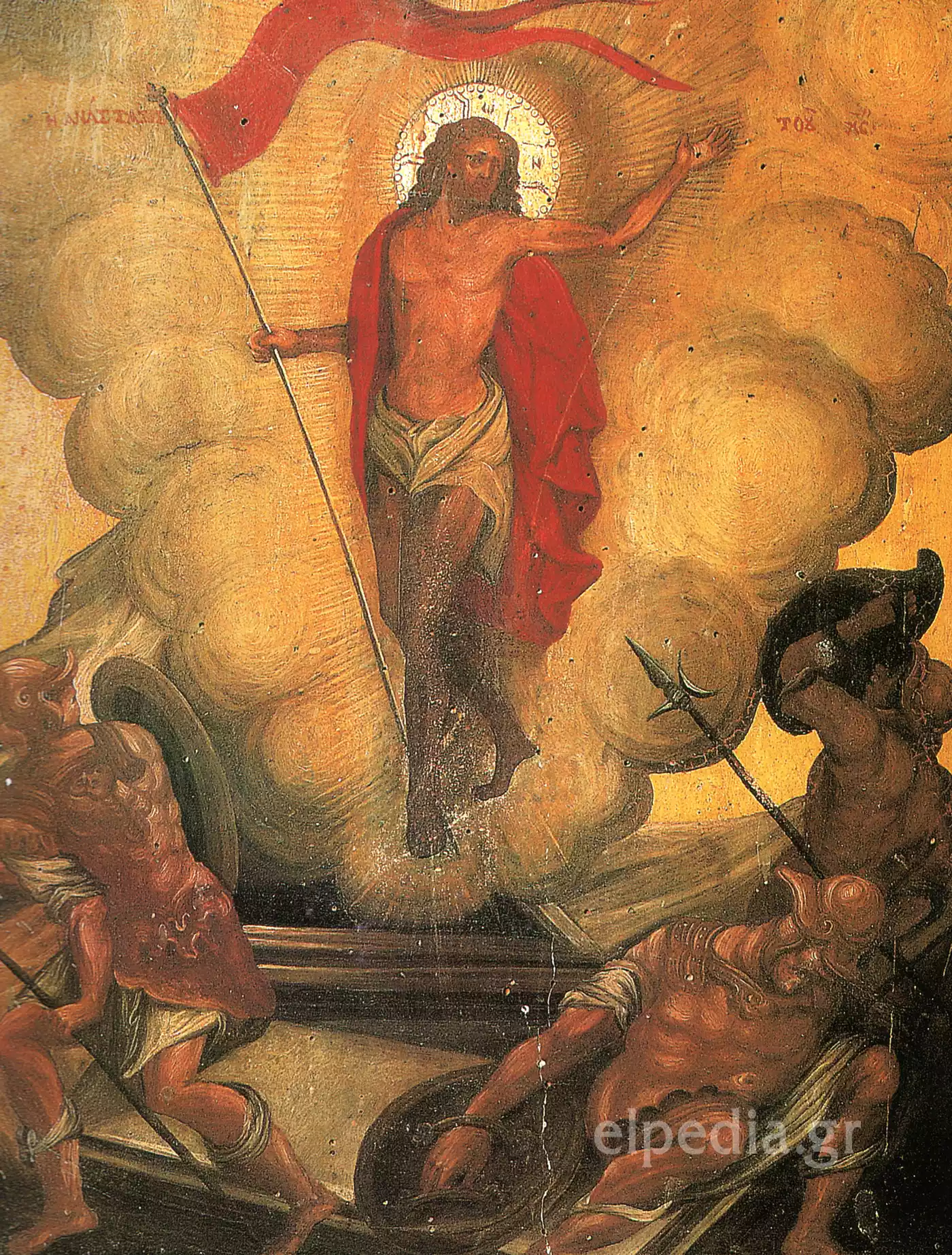
A portable icon of the eighteenth century, originating from the Greek Orthodox church of Barletta in Apulia, southern Italy, depicts the Resurrection of Christ through the old Byzantine type of the Descent into Hades. The painter, whose name has not survived, faithfully follows an iconographic tradition established already from the eighth century and which continued to be cultivated in the Greek communities even under Ottoman rule.
Instead of showing Christ emerging from the tomb, as is customary in Western painting, the composition presents the moment at which the risen Lord shatters the gates of Hades and draws up Adam, the first man, at the head of all the righteous of the Old Testament. The theological perspective that governs the composition is not exhausted in the narration of a miracle, but expresses the doctrine of salvation as an event that embraces the whole of humanity, from the first man to the last. The gold ground, the coiling clouds about the figure, the red mantle and the banner of victory compose an image of profound theological density, a token of the art by which the Greek community of Barletta preserved, down the centuries, its memory and its identity.
Byzantine Icon of the Resurrection: Christ Triumphant over Death
At the centre of the composition, amid dense, coiling clouds of deep golden yellow, rises the figure of Christ. He wears a deep red mantle fallen upon the shoulders in angular folds, which leaves the torso bare, rendered in warm ochre tones with a somewhat schematised treatment of the muscles, while about the waist he draws tight a white loincloth knotted at the front. The body appears to hover above a dark rectangular opening, the shattered door-leaves of Hades, with the feet barely touching its edge. The right hand is raised high, the fingers open in a gesture of blessing and authority, towards the point where a red banner flutters, while the left holds a slender, long staff, at the top of which is fastened the flag of victory, the established iconographic symbol of triumph over death. Above, in the two upper corners, may be discerned the red letters of the inscription “Η ΑΝΑΣΤΑΣΙΣ” and “ΤΟΥ ΧΡΙΣΤΟΥ” [THE RESURRECTION OF CHRIST], as is customary in icons of the Twelve Great Feasts. Below, armed figures lie in disarray: one bears a crested helmet and holds a round shield, another lies beside a broken lance that crosses the lower right corner obliquely.
This motif fuses the older Byzantine tradition of the bound personification of Hades with the more narrative element, familiar from the Western iconography of Easter, of the guards of the tomb collapsing. It is a fusion common in the post-Byzantine painting of the Greek communities of Lower Italy, where local workshops assimilated elements of the Italian visual idiom without abandoning the doctrinal core of the Byzantine model.
The study of this iconographic type, especially by the art historian Anna Kartsonis in her now classic book on the Resurrection, shows that the Descent into Hades was never a simple pictorial convention. It was the product of a long theological dispute concerning the meaning of Christ’s death, a dispute that lasted centuries before the Church established the icon as the official manner of depicting its greatest feast. The choice of this type, rather than the simple representation of the empty tomb, was not therefore an artistic preference but a doctrinal stance, one that the icon of Barletta, centuries later, continues faithfully to convey.
The Halo and the Golden Light
About the head spreads a cruciform halo, studded with small circles recalling beads, from which shoot forth slender golden rays that fill almost the entire depth of the icon. Within the arms of the cross are read the letters Ο, Ω, Ν, the ancient divine appellation “ho ōn”, he who is, as was revealed to Moses. The light does not merely decorate. It declares the uncreated glory that arises from the victory over corruption, a glory which the painter chose to render not with shadows, but with gold that covers almost every trace of sky or landscape.
Detail of the Figure: the Face and the Movement of the Body
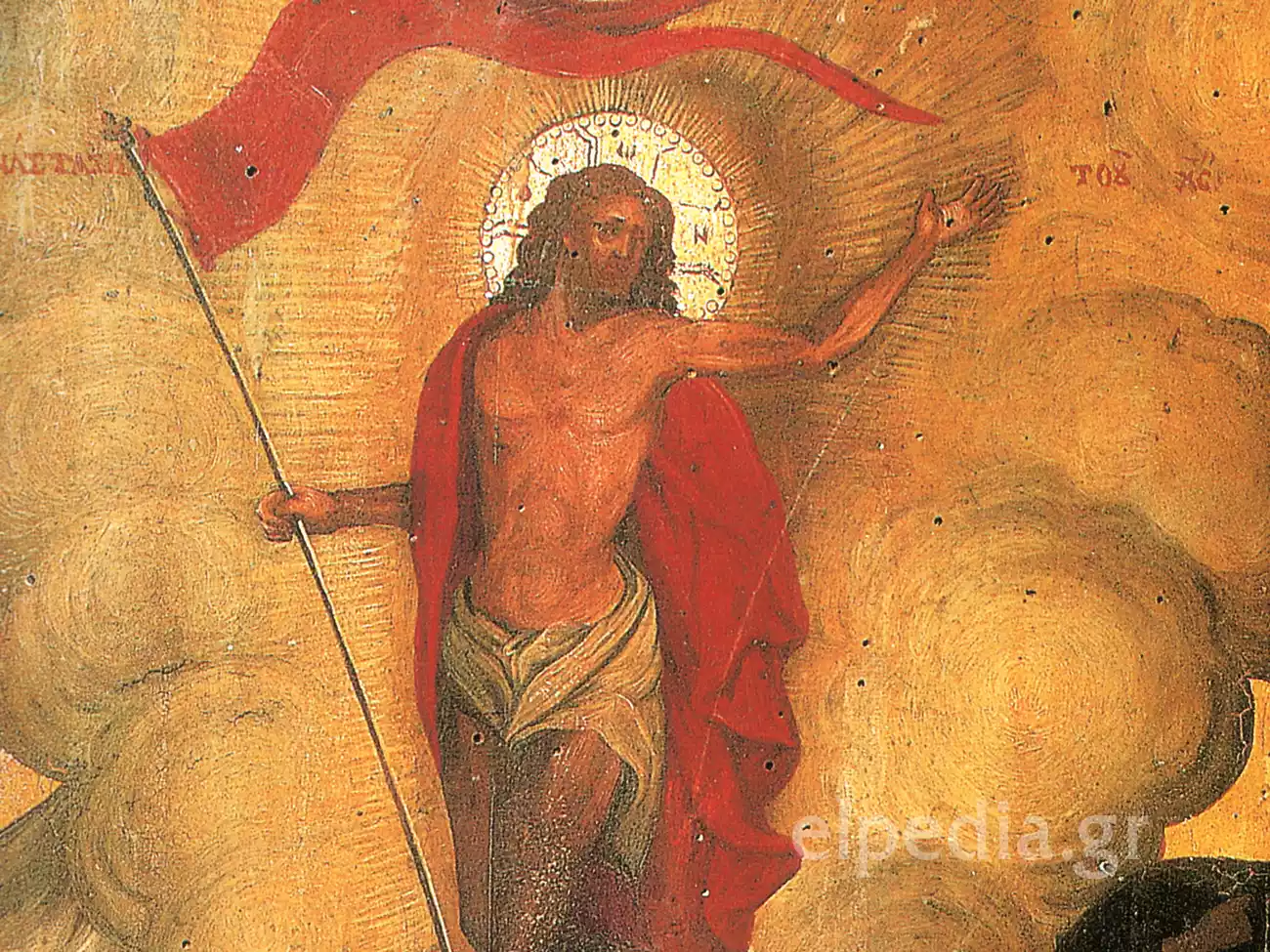
Closer up, on the same figure, the features of the face may be discerned more clearly: long brown hair falls in soft waves to the shoulders, the beard is short and well-kept, the gaze turns slightly to the side and downward, not directly at the viewer, giving the impression of inward concentration rather than triumphant address. The complexion is rendered with a limited gradation of tones, the shadows built up with dense, parallel brushstrokes of darker ochre instead of smooth modelling, a technique that betrays a hand more familiar with pattern-books than with the study of the nude body.
On the palm of the raised hand a faint mark may be discerned, a possible reference to the wound of the Passion, although the wear of the surface hinders its clear reading. Small losses of pigment are scattered like flecks over the gold ground, traces of centuries within a church where damp and fluctuations of temperature commonly afflict portable icons. The red mantle, here closer to the viewer, reveals folds drawn with linear glints of orange, a convention of lighting that indicates volume more through drawing than through actual plasticity.
The church from which the icon comes, known in the local tradition of Barletta as the church of the Greeks, was built in 1398 and housed for centuries the city’s small Greek community, descendants of refugees from the Peloponnese who had settled there fleeing the Ottoman advance.
The plague of 1656 forced the community to abandon the church, which passed into the Roman Catholic rite, until in 1789 the return of Greek merchants to the city brought Orthodox worship back to the same building, where it remained active until 1842.
The templon of the church, the work of different hands from the sixteenth to the nineteenth century, is considered today one of the most important examples of post-Byzantine wood-carving and painting in the whole of southern Italy, with despotic icons attributed to a significant Cretan painter of the sixteenth century, who also worked in the corresponding church of the Greeks in Venice. Among these works is numbered also the icon of the Resurrection, a token of an art which the Greek community of the city kept alive amid persecutions, plague, and changes of liturgical use.
(Translated from the Greek original by K. Pappas.)

