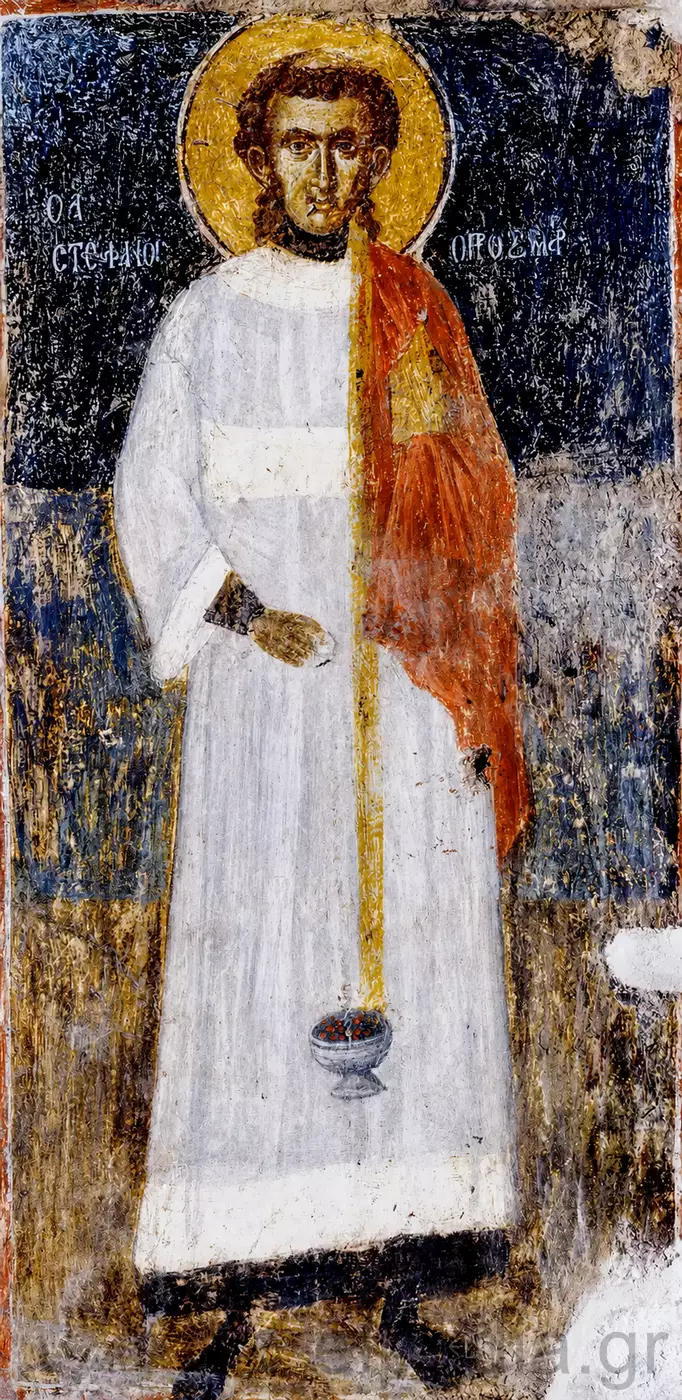
A young deacon with wavy chestnut-red hair has held, for nearly six centuries now, the censer of a liturgy that has not yet ended. This is Saint Stephen the Protomartyr, the figure that an anonymous painter set down in the early fifteenth century upon the plaster of the Panagia Odigitria, at the Holy Monastery of Valsamonero, south of Zaros in Crete. This fresco, worked in the spare technique of Byzantine wall-painting upon wet lime plaster, ranks among the most representative examples of the early Cretan School, that generation of painters who would prepare, without yet knowing it, the ground for Domenikos Theotokopoulos two centuries later. The story of the young deacon who became the first martyr of the new faith is told at length in the Acts of the Apostles, in chapters six and seven, where his trial before the Sanhedrin is described, along with the vision of the glorified Christ that he recounts at the moment of his death, and his stoning outside the walls of Jerusalem. In the memory of the Church he remained the first of the seven deacons of the early Christian community, the man who died forgiving his executioners, and iconography has since rendered him with fixed attributes: a youthful face, the white vestments of a deacon, a censer in hand.
None of these is absent from the Valsamonero composition. The work, damaged in places but essentially legible, offers scholarship today something more valuable than a simple devotional image: an almost laboratory-like testimony to how colour, drawing and dress were conceived by the painters of an island society that found itself, in the early fifteenth century, between Byzantine heritage and Venetian rule.
Stance and Vestments in the Wall Painting of Saint Stephen
The saint stands frontally, full-length, his weight resting equally on both feet, upon a dark pedestal that separates him from the coloured, earthen ground beneath his feet. He wears the deacon’s white tunic, the sticharion, with long sleeves and broad, elongated folds falling vertically to the ankles, while the himation, a deep orange and almost brick-red in places, is wound diagonally across his left shoulder and falls free to the knee, leaving the right shoulder light, clothed only in the white fabric. At waist height his right hand holds a golden chain, which descends vertically to his feet and ends in a censer with glowing coals, rendered in a vivid reddish-orange, a detail that would pass unnoticed were it not for how sharply it breaks the monochrome of the ground.
Behind his head opens a vast golden disc, the halo, which occupies almost a third of the composition and converses visually with the deep, almost inky blue of the background. Two inscriptions in capital, typically Byzantine letters frame the figure: one gives the name, the other the title, “protomartyr,” confirming what we already suspect from the vestments and the censer. Lower down, the blue gradually yields its place to a greyish band and then to a warm ochre, the earth on which the saint stands, a simple but effective stratification that gives depth without perspective, in the manner the Byzantine painter had learned to think centuries before the Renaissance. The surface of the plaster, better preserved in the azure areas of the background, still bears the traces of the damp of centuries, small white crystallisations scattered like a constellation across the dark ground, testimony material rather more than pictorial; and near the pedestal the render has lost its original texture in places, a fact that does not, however, hinder in any way the reading of the composition as a whole.
The Protomartyr’s Face: A Detail Seen Close-Up
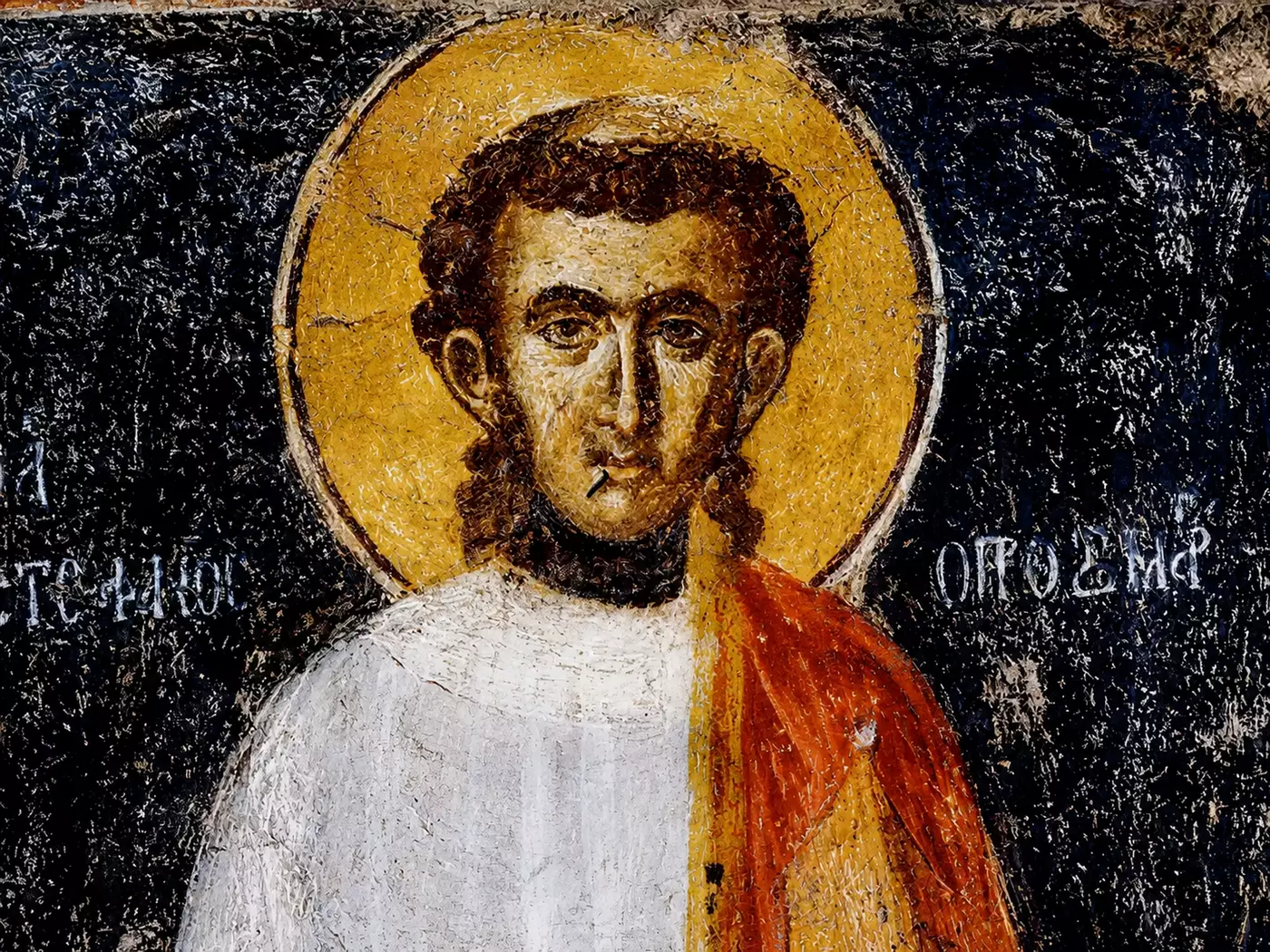
Seen close up, the face changes. The large, deep-set eyes look straight ahead, the gaze escaping in no direction, and the eyebrows, accented with a dark, almost brown line, give the expression a gravity that does not reach as far as sorrow. The hair, chestnut-red, falls in wavy locks to the shoulders, while above the lip a thin moustache can just be made out, so faint that it might belong to a youth, consistent with the iconographic convention that holds the protomartyr beardless, almost a child still at the moment of death. The painter has worked the face in successive layers, from the darker underpainting to the light highlights on the forehead, the nose and the cheekbones, a technique known in the iconographic tradition as “sarkoma,” which gave the faces of saints the impression of an inner, rather than an outer, light. The white brushstrokes around the iris, sparing but precise, bring the gaze to life without making it realistic in the modern sense of the term. The halo, here in the foreground, reveals the detailed work of the outline, a thin dark line that separates it clearly from the blue field, while the letters of the inscription, worn but legible, retain their typically Byzantine form, their horizontal terminals recalling incision rather more than brushwork.
One would be hard pressed to call this the work of a provincial workshop. The precision in the drawing of the face betrays a painter familiar with metropolitan models, perhaps through copies circulating in the Cretan monasteries, perhaps through direct contact with artists who had taken refuge on the island from Constantinople, on the eve of, or immediately after, the final fall of the empire.
The Cretan School and the Value of Valsamonero as a Historical Source
Valsamonero Monastery is not home only to the figure of Saint Stephen. Inscriptions of 1332, 1404 and 1407 in the same church show a workshop that worked across decades, in successive layers, adding pictorial programmes with each generation. The name of Konstantinos Rikos, a Cretan painter recorded in 1431 in connection with the monastery, is often linked in the literature with this ensemble, although the particular wall painting of Stephen remains, formally, the work of an anonymous hand. As the foundational research of Manolis Chatzidakis into the genesis of the Cretan School has pointed out, it is precisely ensembles of this kind, with multiple dated layers in one single church, that allow us to follow stylistic development with rare precision.
Its significance exceeds the bounds of a single devotional composition. In the face, in the vestment, in the manner in which the gold of the halo is worked, one reads at once two worlds: the Byzantine tradition that Constantinople had shaped across centuries, and Venetian-ruled Crete, where this tradition is reformulated, without being lost, before passing, two generations later, into the workshop from which Domenikos Theotokopoulos set out. Today, visitors who arrive at the small church of the Panagia Odigitria find Stephen in his place, on the same wall where his painter set him six centuries ago. Study of the Cretan School continues, with new documentation being added regularly to the catalogue of monuments, and Valsamonero remains a fixed point of reference for this research, one of the few places where the painting of three generations remains visible in that exact same space.
(This is a translation from the Greek original text; the translation was made by K. Pappas.)

