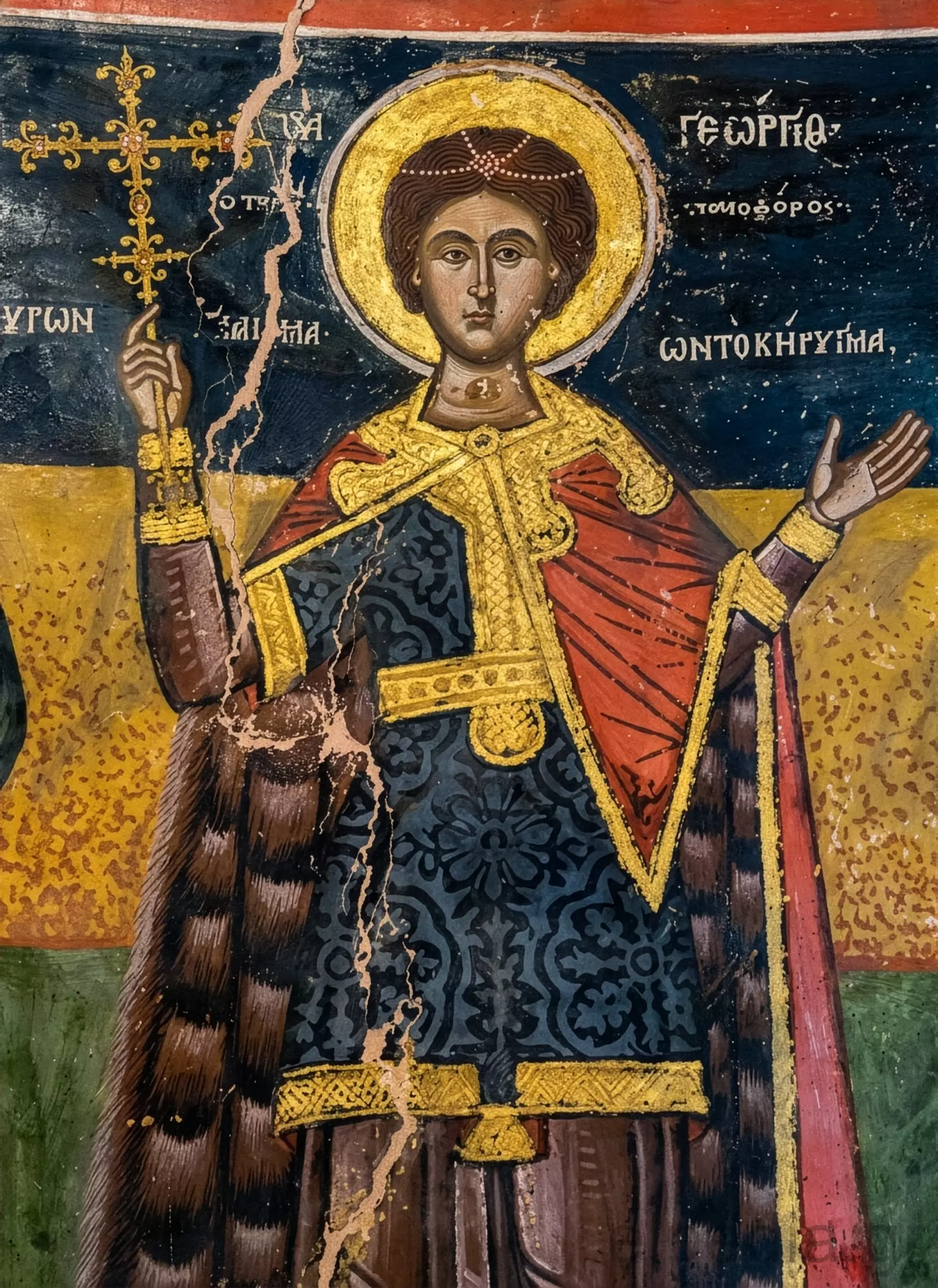
The inscription GEORGE, incised in white capitals beside the golden halo, identifies beyond doubt the figure examined here: a young military saint, painted frontally, with one hand raised in a gesture of speech and the other holding a small cross-bearing staff of authority. An anonymous painter, probably a member of one of the mountain workshops active in the seventeenth century between Thessaly and Epirus, gave him a face that is rugged, almost austere in its rendering, far from the sweetness that the more academic hagiography would later adopt. In the surviving portion of the composition may be discerned the face, the two hands, part of the richly embroidered garment, and traces of a second inscription, which appears to attribute to the saint the title of trophy-bearer, a title common in the Byzantine and post-Byzantine iconography of the military saints. On a rock rising 1,400 metres above the village of Karitsa, founded in the late fifteenth century and completed in 1529 by the neo-martyr Damian, stands the Holy Monastery of Panagia Pelekiti, two churches of which were frescoed in the seventeenth century, one dedicated to the Ascension of the Saviour in 1654 and the other to Panagia Phaneromeni in 1666, while it is in one of these that the fresco studied here is set. The precipitous landscape of the Agrafa allowed this fresco tradition to remain relatively untouched by later interventions, something that renders every detail of it a precious testimony to a technique and a style rare elsewhere.
The Iconography of Saint George the Trophy-Bearer in the Fresco
With the red cloak cast over the right shoulder and fastened at the breast with a golden clasp, the saint stands in a strictly frontal posture, as tradition demanded for figures that do not narrate a scene but present themselves before the beholder. The inner garment, deep blue with dense floral ornament in a lighter tone, reaches to the knees and is fastened at the waist with a golden, adorned belt, while about the neck spreads a gold-embroidered collar that recalls the courtly uniforms of the imperial guard. In the left hand, covered to the wrist by the fur lining of the mantle, the saint holds a slender staff ending in a cross. The right, with the fingers open, is raised in a gesture that combines blessing with the rhetorical emphasis inherited from the ancient models of the learned man.
The Trophy-Bearer Type and Its Origin
This type, standing and courtly in dress, differs significantly from the pictorial type, more popular in the popular consciousness, of the mounted dragon-slayer. In Byzantine art George was honoured primarily as trophy-bearer, that is, as bearer of the trophy, of the victory over evil, and only later did the popular narrative of the dragon prevail to such an extent as to overshadow the older, more hieratic image of the warrior saint in an attitude of prayer. The choice of this particular, static type by the painter of Pelekiti shows an adherence to older models, perhaps of Cretan or Constantinopolitan origin, which were channelled into the mountain workshops of mainland Greece through copies and drawings that circulated among the hagiographers.
The Background, the Cross, and the Technique of the Fresco
The field behind the figure is deep blue, almost black in its shadows, a choice that Byzantine painters preferred early on in order to signify the abstract depth behind their saints, before the golden field became more widely established in imitation of mosaic. In the upper left part of the composition may be discerned a cross with ends in the shape of a lily, rendered in gold: perhaps a reminder of some venerated relic, perhaps simply a symbol of the victory embodied by the trophy-bearing saint. The inscriptions, written in white capital letters on either side of the halo, follow the customary scheme for the identification of sacred figures in monumental painting, where the name functioned simultaneously as identity and as invocation, addressed to whoever raised his gaze towards the wall. Technically, the surface betrays the customary practice of the mountain workshops: true fresco for the large fields of colour, with dry-technique interventions for the fine lines of the eyes, the letters, and the ornaments, once the plaster had already dried. The earthy colours, mixed with lime-water, bonded over time into a single crust with the wall, while the gold of the halo and the ornaments was probably applied in thin leaf upon a prepared, adhesive surface. The cracks that run today through the plaster are not mere deterioration. They too record, in their own way, the succession of the working days of the hagiographer.
The Detail of the Face: The Saint’s Gaze
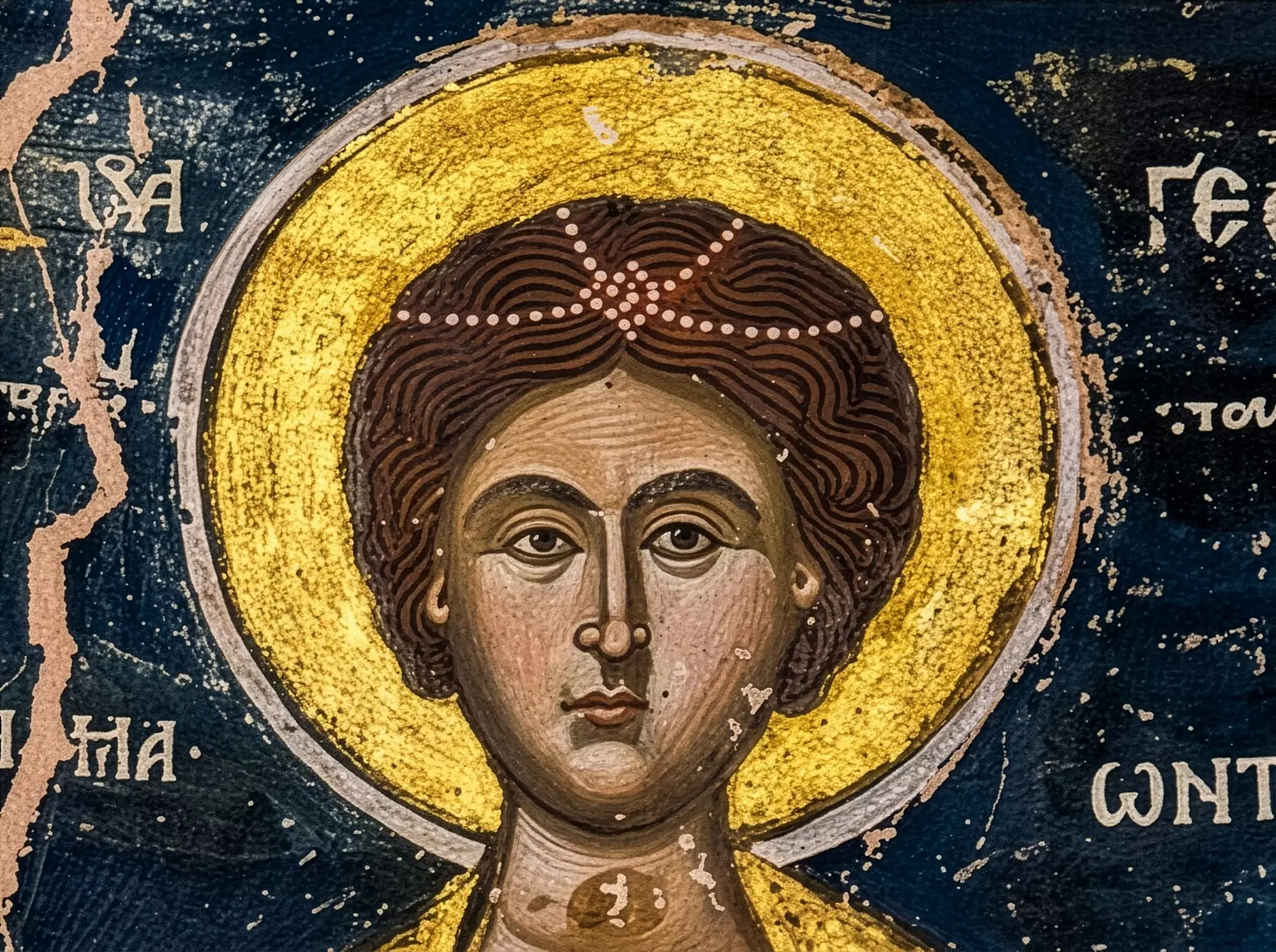
In the face, which constitutes the most damaged yet also the most eloquent part of the composition, the hair is rendered in dense, wavy lines of dark brown, bound at the forehead with a fillet of white, round beads forming a criss-cross motif, an indication of youth and perhaps of social standing. The eyebrows, arched and pronounced, frame large almond-shaped eyes with heavy lids, painted with the familiar technique of successive, ever brighter layers over a dark-toned underpainting. The nose, long and almost straight, ends in a rounded tip, while the mouth, small and tightly closed, betrays no trace of emotion. This severity in the gaze accords with the general style of the painters of the monastery, known for the rugged, almost austere expression that they gave their saints, far from any trace of saccharine sentimentality. The cheeks, lightly reddened with a red pigment over the ochre of the underpainting, animate a face that, despite the ravages of time and the cracks in the plaster, preserves intact the intensity of the gaze.
This fresco does not constitute an isolated find, but a part of a wider wave of hagiography that flourished in mainland Greece in the seventeenth century, when workshops of painters, heirs to the Cretan and the north-Greek tradition, continued to decorate katholika and side-chapels in inaccessible monasteries, far from the great urban centres. At Pelekiti the remoteness of the location proved no obstacle; it proved, rather, a condition of preservation. The fresco of George, with its broken colours and the cracks in the plaster, conveys down to our own days a style that elsewhere has been lost amid later overlays and renovations.
(Translated from the Greek original; translation by K. Pappas.)

