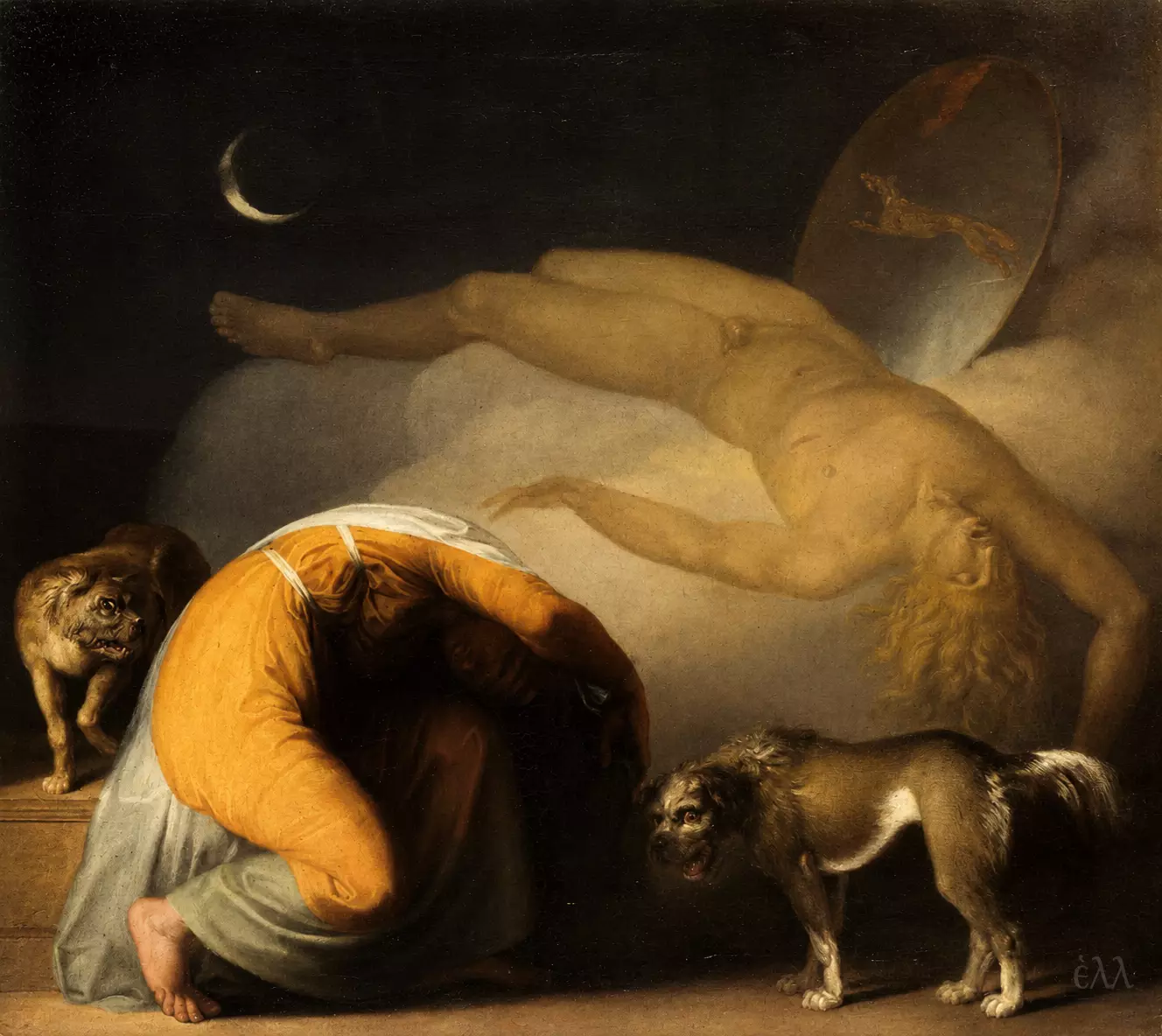
 Nicolai Abildgaard depicts Culmin’s ghost hovering above his bowed mother, while two dogs react to what she does not see.
Bowed over herself, her face lost beneath the folds of a white veil, a female figure wrapped in dense cloth of deep ocher collapses to the ground, her hands clenched into one another, her bare feet jutting out beneath the gray-blue dress. Higher and farther back, amid thick clouds lit by a crescent moon, a youthful nude body stretches horizontally in the air, arms open at the sides, the head tipped back, long hair streaming in a wind that elsewhere in the composition touches nothing.
This scene was painted around 1794 by the Danish Nicolai Abildgaard, who gave it the title The Ghost of Culmin Appears to His Mother: a medium-sized canvas, sixty-two by seventy-eight centimeters, executed in oil on canvas, now held in the Nationalmuseum in Stockholm. The subject comes from the Ossianic cycle, that is, the lays which the Scotsman James Macpherson presented in the 1760s as translations of ancient Gaelic poems, a claim already sharply disputed by contemporaries such as Samuel Johnson, though this did not prevent the text from captivating painters, poets, and composers across Europe for decades. Abildgaard was among the first to turn systematically to this material, composing an entire series of works inspired by Ossian’s verses, among them the heroes of Fingal and Temora.
Culmin’s ghost in Abildgaard’s painting
At the edge of the darkness, where the moon is barely traced as a thin line of light, the body of the dead youth is illuminated by a source that no lamp or torch within the composition can account for, as if the ghost itself were producing the light that makes it visible. To the right, half hidden in the haze, one can make out a round, shield-like mass with a relief of a winged figure, a possible reminder of the martial glory the youth had not been allowed to enjoy in full. Abildgaard’s painting here does not seek detailed narration. It prefers suggestion, the half-lit, the semi-transparent, building atmosphere with brushstrokes that dissolve into one another rather than being clearly bounded.
The mother, the dogs, and the ungraspable
Low on the ground, the female figure remains hunched in upon herself, almost in an embryonic posture, without turning her gaze toward the son floating above her. Her inability to perceive what the viewer sees clearly gives the scene an intensity that no cry could render more effectively. Two dogs frame the composition. One, calm, stands at a distance and watches. The other, mouth open and fur raised, barks toward something the viewer cannot see, perhaps precisely toward the shadow of the dead man. The contrast between the two animals, one untroubled and the other agitated, suggests that something beyond human grasp passes imperceptibly through the scene, something that only animals, with the primal acuity of their senses, may perhaps be able to divine.
The Ossianic myth and the life of Nicolai Abildgaard
The legend behind the painting is found in the fifth book of Temora, where the young Culmin, son of Coul-alin, rushes headlong against Rothmar and is killed, while his mother remains in the manor, her gaze fixed on the stream of Strutha, as a whirlwind swirls around the spirit of her child. Abildgaard does not illustrate the verses literally. He imagines them, translates them into visual language, gives them body and shadow. Born in Copenhagen in 1743, he studied at the Academy there before moving to Rome in 1772, where his contact with the Swedish sculptor Johan Tobias Sergel and the painter Henry Fuseli gradually drew him away from the academic classicism of his youth. Homer, Shakespeare, and the supposedly ancient Ossian led him toward a visual language that placed him among the pioneers of Scandinavian pre-Romanticism. He served as director of the Copenhagen Academy from 1789 to 1791, taught, designed furniture and buildings, and died at Frederiksdal in 1809.


