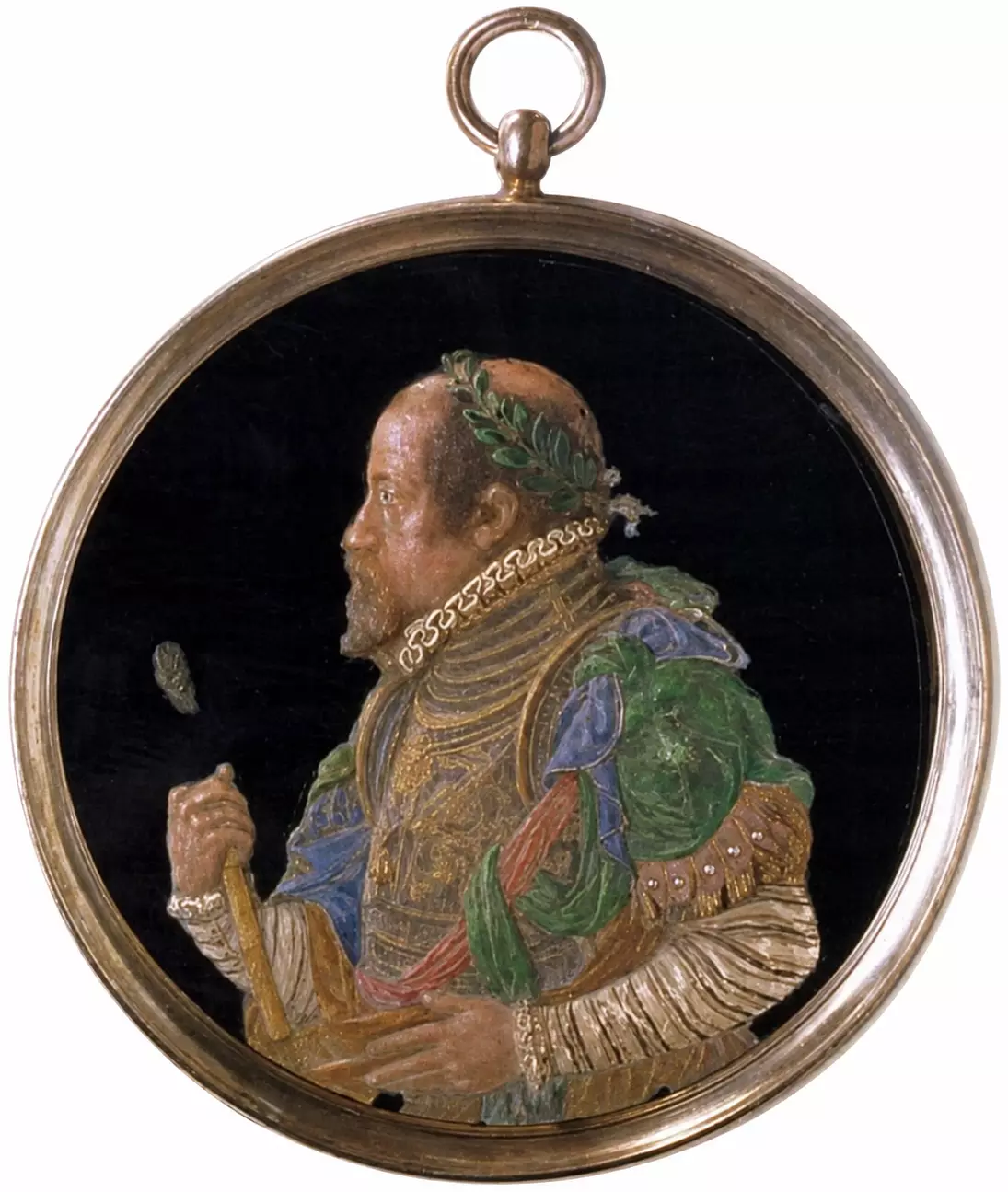
A wax relief portrait of the Habsburg emperor Maximilian II, made around 1575 by the Italian medallist Antonio Abondio, is now kept in the Kunsthistorisches Museum in Vienna; it is worked on an obsidian disc with a silver and pearl frame. The artist, born in Riva del Garda in 1538 and died in Vienna in 1591, was a pioneer of polychrome wax portraiture at the Habsburg court, where he served Maximilian II and later his successor, Rudolf II.
This small object, probably made in Innsbruck, condenses court art’s ambition to immortalize the features of a ruler with the accuracy of a painter and the material presence of a sculptor. The emperor is shown in a strict profile view, as the tradition of ancient coinage required, with a laurel wreath on his head and a marshal’s baton in his right hand.
The art behind the Maximilian medallion
Against the black ground of the obsidian, the wax acquires the plasticity of oil paint, rendering every fold of the face with almost painterly subtlety, from the sparse beard to the wrinkles around the eyes. The cuirass, engraved with gold arabesques, recalls the armor of Roman generals, while around the neck there spreads a high, pleated collar and a gold chain, signs of rank.
On the shoulder, a bulky green sleeve with gold stripes contrasts with the blue fabric falling freely, as a red sash crosses the chest diagonally, an allusion to military honor, while the left hand, half concealed, rests low on the cuirass. On the reverse of the medal, the inscription VICTORIA DACICA is engraved, an echo of the court’s military ambitions against the Ottomans.
An inheritance of Roman numismatic portraiture, this technique, in Abondio’s hands, became a highly refined micro-sculptural art, portable and precious, made to be worn or given as a gift among rulers.


