In the sanctuary of the katholikon of the Monastery of the Holy Forty Martyrs at Chrysafa in Laconia, the Communion of the Apostles forms part of the exceptionally extensive wall-painting programme executed by Georgios Moschos of Nafplio in 1620. The scene belongs to a church whose construction had begun several years earlier and whose painted decoration, according to the dedicatory inscription, was entrusted to Moschos by the monastery’s community. The painter, when he identifies himself in that inscription, calls himself the “humblest painter Georgios Moschos from the city of Nafplio”; elsewhere his documented activity extends from the first decade of the seventeenth century until at least 1638. A recent Dimitriou thesis examines the katholikon as the principal signed monument through which Moschos’s artistic personality and his position in seventeenth-century Post-Byzantine painting can be assessed.
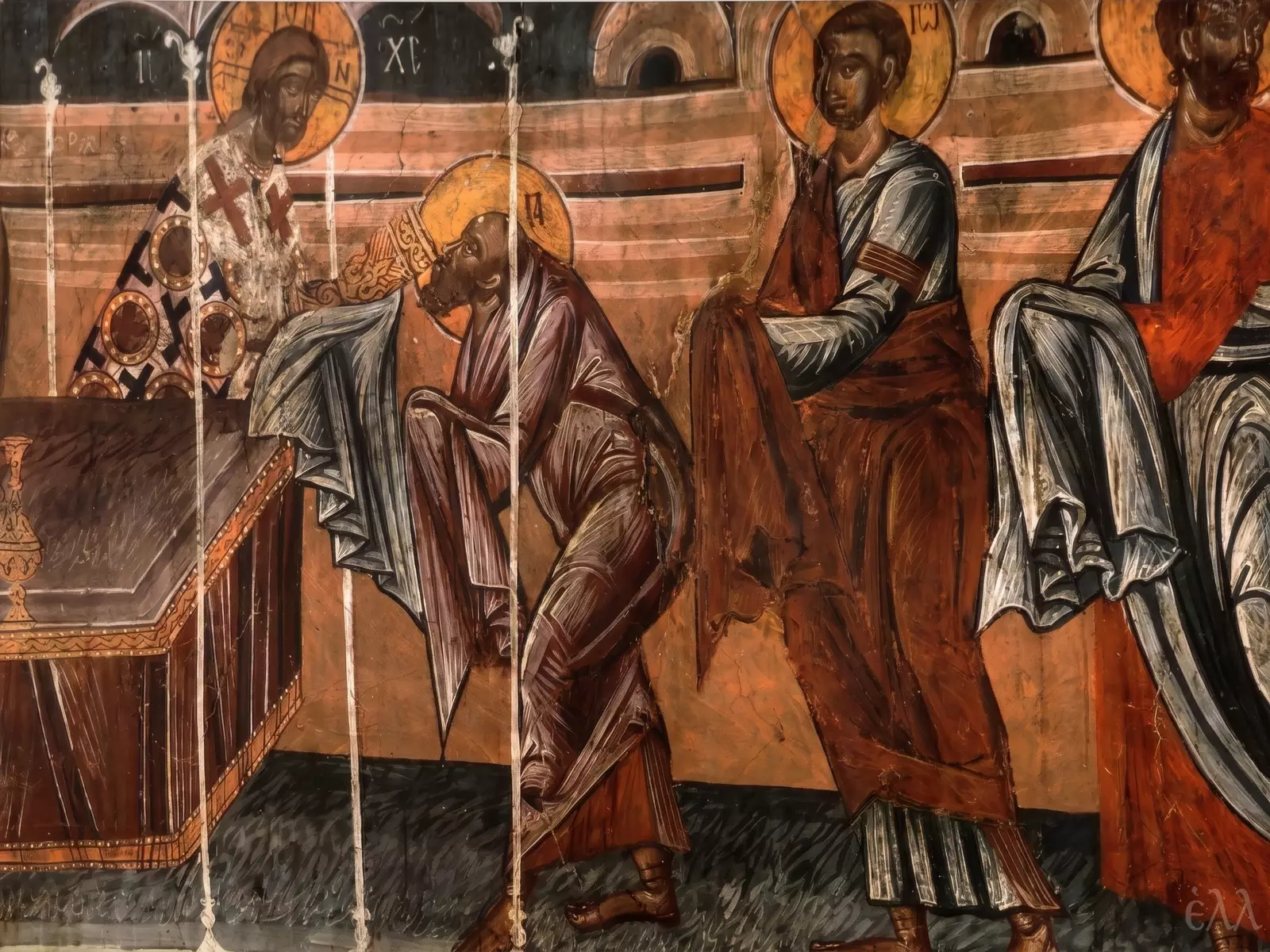
Within this dense sanctuary decoration, the Communion occupies a particularly charged position. It is painted immediately below the Heavenly Liturgy, establishing a vertical sequence of Eucharistic subjects, while its pictorial language remains emphatically earthly in certain details: vestments, liturgical vessels, the Holy Table, gestures of approach. The surviving detail concentrates upon one side of the larger composition. Christ, marked by the cross-inscribed halo and dressed in elaborate episcopal vestments, administers Communion to the deeply inclined Apostle Peter. Behind Peter the remaining apostles advance in a closely compressed line, their haloes, shoulders and folded garments creating an almost uninterrupted sequence across the reddish architectural background.
Communion of the Apostles fresco in the sanctuary
Christ as High Priest and the double Eucharistic action
The complete composition, according to the documentation of the monastery, presents Christ twice behind the Holy Table and beneath two ciboria. The duplication has a narrative purpose. One figure distributes the consecrated bread, the Body of Christ, to Peter at the head of one apostolic procession; the other presents the chalice, containing the Blood, to Paul at the head of the opposite group. Between the two manifestations of Christ rises a great seraph holding two liturgical fans, while the Holy Table carries a paten with portions of bread, a Gospel book and a vessel associated with the zeon. The inscription incorporates the Eucharistic words “Take, eat” and “Drink of it, all of you” (Matthew 26:26–27).
Such duplication does not imply two separate figures of Christ in a theological sense. A single sacred action is unfolded into successive pictorial moments. Byzantine and Post-Byzantine narrative frequently allowed the same person to appear more than once within a unified field when distinct phases of an event had to be made simultaneously intelligible. In the Communion of the Apostles this device acquires unusual clarity: bread and wine, Peter and Paul, the two advancing groups. The altar remains their fixed centre.
Only one half of this structure dominates the surviving detail. Christ stands firmly upright at the left, his vertical bearing sharply opposed to Peter’s almost folded body. Peter approaches with his head raised at the final moment, his torso bent into a pronounced diagonal beneath the horizontal line of the architecture. From unlike directions, from the stability of Christ and the forward inclination of Peter, Moschos constructs the encounter.
Colour reinforces the distinction. Christ’s pale episcopal garment is covered by a dense pattern of dark geometric forms and circular red-gold ornaments, creating the richest local surface in this part of the painting. Peter’s mantle, blue-grey with greenish inflections, falls in long angular folds edged by pale highlights. Behind him, a darker red-brown mantle encloses the next apostle; farther along, cool blue-white fabric cuts through the large field of deep red worn by a younger, dark-haired figure. Warm ochres, brick reds, black, grey-blue, thin almost metallic-looking highlights: these hold the group together without reducing its internal differences.
Apostles, movement and compressed pictorial space
Space is narrow. Moschos does not attempt to open a deep architectural interior behind the apostles. Their bodies overlap, haloes approach one another, and the red-brown structure in the background presses the procession towards the foreground. This compression turns the group into a single moving body while still permitting differences of age, physiognomy, posture and colour.
Peter provides the greatest interruption. His movement is abrupt, almost angular; behind him the next apostle inclines more gently, while the subsequent figure is nearly upright. The sequence gradually straightens. Seen across the composition, body, halo, body, halo become elements of a measured visual rhythm. Very little empty space remains.
Moschos gives particular weight to drapery. The garments do not soften the underlying anatomy through broad tonal passages; rather, they divide it through line and sharply differentiated planes. Thin light strokes follow ridges of cloth, darker zones separate one fold from another, abrupt changes of direction structure knees, arms and shoulders. On the younger apostle farther to the right, the cool highlights crossing the tunic are especially forceful; on the partially preserved figure at the extreme edge, pale folds descend in long broken bands against orange-red cloth. Much of the modelling is carried by line.
The faces behave differently. Brown and olive flesh tones are built against darker shadows, with small highlights defining forehead, nose and cheek. Eyes are large and attentive. Among the apostles Moschos avoids a uniform response: one bends almost completely towards the sacramental act, another watches from immediately behind, another remains more self-contained. Modest distinctions, but enough to prevent the procession from becoming decorative repetition.
The source describing the entire composition records identifying letters on the apostolic haloes. At the termination of the sequence Judas Iscariot is shown leaving while carrying the portion of bread he has received, recalling the Gospel account of his departure after receiving the morsel (John 13:26–30). That departure introduces a narrative fracture into an otherwise ordered procession. The Eucharistic assembly remains visually complete, though one participant already moves away from it.
Georgios Moschos and seventeenth-century Post-Byzantine painting
Moschos’s wall painting belongs to a moment when the Byzantine artistic inheritance remained active through established iconographic types while painters continued to adjust them to new monuments, patrons and intellectual circumstances. His origins in Nafplio are important. Georgios and his brother Dimitrios Moschos worked across the Peloponnese and the Ionian sphere, and Georgios is documented at monuments including the church of Saint Nicholas near Chrysafa, the Holy Apostles at Sarantapicho and the Monastery of Saint Nicholas at Karya. The Holy Forty Martyrs, however, offers an unusually large signed ensemble through which his treatment of narrative, liturgical themes and monumental space can be followed.
The monastery itself appears to have encouraged an unusually ambitious programme. The learned bishop Parthenios of Vresthena, closely associated with the community, has been proposed as an important intellectual presence in its formulation. His knowledge of scriptural and liturgical texts may have contributed to the selection and placement of subjects. The suggestion remains a scholarly reconstruction, yet it corresponds well with the extraordinary density of Eucharistic, Christological, Marian and hagiographical imagery covering the church.
Among the unusual features of the wider sanctuary decoration is Moschos’s interest in making ecclesiastical architecture itself part of the represented world. In the Divine Liturgy above the Communion, the painted continuation of the templon has been compared with rare examples associated with Georgios Klontzas and with other Cretan-connected monuments. Painted sanctuary, actual sanctuary, ritual object, represented ritual: the device brings these fields deliberately close and gives the sacred action an unusual architectural immediacy.
Connections with Klontzas have also encouraged discussion of the broader confessional climate in which these works were produced, particularly contemporary arguments surrounding Eucharistic doctrine. The Chrysafa paintings nevertheless resist reduction to a single polemical purpose. Moschos knew an inherited visual language, enlarged it, localised it, and sometimes made it surprisingly concrete.
Eucharistic iconography and historical meaning
The Communion of the Apostles had a long history before Moschos. Its presence within sanctuary decoration was well established in Byzantine monumental painting, although individual details—the number and position of Christ’s figures, episcopal vestments, the vessels upon the altar, the disposition of the apostles—changed across periods and monuments.
The relationship between the represented event and actual liturgy requires some care. Older interpretations often treated the scene almost as a visual equivalent of the Eucharistic rite celebrated before it. More recent scholarship has complicated that reading. In his Marinis study, Vasileios Marinis argues that the Byzantine subject should be understood primarily in relation to the historical institution of the Eucharist, cautioning against seeing it simply as a pictorial transcription of contemporary ceremonial practice. Christ’s later representation in patriarchal or high-priestly vestments introduces further ecclesiological associations without turning the painting into a straightforward record of ritual.
At Chrysafa, however, physical location remains impossible to ignore. The scene lies inside the sanctuary, directly beneath another liturgical composition and close to the Holy Table before which the Eucharist was actually celebrated. Spatial before interpretative, the correspondence is immediate. Moschos intensifies it through recognisable vessels, vestments and gestures, then shifts the event away from ordinary time through the doubled Christ, the seraphic presence, the gold-orange haloes and the rigid ordering of the apostles.
Surface wear has left cracks, abrasions and small interruptions in the paint, yet the principal relationships remain clearly legible. Most striking is still the encounter at the left: Christ erect in vestments patterned and ceremonial; Peter bent almost double; behind him, the waiting figures. Authority, approach, reception. Within the elaborate seventeenth-century programme of the Holy Forty Martyrs, the Communion of the Apostles becomes a carefully structured convergence of inherited Byzantine iconography, Post-Byzantine pictorial language and the particular liturgical environment for which Georgios Moschos painted it.
(The translation was edited by K. Pappas.)