The very first sentence of the work contains two words that were later to give their name to an entire discipline: ἱστορίης ἀπόδεξις. For Herodotus, ἱστορίη meant inquiry, that is, knowledge acquired by asking questions, by travelling and by comparing testimony. Ἀπόδεξις was the public presentation of its findings. His purpose, as he himself states it, was that the deeds of men should not fade with time and that the great and marvellous achievements of Greeks and barbarians should not go without renown. Above all, he wanted to make clear the cause for which they went to war with one another.
It was Cicero who called him the father of history. In the same sentence, however, he observed that the work is full of countless fables. That double verdict has accompanied Herodotus for two thousand years.
From Halicarnassus to Thurii
Little is known about his life with any certainty. Most of what we have comes from later sources, some of them very much later, such as the Byzantine lexicon known as the Suda, compiled in the 10th century. He was born at Halicarnassus in Caria, modern Bodrum, c. 484 BC. The date rests on ancient calculations and should not be taken as exact. Dorian by foundation, the city nevertheless had a strong Ionian element. At the time it was ruled by local tyrants who were subjects of the Persian king. From the same house came Artemisia, who followed Xerxes to Salamis with her ships. Herodotus devotes pages to her, and not without admiration.
His family belonged to the city’s aristocracy, and tradition has it that the epic poet Panyassis was a relative. As a young man Herodotus took part in an attempt to overthrow the tyrant Lygdamis, and for that reason he fled to Samos. He returned after the tyrant’s fall, some time before 454 BC. Then came the great journeys, or at least those he himself allows us to infer. When these travels took place, and how far they really extended, remain open questions.
In the mid-440s BC we find him in Athens. There, according to ancient testimony, he gave public readings of his work. Plutarch speaks of a friendship with Sophocles. Reports of honours and payments of money from the city are treated with caution by modern scholars. A profound influence of Pericles on him was once regarded as certain, but the picture today is more measured. He was neither a fervent admirer of Pericles nor a mere apologist for Athens.
He was later associated with Thurii, the colony founded on Athenian initiative on the Gulf of Tarentum in 444/3 BC. Whether he was among the first settlers we do not know. The connection was in any case so close that Aristotle quotes the opening of the work as that of ‘Ἡροδότου Θουρίου’ and not of a Halicarnassian. According to some ancient sources, he died and was buried there. No source says when. The work alludes to events of the early years of the Peloponnesian War, which is why the publication of the Histories is usually placed between 430 and 424 BC.
The architecture of the Histories
The Histories survive in nine books. The division was made by the philologists of the Hellenistic age, and the names of the Muses that each book bears were likewise added later. Written in the Ionic dialect, the work opens with Croesus, king of Lydia. His overthrow by Cyrus clears the way for Persian expansion, which forms the backbone of the narrative. Whenever the Persians reach a new people, Herodotus pauses to describe it: its land, its customs, its gods and whatever marvels he encountered or heard of. So it is that the second book is given over almost entirely to Egypt, prompted by the campaign of Cambyses. The fourth deals with the Scythians, occasioned by the expedition of Darius beyond the Danube.
These digressions, the logoi as they are called, have at times troubled readers looking for a straightforward narrative. They are not arbitrary, however. They follow the geography of the Persian conquests. From the Ionian Revolt of 499 BC onwards the pace quickens: Marathon, the expedition of Xerxes, Thermopylae, Artemisium, Salamis, Plataea, Mycale. The invasion of Xerxes takes up almost a third of the work. The Histories end shortly after the battles of 479 BC, with the capture of Sestos on the Hellespont.
‘I must report what is said’
Herodotus never set out his method systematically. It has to be pieced together from scattered remarks. In the second book he distinguishes three paths to knowledge. The first is sight (ὄψις), what he saw with his own eyes. The second is judgement (γνώμη), his own personal assessment. The third is inquiry (ἱστορίη), research carried out by asking questions. His sources are for the most part oral: priests, officials, descendants of those who had fought, inhabitants of the places he describes. Hecataeus of Miletus, his most important predecessor, he names as a source only twice. Yet he certainly drew on him more often than he admits.
He frequently gives more than one version of the same event and leaves the reader to judge. In the seventh book he examines the attitude of Argos towards the Persians, and there he formulates a principle that could stand as the motto of the entire work: ‘ἐγὼ δὲ ὀφείλω λέγειν τὰ λεγόμενα, πείθεσθαί γε μὲν οὐ παντάπασιν ὀφείλω’. He is bound, in other words, to record what is said, but not to believe all of it.
His view of the world retains many archaic features: divine punishment of arrogance, oracles that are fulfilled, dreams that give warning. Alongside them, though, sits a rationalist curiosity. Herodotus compares the customs of different peoples, questions explanations that strike him as naive and inquires persistently into the sources of the Nile.
Father of history or teller of tales?
The first challenge came from the historian of the very next generation. Thucydides, without naming him, corrected errors found in the Histories, such as the supposed double vote of the Spartan kings. He also remarked on how little effort most people put into finding the truth: ‘οὕτως ἀταλαίπωρος τοῖς πολλοῖς ἡ ζήτησις τῆς ἀληθείας’. Most scholars read the barb as directed at his predecessor.
Harsher still, more than five hundred years later, was Plutarch. In his treatise On the Malice of Herodotus he accused him of partiality and bad faith and called him a lover of barbarians. Plutarch was a Boeotian, from Chaeronea. He could not forgive the way the Histories had dealt with the medism of Thebes, that is, the Thebans’ collaboration with the Persians. Local patriotism, it must be said, was never absent from ancient criticism.
Modern scholarship has oscillated between two extremes. In 1913 the German philologist Felix Jacoby took the references to informants literally. He saw Herodotus as an eyewitness who had travelled from the Euxine to Egypt and Babylon. Detlev Fehling argued, on the contrary, that the citations of sources are to a large extent a literary device. Other scholars prefer to read them as indications of where the historian believed the information could be found.
There are, all the same, points at which the narrative can be tested against independent evidence, and it holds up. According to Herodotus, six Persian nobles conspired together with Darius to overthrow the usurper, the Magus. Five of the six names coincide with those that Darius himself had carved in the trilingual inscription at Behistun. Behistun, of course, is the official version of the victor, and that should not be overlooked.
The portraits of a historian
No portrait of Herodotus survives from his lifetime. All the heads that bear his name are copies from the Roman period. The bust in the Metropolitan Museum of Art in New York, for instance, was found shortly before 1891 at Benha in Lower Egypt, ancient Athribis. It dates from the 2nd century AD and is considered one of many copies of a bronze statue, most probably of the first half of the 4th century BC.
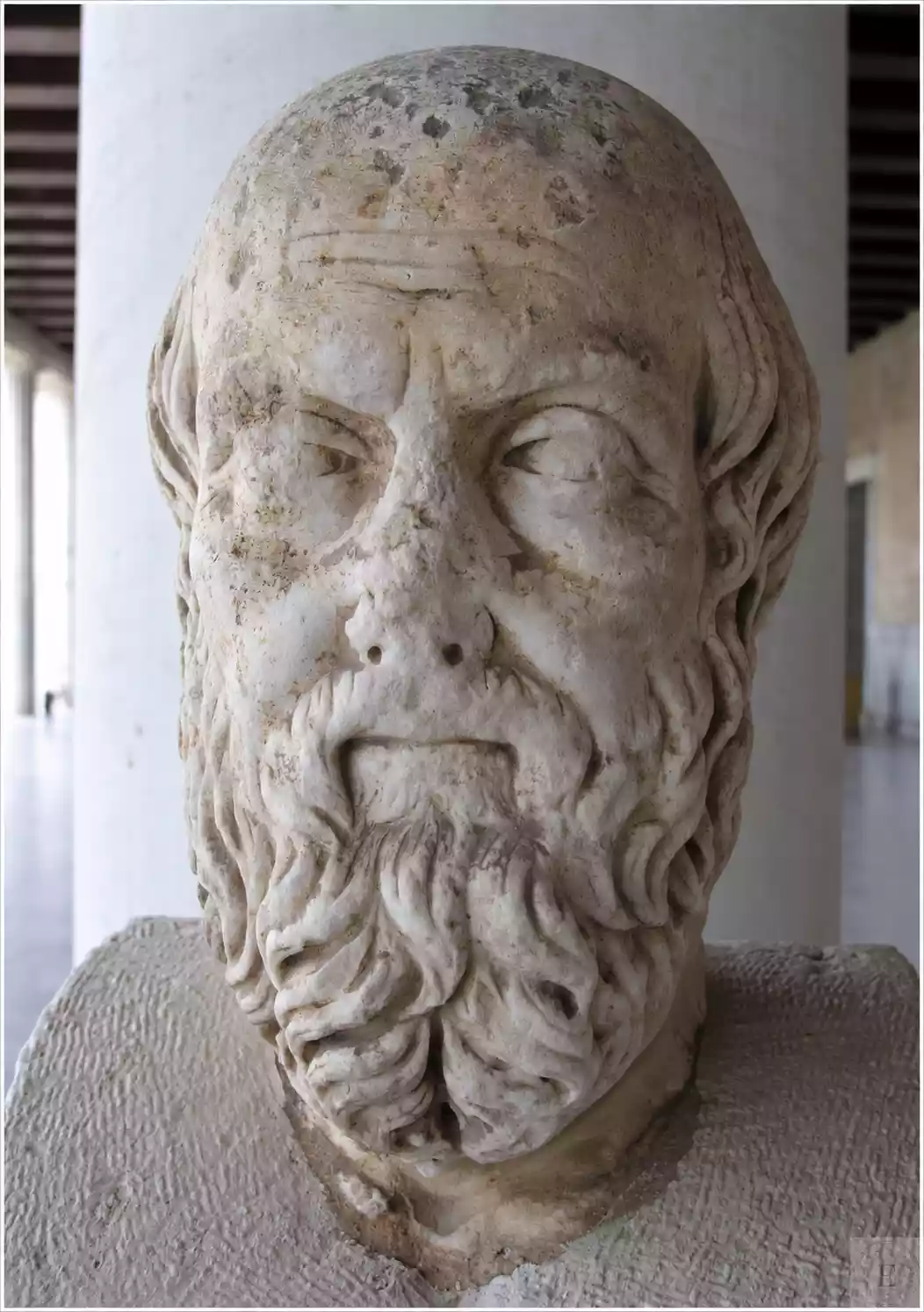 Marble head attributed to Herodotus, Roman copy of the 2nd century AD, Museum of the Ancient Agora, Stoa of Attalos, Athens.
In Athens, the Museum of the Ancient Agora, housed in the Stoa of Attalos, displays the head of a bearded man in Pentelic marble, found in 1933. The man is bald, with hair that falls at the sides and almost covers the ears. His beard is parted in the middle, and the nose has been lost. In the excavation records the head is listed as a Roman work of the 2nd century AD, and its identification as Herodotus is accompanied by a question mark.
In Naples, on a double herm in the National Archaeological Museum, his head stands back to back with that of Thucydides, the man who had corrected him so coldly.


