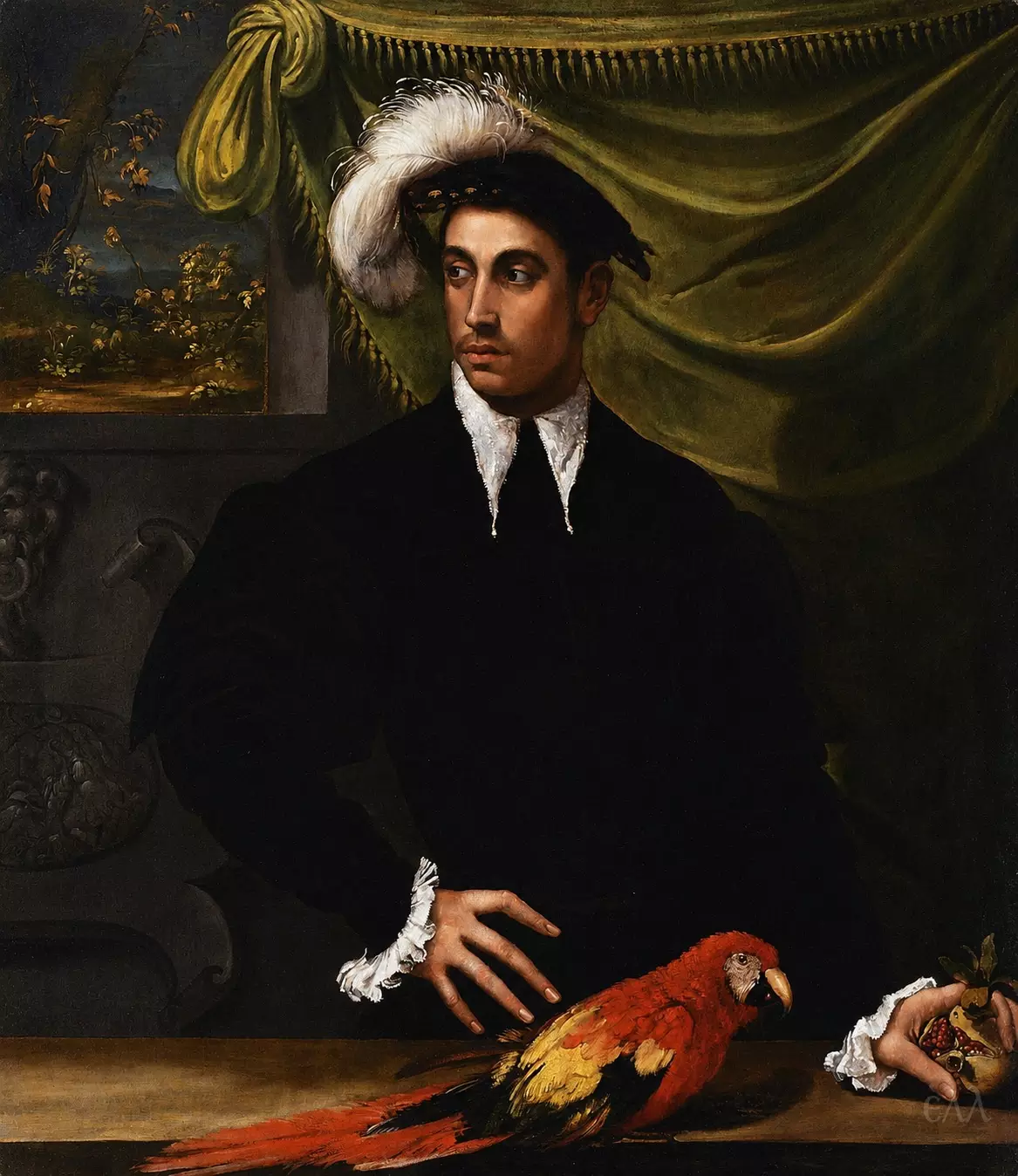
The name of Niccolò dell’Abate is usually associated with the large frescoes and mythological landscapes that he painted in the region of Modena and Bologna, before departing for the French court at Fontainebleau. Around 1540, however, the artist also produced a portrait of a very different character: a young man with dark hair and an intense gaze, standing behind a wooden counter upon which rests a red parrot with outspread wings. It is an oil painting on canvas measuring 125 by 109 centimetres, known as Man with a Parrot, which is now housed in the Kunsthistorisches Museum in Vienna, in the museum’s Picture Gallery, where it is recorded as part of the old museum holdings, with an additional entry in the inventory of 1890.
Young, with dark hair and intense, almost severe features, the man wears a black garment with a white lace collar, divided into two pointed ends that terminate in small decorative tips. On his head can be seen a dark hat, adorned with a large white feather that rises dramatically above his forehead. Behind him extends a heavy green curtain with golden tassels, tied in a knot at the left edge of the composition, a scenic element frequently encountered in Venetian and Emilian portraiture of the period. Further beyond, through a small opening, a landscape can be glimpsed, a breath of nature entering discreetly into the enclosed, almost theatrical environment of the room.
The Composition of the Portrait of a Man with a Parrot: the Young Man, the Bird and the Pomegranate
The right hand of the figure remains at the centre of the composition, the fingers open and resting lightly above the body of the parrot, as though he had just released it or were preparing to touch it again; it is difficult to say with certainty which of the two. The left hand, extending towards the edge of the counter and partly cut off by the frame of the canvas, holds a pomegranate among other ripe fruits. In the iconography of the period, such exotic fruits and birds did not constitute mere decoration, since they usually referred to wealth, access to merchandise arriving from distant ports, and sometimes also to suggestions of marriage or abundance. The parrot, a rare and expensive bird at the time, often functioned as an indicator of social position as much as an object of pleasure, which perhaps explains why the painter placed it so close to the sitter’s hand, almost as his interlocutor.
The Feathered Hat in the Portrait of a Man with a Parrot: a Detail of Style and Renaissance Fashion
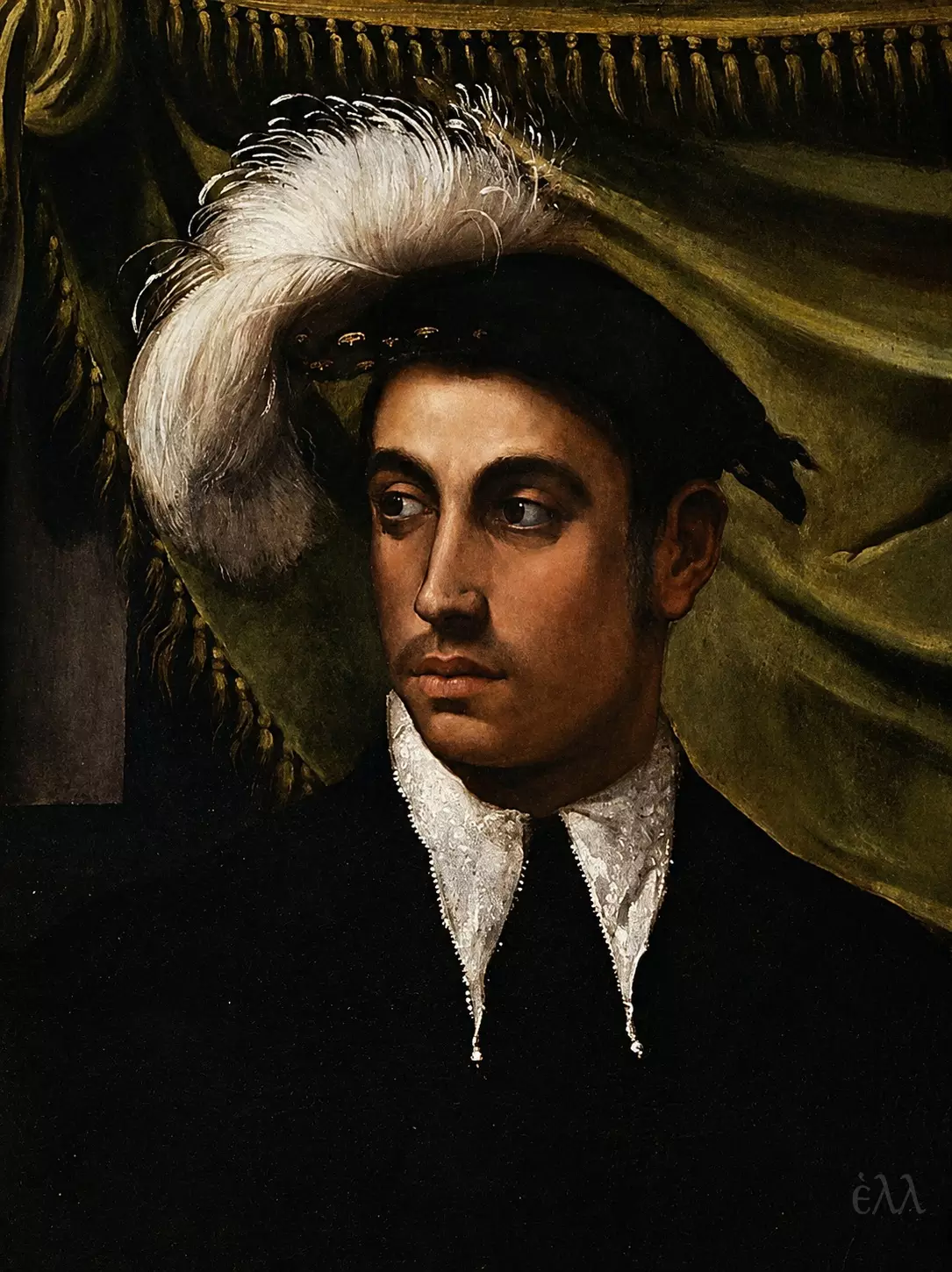
On approaching the face, the eye distinguishes a metallic band at the base of the feather, probably decorated with small inlays, which holds the rich white plumage upon the dark hat. The face, turned obliquely towards the right and with a gaze that appears to disregard the viewer, is rendered with restrained touches of light upon the cheeks and forehead, while the shadow beneath the chin gives volume without resorting to excessive contrasts. The collar, with its two pointed ends, bears at its extremities small white knots resembling pearls, a detail of dress treated with particular care for the period. The solidity of the drawing, combined with the psychological intensity of the expression, is regarded by several scholars as a characteristic of the portraiture of Niccolò dell’Abate, who appears to have sought something more than faithful likeness in the faces he painted.
The influence of Correggio and Parmigianino, with whose work dell’Abate became acquainted during his years in Bologna, is visible here not so much in the colour as in the plasticity of the face and the gentle transition from light to shadow. It is a form of portrait art that borrows elements from the great Venetian tradition, without losing its own Emilian character, more restrained, more inward-looking in its rendering of personality.
(Translated from the Greek text by K. Pappas.)


