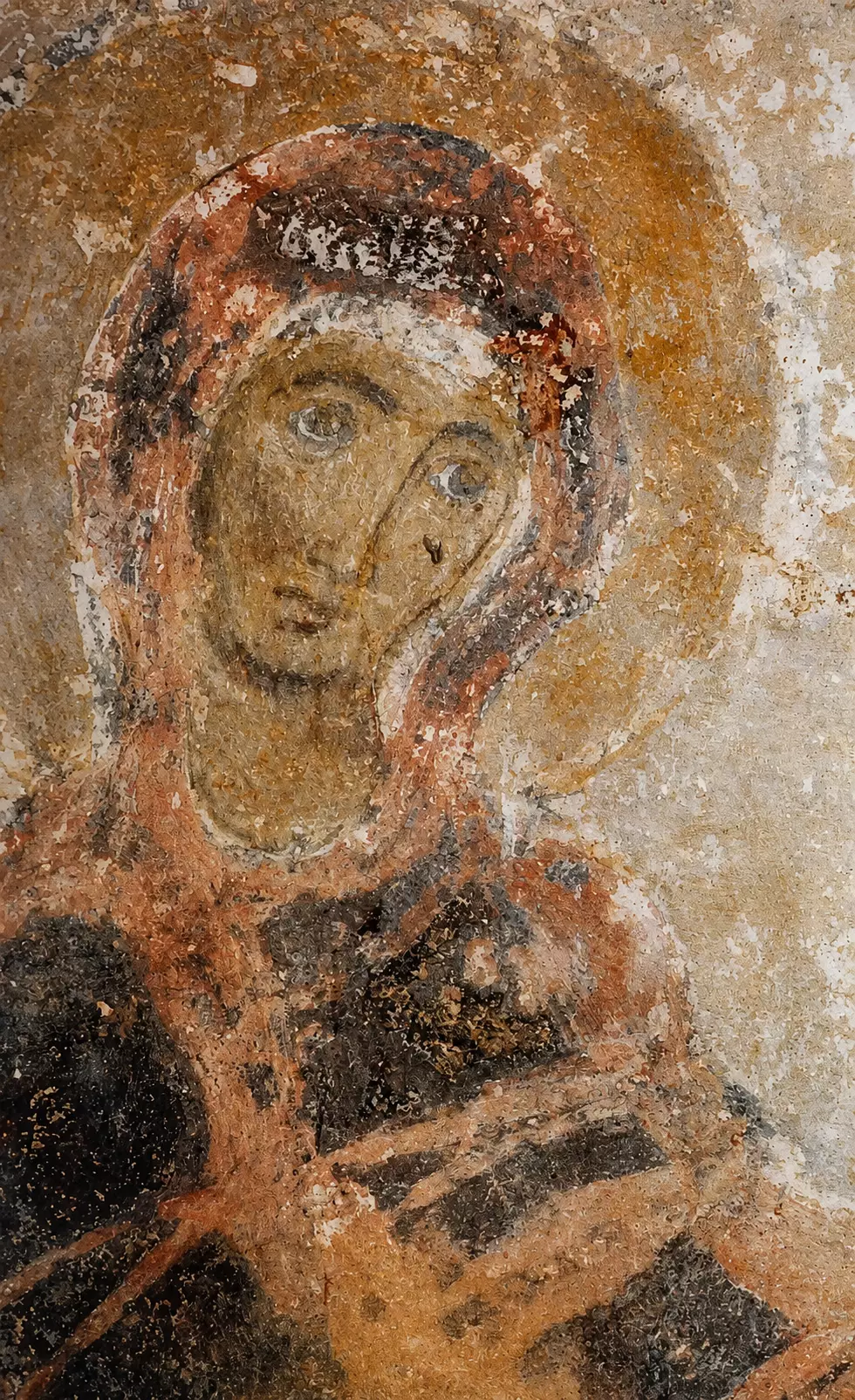
In the northern apse of a small Byzantine church in Naxos survives, blurred by time but still distinct in its main features, one of the oldest known depictions of the Virgin Mary within a Deesis composition, dating back to the 7th century AD. This church bears the name Panagia Drosiani and belongs to one of the oldest monastic complexes of the Byzantine world, with roots that scholars place between the 4th and 6th centuries. Unknown remains, as is the case with most early Christian painting, the name of the artisan who held the brush.
The figure we discern, in a posture of supplication with delicate, almost transparent features, does not stand alone on the wall. She belongs to a broader composition that goes far beyond the established trimorph depiction of Christ, the Virgin Mary, and St. John the Baptist, as it was later consolidated in Byzantine art; at Drosiani, the Deesis takes on five figures instead of three, two of which remain open to interpretation to this day—an issue that has repeatedly occupied research surrounding the monastery’s oldest frescoes and their era. Her survival is due, in a somewhat ironic sense, to subsequent layers of plaster and paint that covered her for centuries, thus inadvertently protecting her from the fury of iconoclasm.
The Composition and the Face of the Virgin
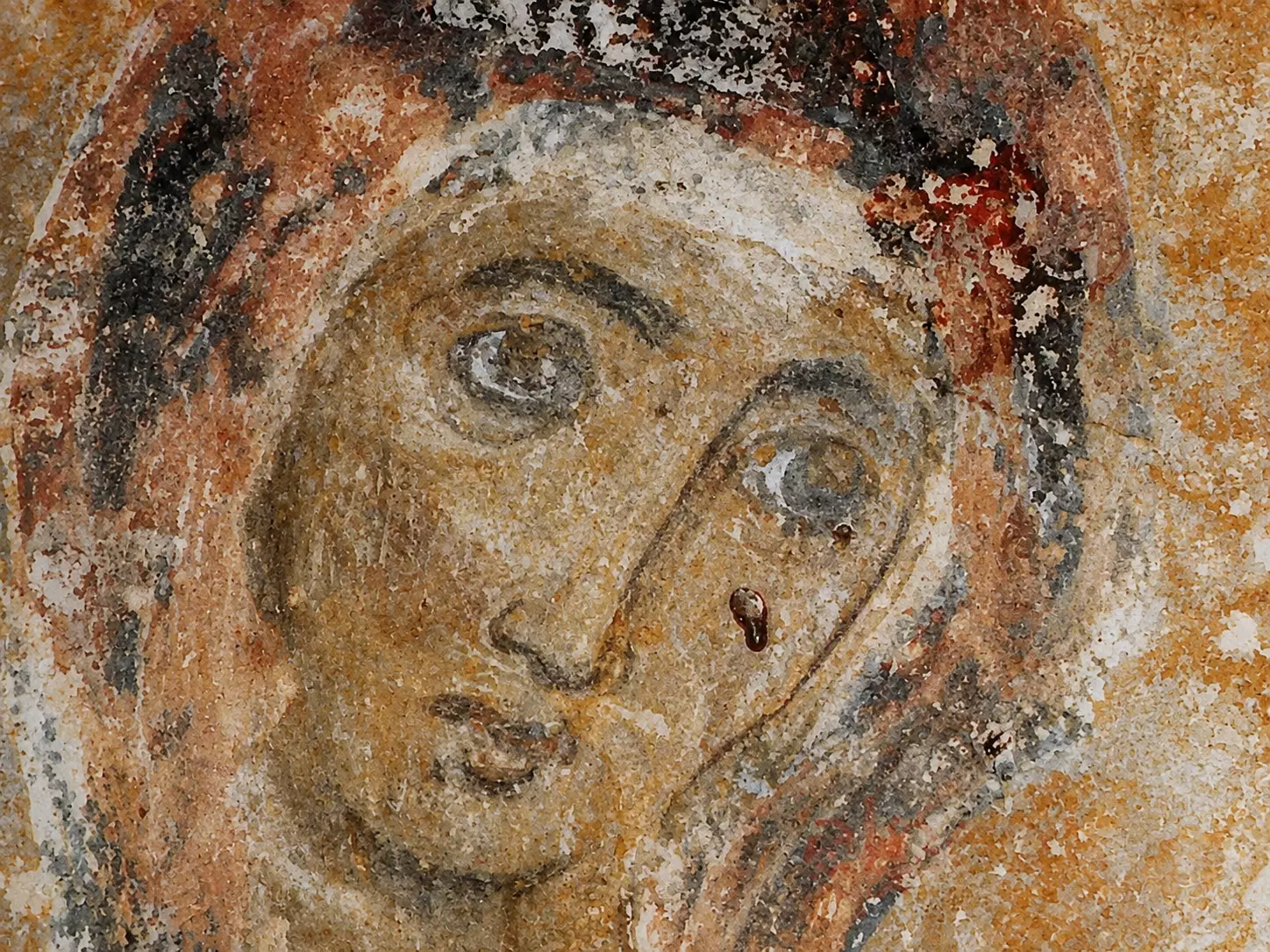
The face we see fills almost the entire surface around it, encircled by a halo designed with a double circumference, in shades of ochre that transition into a deeper orange toward the edges. The head-covering, dark at the top and light around the face, frames features that decay has left asymmetrical: one eye still retains its strong outline, while the other has almost dissolved into the color of the wall. Between them, a thin nose and a small, almost tight mouth give the face an introspective expression, far removed from any theatricality.
Below the neck, dark spots mark where the plaster has completely detached, leaving the masonry bare. However, this is not random decay without meaning for today’s viewer. The contrast between the surviving section, with the delicate lines of the face, and the lost section of the body reveals something about the construction technique itself: the color was applied in thin layers over damp mortar, a method that left vulnerable precisely those areas where adhesion was weakest. Around the head, traces of red paint can be discerned on the fabric covering the hair, a reminder of the Virgin’s traditional red maphorion, although the main body of the garment no longer survives to an extent that allows for safe conclusions about its design.
Color and Technique
The palette is limited to earthy tones: ochre, brown, a muted red, and the dark, almost black, of the losses. There is no wealth of gold background here that would dominate centuries later in the Cretan School; the surface remains austere, with the line carrying the entire weight of expression instead of the color. This austerity is not a technical weakness. Rather, it echoes the late antique tradition of portrait painting—the one that had already shaped, in the Roman funerary portraits of Fayum, a way of rendering the gaze through large, expressive eyes. The fresco of Panagia Drosiani seems to inherit exactly this gaze, transferring it to a religious context without fundamentally changing its language.
Its Place in the History of Byzantine Painting
Very few pre-iconoclastic frescoes have reached us, as the destructive fury of the 8th and 9th centuries wiped out most of the visual production of the early Byzantine centuries. According to scholars, Panagia Drosiani possesses the best-preserved fresco program of this period, a fact that partly explains the scientific interest the monument has attracted. Above these original depictions, later painters added new layers that continued up to the 14th century, covering the Deesis for hundreds of years before it was revealed again. In the dome of the same church survives a peculiar double depiction of Christ, first at a young age and then as a mature man—an element demonstrating how rich and unusual the theological program conceived by the unknown artist or artists of Drosiani was.
The visitor standing before this face today does not merely look at a relic. They see the point where the late Hellenistic sense of the human figure met a newly formed Christian community’s need to give shape to intercession, supplication, and human anguish before the divine. The two unidentified figures that accompany the five-figure composition remain, until further notice, an open question for research, a reminder that even the most thoroughly studied monuments harbor gaps that no bibliography has yet managed to fill entirely. Decay, after all, does not only subtract; sometimes it leaves visible what a perfect surface would hide—namely, the way the hand worked beneath the final layer of color. In Naxos, within a space that the daily routine of visitors often rushes past, this face continues to look in a direction that the Deesis composition itself determined fourteen centuries ago, needing no confirmation from us to remain what it is.