
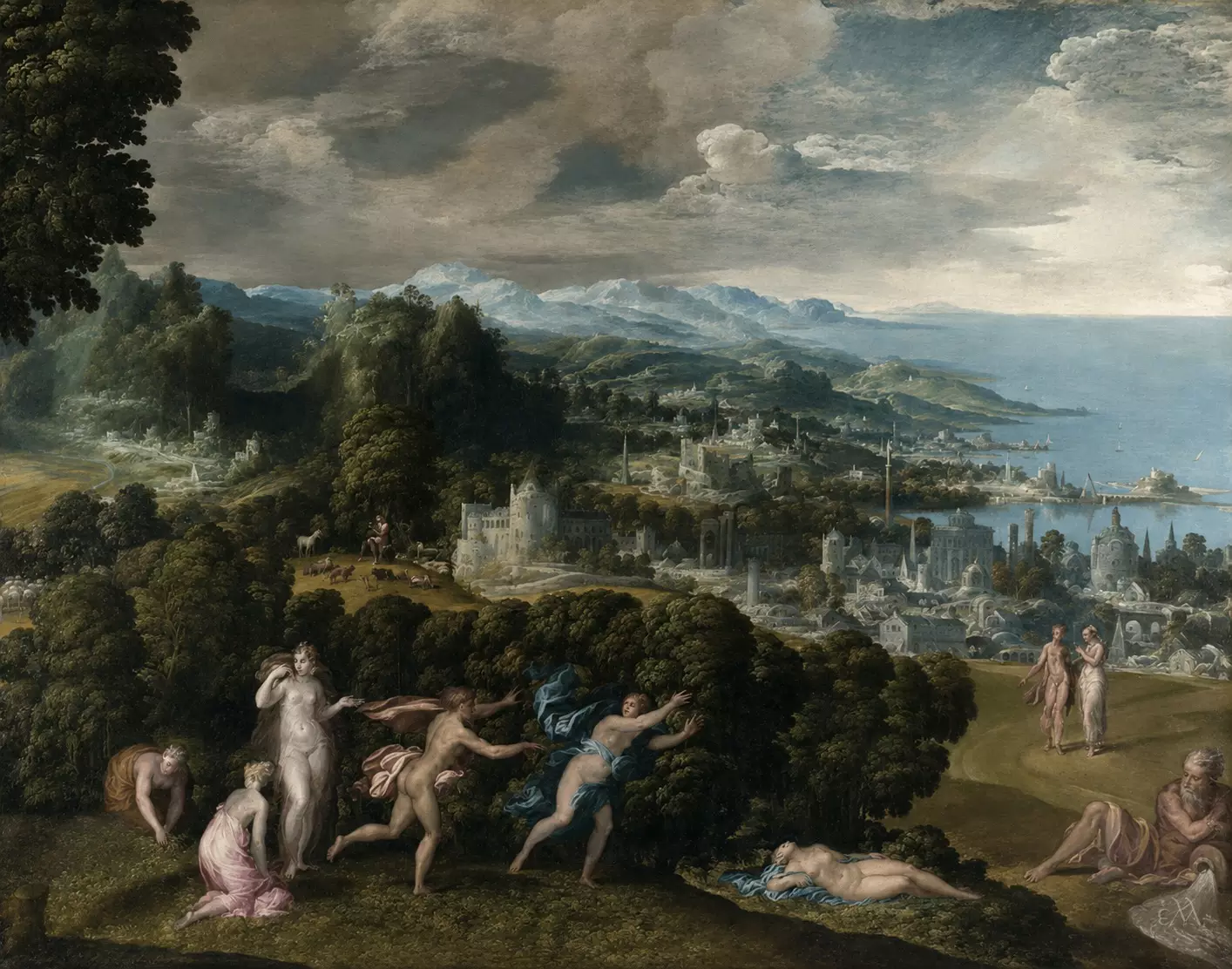
Niccolò dell’Abate’s The Death of Eurydice, painted about 1552–71, turns a mythological catastrophe into an expansive landscape whose scale almost overwhelms the human drama unfolding across it. Executed in oil on canvas and measuring 189.2 × 237.5 cm, the work belongs to the National Gallery in London, which acquired it through the Art Fund in 1941. Across dark wooded slopes, distant mountains, a coastal city and an immense clouded sky, dell’Abate distributes successive episodes from the story of Eurydice and Aristaeus. The painting belongs to his French period, begun after his departure for France in 1552, when he became associated with the courtly Mannerist culture of Fontainebleau and worked alongside Francesco Primaticcio.
Landscape immediately establishes the canvas’s scale. Dense masses of trees occupy much of the lower half, their deep greens and brown-green shadows creating a heavy foreground barrier through which the small figures emerge. Beyond them, buildings multiply along slopes descending toward a pale blue sea: towers, domes, columns, walls, distant settlements. Mountain chains retreat through increasingly cool blue-grey tones until their contours almost dissolve into the horizon. Above all of this, immense clouds sweep across the sky in broad passages of grey, cream and muted blue, penetrated unevenly by warmer light. The result is spatially ambitious and emotionally unsettled, with alternating illumination and shadow moving across the terrain.
The Death of Eurydice and the Continuous Narrative
Dell’Abate based the narrative on the story recounted in Virgil’s Georgics, Book IV, later adapted by Poliziano in his Orfeo. Instead of isolating a single dramatic instant, he adopts a continuous narrative, placing events that occur at different moments within one unified landscape. This device requires the eye to travel: the myth is read through space.
Deep in the distance, Orpheus plays his lyre before a gathering of animals. According to the National Gallery’s identification, the extraordinary audience includes a leopard, stag, boar, lion and unicorn, creatures pacified by the musician’s art. The episode occupies a remarkably inconspicuous position in relation to Orpheus’s importance within the broader myth. Dell’Abate allows him to become part of the surrounding scenery, a minute actor set among trees and hills, while the viewer’s attention gradually descends toward the events connected with Eurydice.
Across the foreground, three nymphs gather flowers. Their pale bodies and softly coloured draperies stand against the dense foliage, making them immediately legible despite their relatively modest scale. Near them the sequence accelerates: Aristaeus pursues Eurydice, the fleeing woman encounters the snake, and shortly afterwards she appears again, stretched motionless on the earth. Her blue drapery provides a visual link between the two appearances, helping the viewer identify the repeated figure within the continuous narrative. The moment of death itself receives little theatrical emphasis. Eurydice lies parallel to the foreground edge, her body quiet, almost absorbed into the surrounding ground and vegetation.
That restraint gives the episode an unusual character. Movement is displaced onto the surrounding figures—the outstretched arms, running bodies, twisting draperies—while Eurydice’s final appearance is horizontal and still. The alternation between movement and stillness works across the canvas as a whole: restless foreground figures, thick immobile woods, receding architecture, calm sea, agitated clouds. Even the mythological narrative seems subject to the rhythms of the terrain.
Elsewhere Aristaeus consults his mother Cyrene after the destruction of his bees, another stage in the story. Close to the lower edge reclines Proteus beside an overflowing urn. In Virgil’s account, Proteus explains that the loss of the bees represents punishment for Aristaeus’s pursuit of Eurydice, completing a chain of actions and consequences that dell’Abate has dispersed through several spatial zones. Narrative time has effectively been converted into pictorial distance.
Landscape, Mannerism and Fontainebleau
For all the complexity of its literary subject, The Death of Eurydice gives landscape exceptional autonomy. Architecture stretches across the middle distance with the imaginative freedom characteristic of Renaissance poetic landscapes: classical-looking columns and monumental structures mingle with towers, spires, bridges and densely clustered buildings, forming an invented civilization along the coast. Against this accumulation of human construction, the mountains rise in long successive ridges, while enormous atmospheric formations dominate the upper field.
Dell’Abate’s approach had roots in northern Italian painting. The National Gallery specifically connects his extensive landscapes with Dosso Dossi, whose fantastic settings and unusual illumination offered an important precedent. Yet the French setting of dell’Abate’s later career gave these ideas another context. At Fontainebleau he participated in a court culture shaped by Italian Mannerism, decorative invention and mythological imagery; the National Gallery considers his integration of landscape and emotional narrative an important development in French art, anticipating aspects of the classical landscapes later cultivated by Nicolas Poussin and Claude Lorrain.
The composition achieves depth through overlapping wooded zones, diminishing architectural scale and atmospheric perspective. Cool blues soften the furthest mountains, while stronger greens, ochres and flesh tones articulate the foreground. Between these extremes lies the city, immensely intricate yet subordinated to the larger geography surrounding it. Light reaches selected surfaces—roofs, slopes, distant water, pale bodies—then disappears again beneath cloud and foliage.
Within this vast constructed world, the tragedy of Eurydice occupies only a fraction of the canvas. Her death becomes one event among forests, mountains, cities, animals, water and changing weather, while the landscape carries much of the emotional weight through its unstable light and enormous spatial reach.