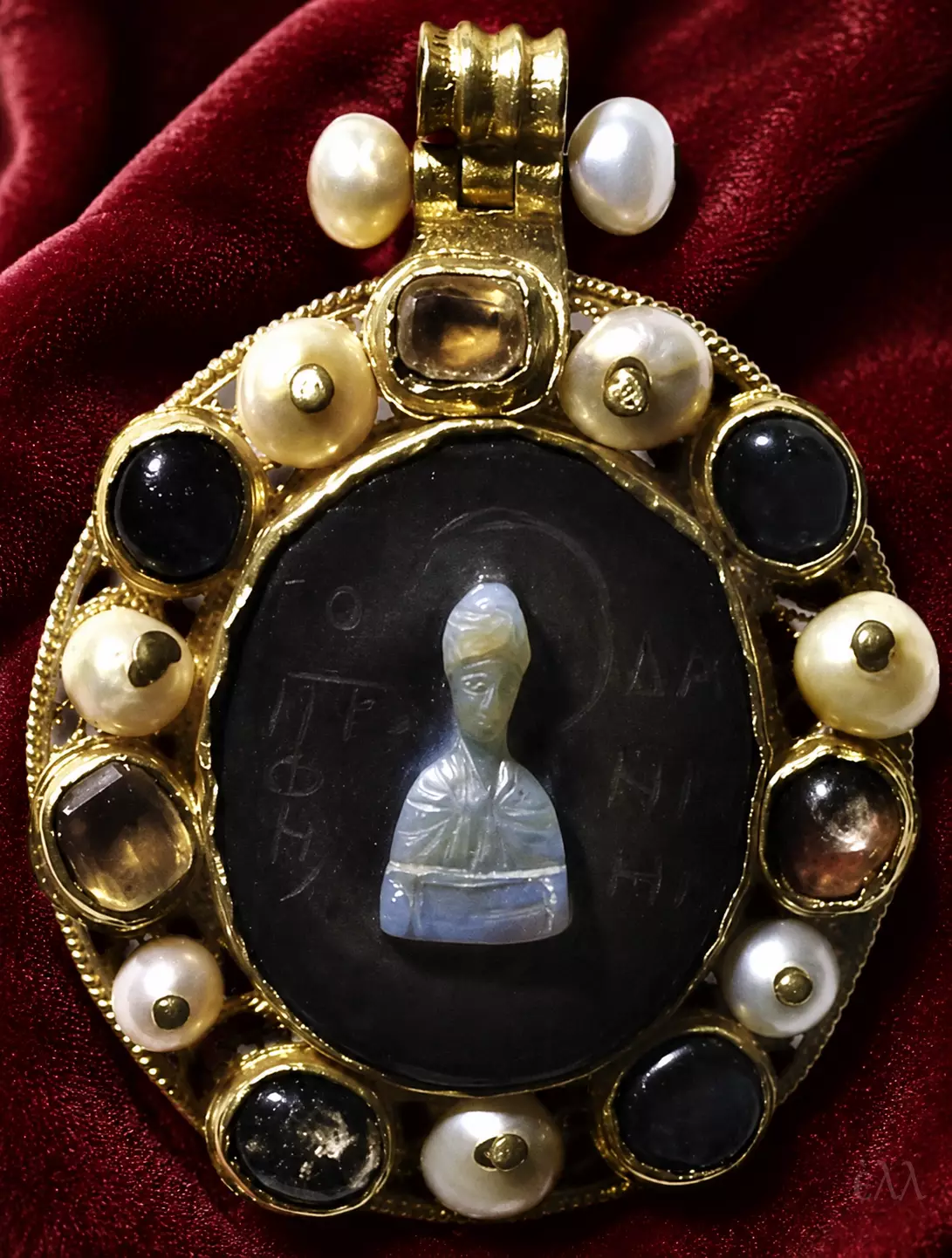
Preserved at Vatopedi Monastery on Mount Athos, the Prophet Daniel Enkolpion is an elliptical pectoral object whose present form brings together two distinct periods of craftsmanship. At its centre lies a twelfth-century sardonyx cameo depicting the Prophet Daniel in bust form; around it, a gold setting made in Novgorod during the fifteenth century incorporates pearls and precious stones. The documented chronology therefore separates the earlier carved gem from its later mounting, allowing the object to preserve within a single ensemble two phases of medieval artistic production.
Against the almost black field of the sardonyx, Daniel appears as a small, pale figure occupying the central vertical axis. His head and upper body emerge with unusual clarity from the surrounding darkness, the natural contrast of the stone becoming an essential part of the image. The figure is highly compressed, frontal and hieratic. Little space is required. Within this miniature scale, the gem cutter concentrates attention on silhouette, facial presence and the sharply defined transition between the pale form and its dark ground.
The Prophet Daniel Enkolpion and Its Jeweled Setting
Around the cameo, the fifteenth-century gold mount changes the visual character of the earlier carving. Pearls alternate with dark, amber-toned and reddish gemstones around the elliptical perimeter, creating an irregular but carefully controlled rhythm of colour, luminosity and reflection. Some stones project strongly from their individual settings; the pearls, softer in tone, punctuate the composition with small areas of light. At the upper edge, a substantial suspension fitting confirms the object’s function as an enkolpion intended to be worn or suspended.
The contrast between centre and frame is particularly effective. Within the dark stone, Daniel remains restrained and almost monochromatic; around him, gold, pearls and coloured stones produce a dense ornamental border. The later Novgorod mount thus frames the Byzantine cameo as an older and visually distinct precious image, preserving it while giving it a new material environment. Its fifteenth-century setting is specifically associated with Novgorod, while the cameo itself belongs to the twelfth century.
Among the enkolpia preserved at Vatopedi, objects of different shapes, materials and dates survive together, including crosses, carved gems and richly mounted pendants. In this example, the extreme economy of the Prophet’s tiny bust and the elaborate later surround remain visibly separate: dark stone at the centre, then gold, gemstones, pearls, and finally the suspension loop above.