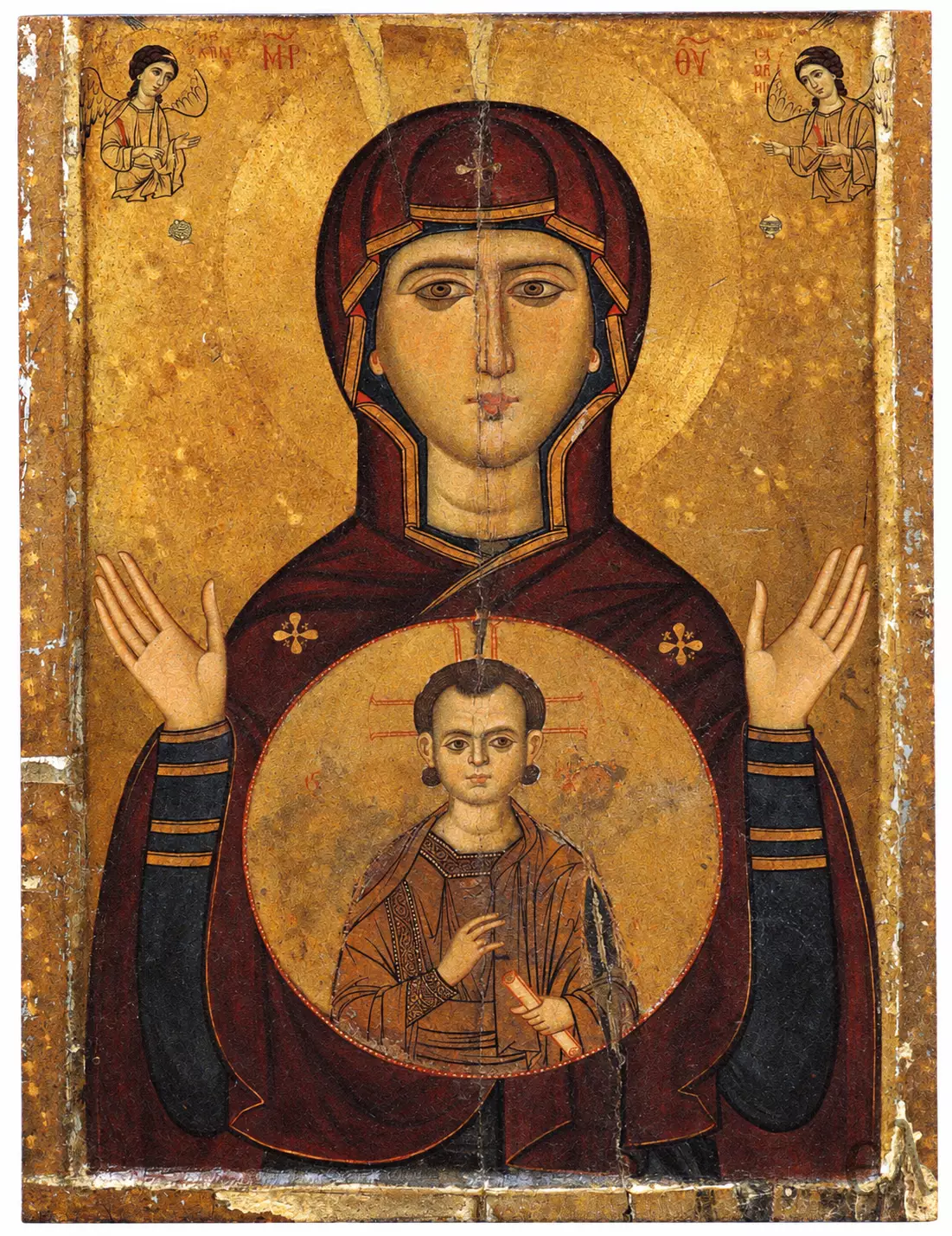
The Virgin Blachernitissa at Sinai, preserved at the Holy Monastery of Saint Catherine, presents the Mother of God half-length and strictly frontal, her arms raised in the ancient orans gesture. Before her breast appears Christ Emmanuel within a large circular medallion, while two archangels occupy the upper corners of the gold ground. Monumental in conception despite its relatively contained dimensions, the panel measures 99.2 × 67 cm. Published catalogues describe its technique as tempera and gold on wood with canvas and mixed media, and record its provenance from the chapel of Saint Symeon Stylites within the monastery basilica.
The icon is a thirteenth-century work. More precise datings have varied: one major catalogue places it around 1260/70, while Doula Mouriki dated it to the last quarter of the century. It therefore belongs among the older surviving substantial panel icons using this Marian formula, although the Blachernitissa type itself has a considerably earlier history.
The Virgin Blachernitissa and the image of the Incarnation
The essential structure of the icon is remarkably economical. The Virgin does not hold the Child in her arms. Her hands are lifted beside her shoulders, palms exposed, while Christ appears independently within the circular field placed against her body. The relationship between the two figures, established through superimposition and axial alignment, places Christ at the centre of the Virgin’s torso, his own body repeating on a smaller scale the rigid frontality of his Mother.
This formulation belongs to the iconographic tradition usually designated Blachernitissa, connected by name and historical association with the celebrated Marian sanctuary of Blachernae in Constantinople. Byzantine usage of the term was not always restricted to a single immutable visual type, and different Marian images could carry the epithet. In the present icon, the familiar combination of the praying Virgin and Christ Emmanuel in a medallion gives unusually concentrated visual form to the doctrine of the Incarnation. A modern scholarly discussion of related representations describes the half-length Blachernitissa as one of the characteristic Byzantine images in which the presence of Christ before the Virgin’s body makes visible the mystery of the Logos taking flesh.
The medallion is crucial. Its perfectly circular contour interrupts the broad dark mass of the maphorion and establishes an image within the image. Christ appears frontally as Emmanuel, already endowed with the visual gravity of sacred authority, rather than as an ordinary infant resting physically upon his Mother. His right hand is raised in blessing; in his left he holds a rolled scroll. The cruciform lines of the halo extend behind his head across the gold field of the roundel.
The scale is carefully judged. Christ is small in relation to the Virgin, yet the enclosing circle gives him considerable pictorial independence. The eye moves first towards the Virgin’s large face, then downward along the central axis to Emmanuel. Through scale, alignment and enclosure, the theological relationship becomes spatially legible without recourse to narrative.
Prayer, frontality and the unusual force of the composition
The Virgin’s raised arms widen the composition dramatically. Her hands almost touch the lateral limits of the panel, creating a broad horizontal movement beneath the much larger vertical emphasis of her face and body. Their pale flesh tones stand sharply against the dark sleeves and deep red maphorion. Long fingers, clearly separated and slightly irregular in their spacing, reinforce the character of the gesture as prayer.
Everything else tends towards stillness. The face, which is constructed around an uncompromising central axis and whose long narrow nose, small mouth and widely opened eyes are controlled by firm contour lines, retains restrained modelling throughout. There is little concern with reproducing the softness or accidental asymmetry of a natural face. The painter instead builds a physiognomy intended for prolonged frontal encounter.
Especially important is the scale of the eyes. They dominate an elongated oval face whose surrounding garments form successive enclosing shapes: the dark inner veil, the red maphorion edged with gold, the large halo, then the gold ground itself. The effect is almost architectural, each contour containing another and directing attention inward towards the gaze.
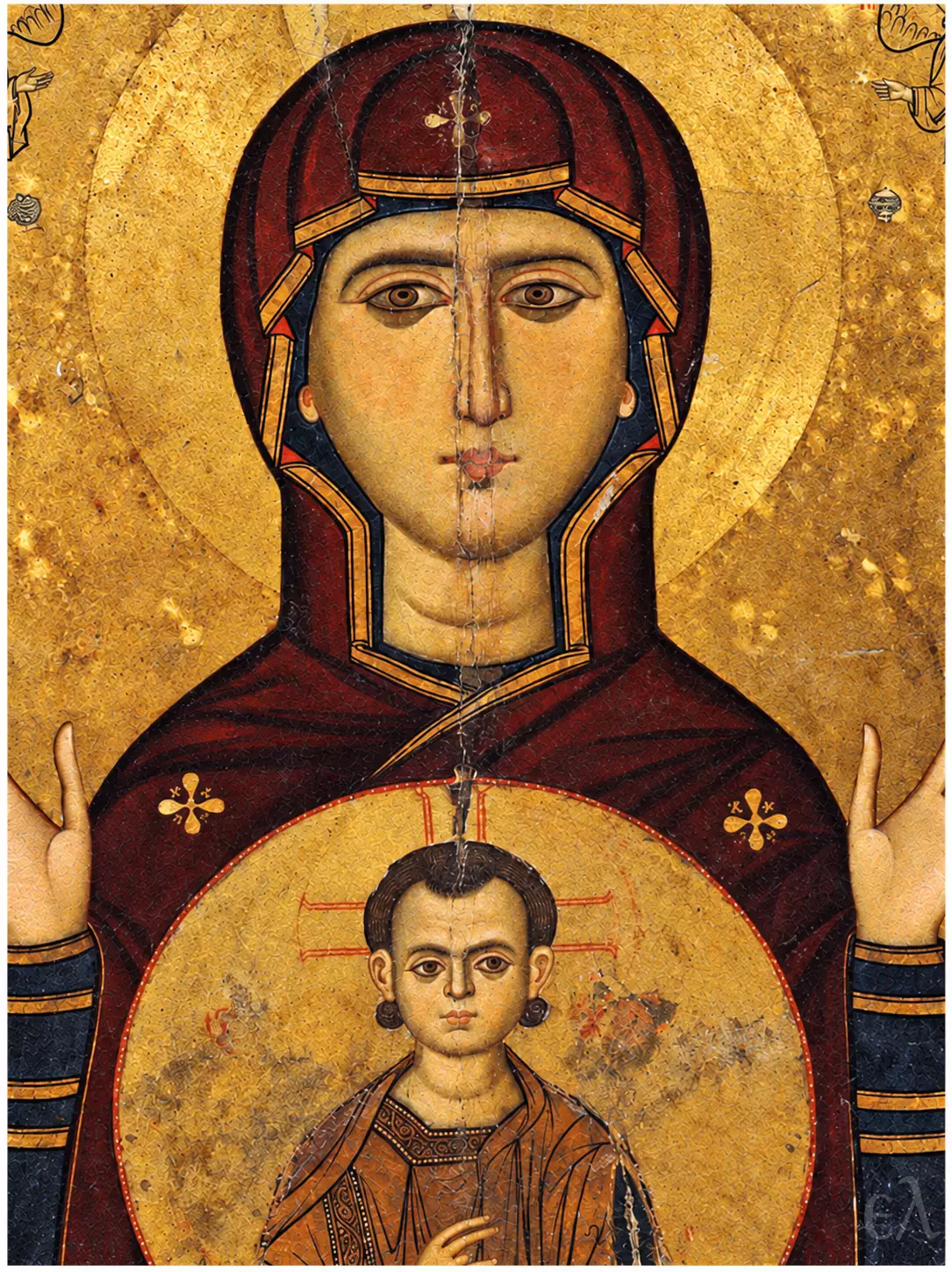
The detail photograph makes this construction especially clear. Around the eyes, cheeks and neck, fine tonal transitions survive, while darker contouring defines the nose and brows with considerable precision. The mouth is unusually small and compressed. An austerity remains in the expression, held in a state of immobility appropriate to the hieratic conception of the figure, without becoming harsh.
Archangels, inscriptions and the gold field
Two winged archangels appear above the Virgin, greatly reduced in scale and turned towards the central figure. The inscriptions identify Archangel Michael on the viewer’s left and Archangel Gabriel on the right. The principal sigla ΜΡ ΘΥ, the customary abbreviation for Μήτηρ Θεοῦ, identify the Virgin as the Mother of God, while Christ is accompanied by the abbreviated name of Jesus Christ. These inscriptions are recorded in the published catalogue of the icon.
Their small scale establishes the hierarchy immediately. The archangels occupy the remaining spaces above the Virgin’s shoulders without competing with her. Their inclined bodies relieve the absolute rigidity of the central axis as well, introducing a quiet lateral movement near the upper edge.
Across the gold ground, abrasions and irregularities produced by age coexist with small embossed circular ornaments visible in the field. Comparative scholarship has drawn attention to such motifs on Sinai icons and treated them as relevant evidence when considering the circumstances of the panel’s production. The icon has been associated with a group of thirteenth-century works linked stylistically to artistic activity in the eastern Mediterranean, including panels connected with the County of Tripoli and Sinai. One publication proposes that this Blachernitissa and several related icons may have emerged from the same atelier, while leaving open the precise movements of the painters involved.
For the catalogue documentation of the panel, including its dimensions, inscriptions and provenance, see the Met catalogue. A recent discussion of the iconographic type and its thirteenth-century parallels is also available through the Christian Archaeological Society.
Colour and the geometry of the Virgin’s garments
The restricted chromatic range gives the panel much of its visual authority. A deep wine-red maphorion covers the Virgin’s head and shoulders, interrupted by dark blue-black sleeves crossed by narrow gold bands. Gold edging around the face sharpens the boundary between flesh and garment. Two ornamental crosses appear on the maphorion beside the medallion of Christ.
Large expanses of unmodulated dark colour contrast with the illuminated flesh and the pervasive gold. The Virgin consequently seems to advance from the background even though conventional spatial depth is almost absent. Her body is broad, simplified, nearly planar; volume is concentrated principally in the face and hands.
Christ receives a denser linear treatment. His brown garment is filled with delicate linear ornament, narrow folds and decorative edging, producing a more concentrated internal surface. The Virgin is articulated through great masses and broad contours; the smaller Emmanuel, through a tighter network of line.
An exacting geometric order also governs the panel. The Virgin’s halo encloses the head; the larger medallion encloses Christ; his cruciform halo provides a third concentric focus. Circles and frontal faces accumulate down the central axis, while the lifted hands open the composition laterally. Small deviations survive everywhere, particularly in the hands, garment folds and facial drawing, keeping this geometry from becoming diagrammatic.
A thirteenth-century Sinai icon and its artistic setting
The dating of the panel deserves some precision. It is often described simply as a thirteenth-century Byzantine icon, which remains the safest broad designation. Richard Cormack published it with a date around 1260/70, whereas Mouriki placed it in the last quarter of the century. Recent scholarship continues to cite her later dating.
Its artistic setting is equally interesting. Thirteenth-century Sinai preserved icons made within a remarkably complex cultural environment. Painters, patrons and objects moved between Sinai, Cyprus, Syria-Palestine and other centres of the eastern Mediterranean. Comparative studies have noted affinities between the Blachernitissa and works connected with the region of Tripoli; the embossed ornament of the gold ground, meanwhile, has been cited in favour of production close to Saint Catherine’s. A named artist or narrowly defined workshop cannot be assigned securely to the icon from this evidence. What emerges instead is a picture of artistic mobility around Sinai during the period.
The panel’s documented location in the chapel of Saint Symeon Stylites also matters. Scholarship on the appearance of archangels associated with incense around Blachernitissa images has suggested a possible Eucharistic resonance, particularly where such representations occupied liturgical spaces. In discussions of this Sinai icon, its considerable size and the accompanying angelic figures have accordingly been considered in relation to a setting in which the Eucharist could be celebrated. The proposal remains a contextual interpretation of the icon’s possible function.
The material history visible on the panel
Age has become part of the icon’s present appearance. A pronounced vertical split runs down the wooden support almost exactly through the centre of the Virgin’s face, continuing through the medallion and the figure of Christ. A second, shorter split is recorded lower on the panel. Scattered scratches and losses occur across the surface, with more substantial abrasion along parts of the raised border. These features correspond closely to the condition described in the published catalogue.
The central fracture is visually intrusive because it intersects the very axis on which the painter constructed the composition. Yet the principal forms remain unusually legible: the direct gaze, the open hands, the circular image of Emmanuel, the two attendant archangels.
In the close view, the surviving painted surface also reveals something easily lost in reproductions of the entire panel. The image depends upon extremely controlled line. Eyelids, nose, lips, the borders of the maphorion and the delicate features of Christ are described by drawing of almost calligraphic economy. At full scale these lines recede into the imposing simplicity of the whole; seen closely, they disclose the discipline behind that simplicity.
(The translation was edited by D. Smith.)