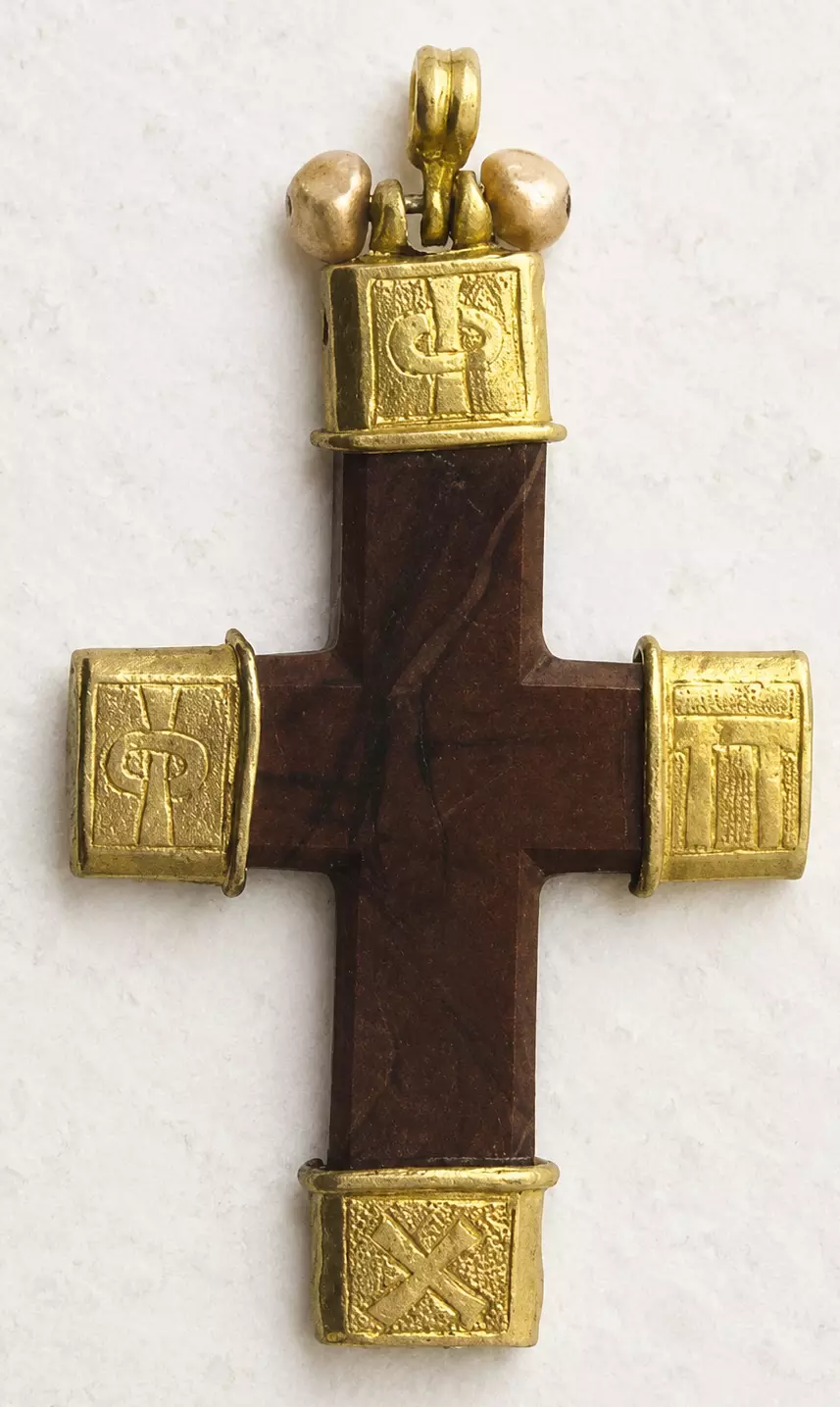
Dating from the 13th–14th century, this Byzantine enkolpion cross combines a dark stone body with carved and engraved gold fittings and pearls. Preserved at the Holy Monastery of Vatopedi, it belongs to a substantial group of Byzantine enkolpia associated with the monastery, objects made for suspension and distinguished by considerable variety in form, material, and workmanship.
The cross has a compact, strongly defined silhouette. Its stone core is broad at the intersection of the arms and extends into comparatively short lateral terminals. Against the dark surface, the gold fittings create an immediate material contrast: rectangular gold elements enclose the four ends, each carrying small engraved or carved decoration. Fine lines are also visible across the stone itself, though their subdued character allows the material of the cross to remain visually dominant.
Byzantine Enkolpion Cross: Gold, Stone and Pearls
At the upper end, the suspension loop identifies the object clearly as a pendant intended to be worn or hung. Two pearls flank the loop, introducing a softer, luminous accent beside the worked gold. Such suspension arrangements, sometimes accompanied by pearls or gemstones, occur among Byzantine enkolpia preserved at Vatopedi.
Concentrated at the terminals, the goldwork functions almost as a precious frame for the stone cross. The engraved surfaces are restrained in scale, appropriate to an object meant to be viewed closely. Stone, gold, linear ornament, pearls: within a very small format, the materials create alternating areas of darkness and reflected light.
The piece is documented as a work of the 13th–14th century made from stone, carved and engraved gold, and pearls, and it remains in the collection of the Holy Monastery of Vatopedi. Its compact construction and suspension fitting place it within the wider tradition of Byzantine personal devotional objects, for which the term enkolpion encompasses several forms of pendant sacred imagery.