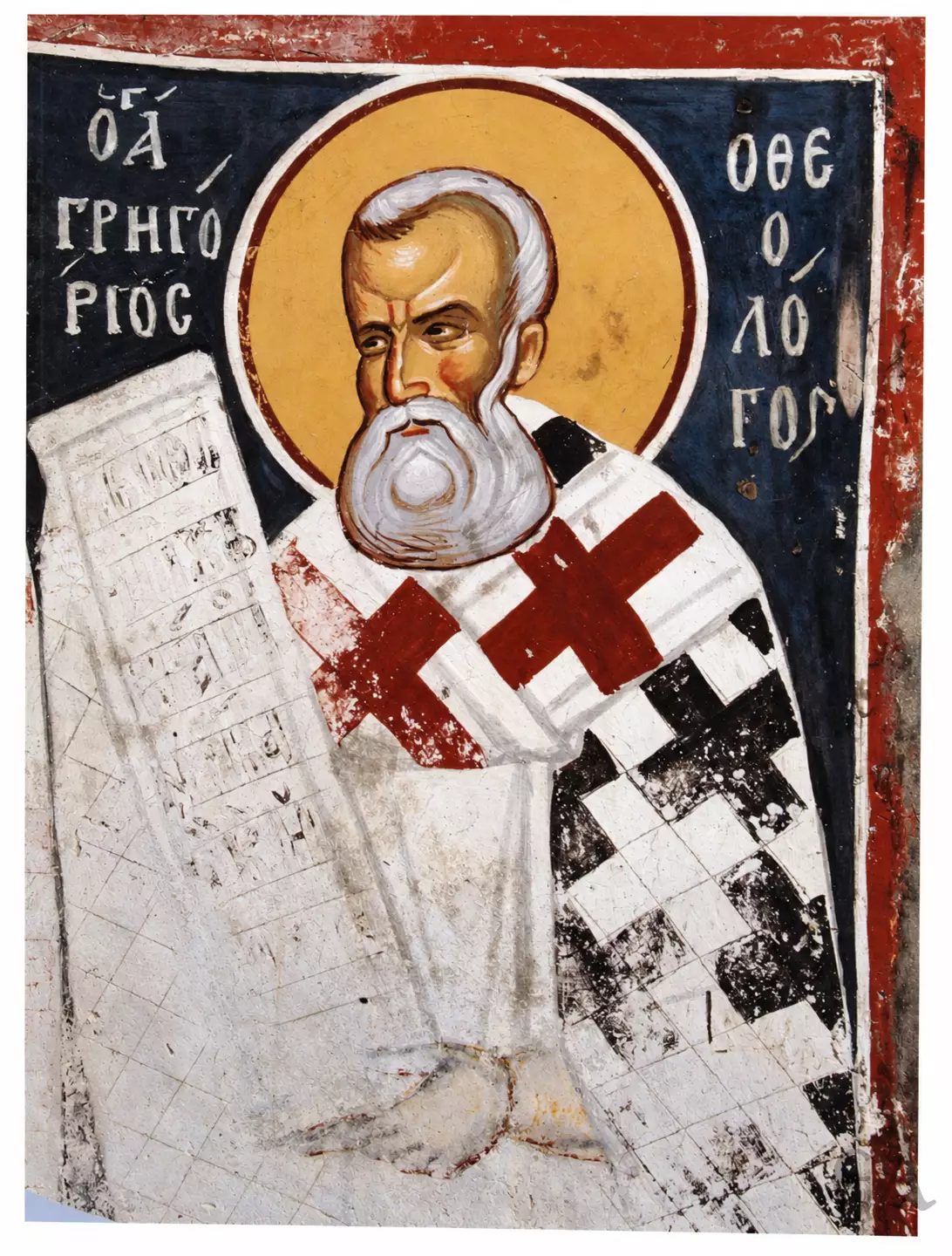
The Saint Gregory the Theologian fresco belongs to the sanctuary decoration of the katholikon of Ypapanti Monastery at Meteora, painted in 1366/67. Gregory of Nazianzus appears as a holy hierarch in the lower part of the sanctuary programme, his body turned towards the interior of the apse and an open inscribed scroll rising beside him. Divided around the halo, the identifying inscription reads Ὁ ἅγιος Γρηγόριος ὁ Θεολόγος. His episcopal vestments, marked by large red and dark crosses, occupy much of the surviving field; above them the painter has concentrated his attention on the strongly modelled head, white hair and ample beard.
Through its inscriptions, the painted decoration of the katholikon is securely connected with the foundation and early history of the monastery. The texts record the role of the hieromonk Neilos, protos of the Skete of Stagoi and hegoumenos of Doupiani, together with the monk Kyprianos, and give 1366/67 for the completion of the wall paintings. The church is a small cross-vaulted structure whose restricted surfaces required a comparatively condensed iconographic programme. Within that system, the Church Fathers occupy a particularly significant place in the sanctuary.
Saint Gregory the Theologian Fresco in the Sanctuary Programme
Gregory forms part of a sequence of concelebrating hierarchs beneath the image of the Theotokos. The surviving arrangement includes Saint Basil the Great, Saint John Chrysostom, Saint Gregory the Theologian and Saint Athanasius of Alexandria. Turned towards the liturgical centre and carrying inscribed scrolls, the bishops form a painted assembly that corresponds closely to the function of the actual sanctuary during the celebration of the Eucharist. A detailed account of the arrangement and its inscriptions is preserved by Meteora Lithopolis.
Gregory’s pose gains much of its effect from this larger ensemble. His three-quarter orientation places him firmly within the sequence of concelebrating hierarchs. The shoulders move diagonally across the narrow pictorial field, while the head turns more emphatically towards the neighbouring figures and the centre of the apse. The scroll follows the same direction. Even the placement of the name, broken into vertical groups of white letters against the very dark background, participates in the compressed architecture of the figure.
Broad and ochre-gold, the halo is edged by concentric dark and light contours. Its nearly perfect circle provides a stable field around a head constructed with noticeably less regularity: the skull rises high above the brow, white hair follows the side of the head in short curved passages, and the beard spreads outward before gathering into a rounded lower mass. The saint’s gaze is directed laterally, alert and concentrated.
The Inscribed Scroll and the Image of Concelebration
The scroll has suffered considerable loss, and much of its lettering is now extremely faint. Earlier documentation records its beginning as:
Κύριε ὁ Θεὸς ἡμῶν, οὗ τὸ κράτος ἀνείκαστον…
The text belongs to the Prayer of the First Antiphon in the Divine Liturgy of Saint John Chrysostom, whose opening addresses God as possessing incomparable might and incomprehensible glory. The same Greek wording appears in the Greek Orthodox Archdiocese’s published liturgical text.
This identification clarifies the function of the scroll within the painting. Its wording places Gregory inside an image of liturgical celebration. Through physiognomy and inscription his historical identity remains fully recognisable, while the action represented belongs to the corporate ministry of the bishops surrounding the altar. In the apse, the Church Fathers are thus shown as participants in the heavenly liturgy mirrored by the service taking place before them.
Gregory of Nazianzus, born around 330 and one of the major Cappadocian Fathers, acquired the epithet Theologian particularly through his defence and exposition of Trinitarian doctrine. His presence beside Basil and John Chrysostom also recalls the grouping familiar in Byzantine tradition as the Three Hierarchs, although the Ypapanti sanctuary develops a wider episcopal assembly. His painted identity here is primarily episcopal and liturgical, with the scroll and vestments governing the visual presentation.
Face, Vestments and Pictorial Language
The face is the most carefully worked passage of the surviving figure. A warm ochre-brown flesh tone provides the underlying field, over which darker lines establish the brows, nose, eyelids and contours of the cheeks. White illumination is restricted and emphatic: a small highlight on the forehead, lighter strokes around the brow and upper facial planes, then the much larger pale mass of hair and beard. The transitions are relatively abrupt. Volume remains perceptible across the forehead and nose, although linear definition continually reasserts itself.
Unusual force is concentrated in the eyes. Their dark pupils sit beneath sharply described brows, while the surrounding shadows narrow the visible flesh and deepen the saint’s expression. A small mouth, almost concealed by the moustache, introduces a brief red accent. The beard receives a different treatment from the face, broad pale forms being subdivided by grey contours and repeated curved lines that give the hair weight and patterned order.
His vestments occupy a considerably flatter pictorial register. Large cross motifs in red and dark pigment spread across the pale episcopal garment, creating a strong alternation of colour around the head and upper body. Some passages retain powerful chromatic contrast; elsewhere abrasion has reduced the painted surface almost to the underlying pale field. Especially worn is the scroll at the viewer’s left, where surviving traces of script now seem almost incised into the light surface.
The source material places the 1366/67 paintings broadly within the artistic current traditionally described as the Macedonian School, while drawing attention to considerable simplification in figure construction, facial detail and drapery. It records bright colours, deeper underpainting, limited white highlights on faces and schematic folds as recurring characteristics of the painter. The same discussion argues for substantial unity of execution throughout the katholikon, while allowing for the possible participation of an assistant.
Gregory’s head shows why such qualifications matter. Its modelling possesses real plasticity, achieved by economical means. Forehead, nose and cheek are built from a few concentrated tonal divisions; the beard becomes increasingly graphic; below, the vestments resolve into broad pale expanses crossed by geometrically assertive motifs. The figure belongs securely to Late Byzantine painting and retains a directness distinct from the more elaborate handling found in some prestigious Palaiologan ensembles.
Ypapanti Monastery and the Painting of 1366/67
Within the fourteenth-century monastic landscape of Meteora, Ypapanti belongs to an important formative phase. The monastery was established within a natural rock cavity north of Great Meteoron, and its katholikon was originally dedicated to the Ascension of Christ, as the foundation inscription records. The present name of Ypapanti became attached to a monument whose earliest painted programme gives particular prominence to the Ascension (Acts 1:9–11). Because the church is small, the usual hierarchy of monumental Byzantine decoration was compressed, with Christological scenes concentrated in the crossing arms and sanctuary and saints, prophets and Church Fathers distributed across the remaining surfaces.
The sanctuary received some of the most explicitly liturgical imagery. Below the Theotokos stand the hierarchs; higher within the eastern zone appear compositions connected with Christ and the Divine Economy. Gregory’s figure consequently acquires meaning through placement as much as through physiognomy. He stands close to the space occupied by the officiating clergy, where episcopal identity and liturgical text are brought into direct visual relation.
The broader site belongs to the historic Meteora complex, whose monastic settlement developed intensively during the later medieval period. UNESCO identifies the fourteenth and fifteenth centuries as decisive for the establishment of monasteries upon the rocks of Thessaly, within a longer eremitic tradition already present in the area.
Surface, Loss and Conservation
Time has altered the visual balance of the Saint Gregory the Theologian fresco. The face and halo remain comparatively legible, while the lower vestments and especially the scroll preserve numerous abrasions and areas of paint loss. Uneven in tone, the pale garment retains several fragmentary crosses, and the lower hand is far less clearly articulated than the head. Against these worn passages, the dark background still provides enough density to isolate the halo and the surviving white inscription.
A conservation campaign undertaken in 2003 by the 7th Ephorate of Byzantine Antiquities, in collaboration with the Monastery of Great Meteoron, treated the wall paintings of the monastery after a long period without comparable intervention. The surviving painted surface therefore carries more than one material history: the original execution of 1366/67, centuries of deterioration, later conservation. Details such as Gregory’s severe gaze, cross-covered vestments and partially vanished liturgical scroll remain readable within that altered surface.
(The translation was edited by N. Jones.)