
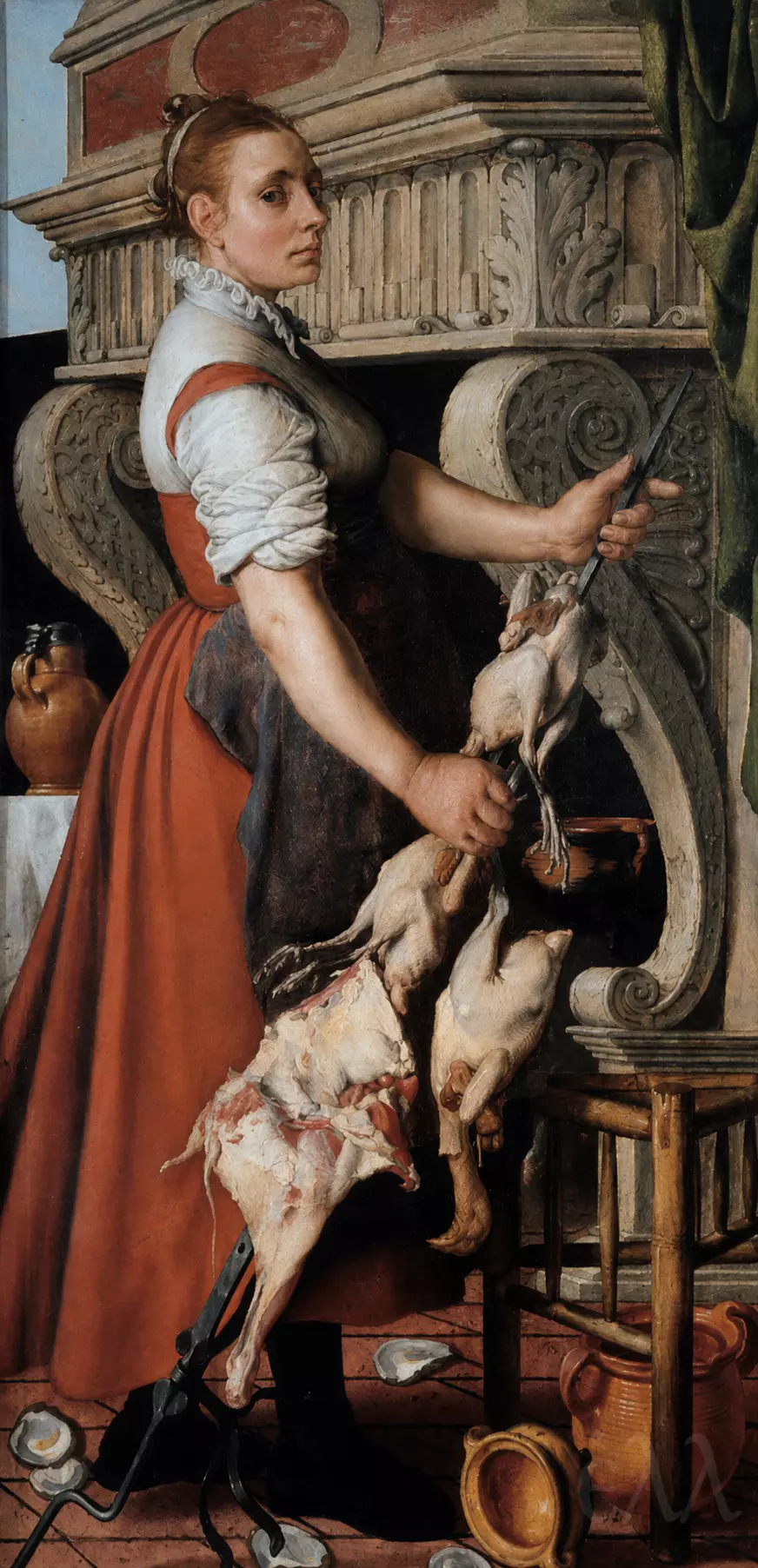
Painted in 1559, Pieter Aertsen’s The Cook gives an anonymous kitchen worker an unusually imposing pictorial presence. Nearly life-size within the tall, narrow field, she stands before an elaborate fireplace, her body turned towards the work while her face turns back towards the spectator. In her right hand she holds the long iron spit from which prepared poultry hangs; the other hand steadies the heavy cluster below. Her work clothes receive the same concentration that Aertsen brings to flesh and architecture. The warm red dress, dark apron, gathered white sleeves and tightly ruffled collar form a compact sequence of surfaces against the cool grey fireplace surround. The image comes surprisingly close to full-length portraiture, although the figure is defined through occupation, clothing and the objects of kitchen labour rather than through name or documented social status.
The painting belongs to the Musei di Strada Nuova, Palazzo Bianco, in Genoa. Its current museum catalogue records dimensions of 171 × 85 cm and inventory number PB 181. More importantly, the support is identified as oil on oak panel, correcting secondary references that describe the work as oil on canvas. The catalogue also documents the inscription “1559 P A” on the fireplace. In a format of such unusual height, the servant occupies the kind of scale at which sixteenth-century viewers were accustomed to encountering saints, rulers or prosperous sitters, while beneath her hands remain the spit, birds and other materials of kitchen work.
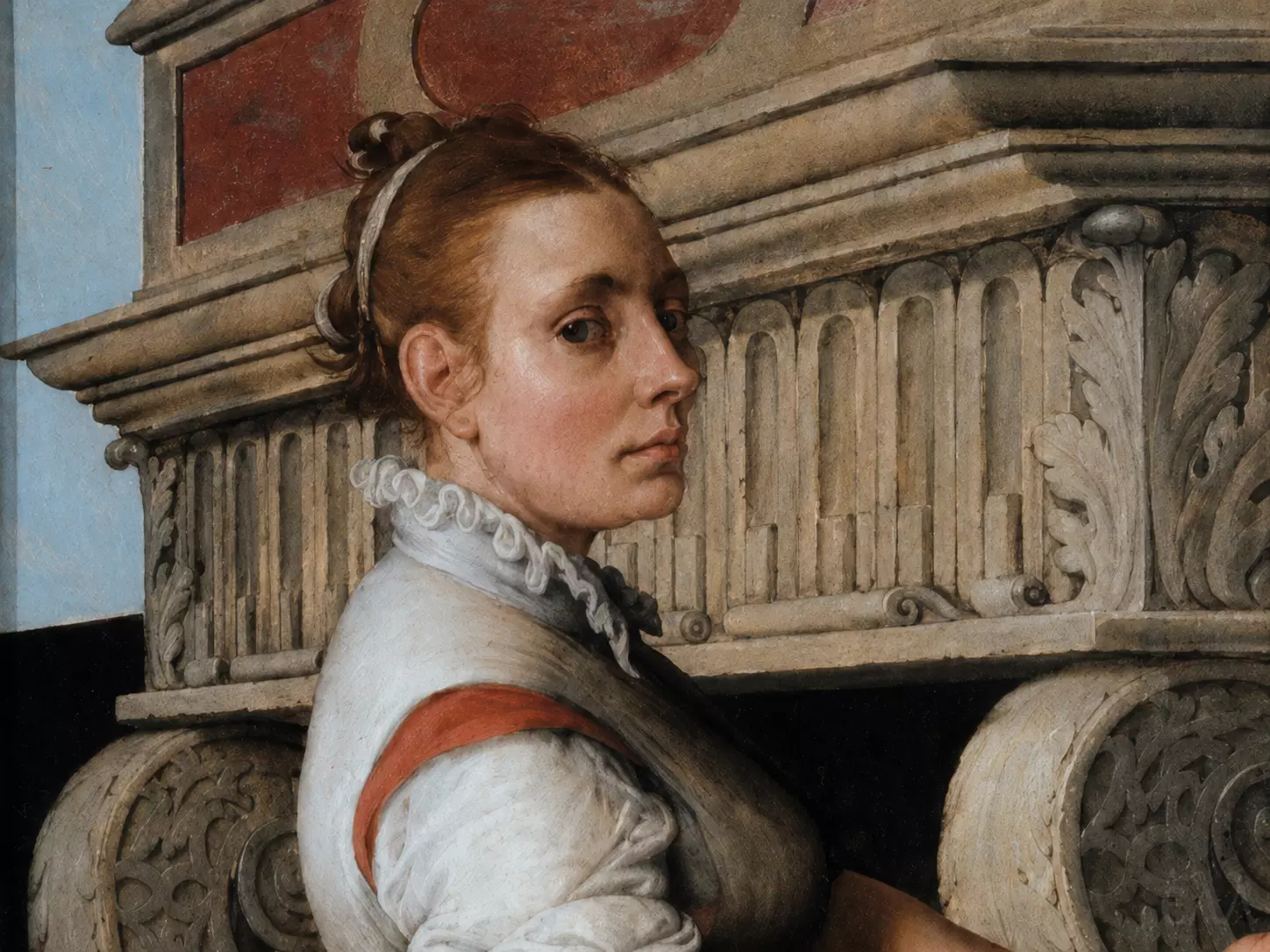
Pieter Aertsen The Cook: Monumental Figure and Kitchen Space
The woman almost divides the composition vertically. Her red skirt descends through much of the lower half of the panel, widening towards the floor, while the upper body is set against the dark opening of the hearth. Aertsen uses that black recess with considerable precision. It isolates the pale forearms, sharpens the silhouettes of the hanging birds and prevents the elaborate architectural carving from absorbing the figure. Above her, the fireplace projects heavily into the room through mouldings, fluted sections and large curling ornaments. Its scale lends the interior an unexpectedly ceremonial weight.
Against this rigid architectural construction, the figure is full of smaller adjustments. The torso turns with the action of the arms; the head comes back towards the spectator. Her hair has been drawn tightly away from the face and fastened behind the head, leaving the forehead and cheek unobstructed. A subdued flush warms the complexion. Around the nose and eye sockets, across the forehead and lower cheek, restrained tonal transitions give the face volume without exaggerating its expression. The mouth remains closed, almost severe, while the direct gaze holds steadily across the narrow space between figure and spectator.
Removed from the abundance of food and utensils below, as in the cropped detail, the woman could almost belong to an independent portrait. Her ruff forms a narrow, irregular white border beneath the chin; below it, the grey bodice and pale sleeve establish a cooler tonal zone before red reappears at the shoulder. The face itself is neither generalized nor caricatural. Individualized features and controlled flesh modelling give the figure a degree of psychological characterization unusual for a kitchen subject, especially in the quiet directness of the eyes.
Farther down, the character of the painting changes. Prepared poultry hangs in an irregular sequence of pale bodies, wings and splayed legs against the dark hearth. Below them appears a large cut of butchered meat, its exposed flesh and fat forming a heavier mass close to the foreground. Open shellfish lie scattered across the tiled floor. Earthenware vessels appear beside the fireplace and beneath the small wooden stool, while a dark iron cooking implement enters diagonally at the bottom edge. Food, utensils, ceramics, working hands: the lower field remains densely occupied without separating itself into an autonomous still life.
That concentration belongs to one of Aertsen’s most significant contributions to Northern Renaissance painting. His kitchen and market pictures helped give foodstuffs, servants, market sellers and domestic work a pictorial authority they had seldom possessed on this scale. Larry Silver’s study of Kitchens and Markets situates Aertsen within the emergence of sixteenth-century Antwerp kitchen and market imagery, a development moving from hybrid compositions with subsidiary religious narratives towards increasingly independent representations of work and material abundance. Within that changing visual world, The Cook is unusually concentrated: no sacred episode appears in the background, and the standing worker remains visually inseparable from the food she handles.
Aertsen had spent an important part of his career in Antwerp before returning to Amsterdam, and the pictorial experiments associated with that commercial environment remain evident here. Scale matters especially. Elsewhere in his work a cabbage, a haunch of meat or an entire market display may become disproportionately prominent; in the Genoa panel, the worker herself receives that enlargement. A household servant can sustain a tall autonomous composition, meet the spectator’s gaze and occupy the principal visual axis without the support of a biblical narrative. Around her, however, the material language of the kitchen remains emphatic and specific.
Even the fireplace participates in this enlargement of ordinary experience. Its immense scrolls curve beside the woman and continue downwards towards the stool, while repeated carving gives the background an architectural richness unusually elaborate for a working kitchen. Warm clothing and pale flesh stand out against its muted stone-grey surface. Near the floor, orange-brown ceramics return the colour of the skirt in rougher, earthier forms, and at the upper right a dark green hanging textile cuts into the architectural field. The picture is densely constructed, yet its vertical movement remains clear from the woman’s head to the skirt, suspended poultry and tiled floor.
The documented history of the panel adds another dimension to its narrow format. The Genoa catalogue identifies the work with a kitchen painting recorded among the possessions of Giovanni Agostino Balbi, who died in 1621. Balbi had assembled an important group of Flemish works during his years in Antwerp between 1595 and 1617. In the old inventory the painting was described as a kitchen scene by “Pietro Long”, the nickname under which Pieter Aertsen was known, and was specified as suitable for placement between windows. Such a position accords closely with the elongated proportions of the oak panel. The work later entered the Genoese civic collections through purchase in 1899.
(The translation was edited by N. Jones.)