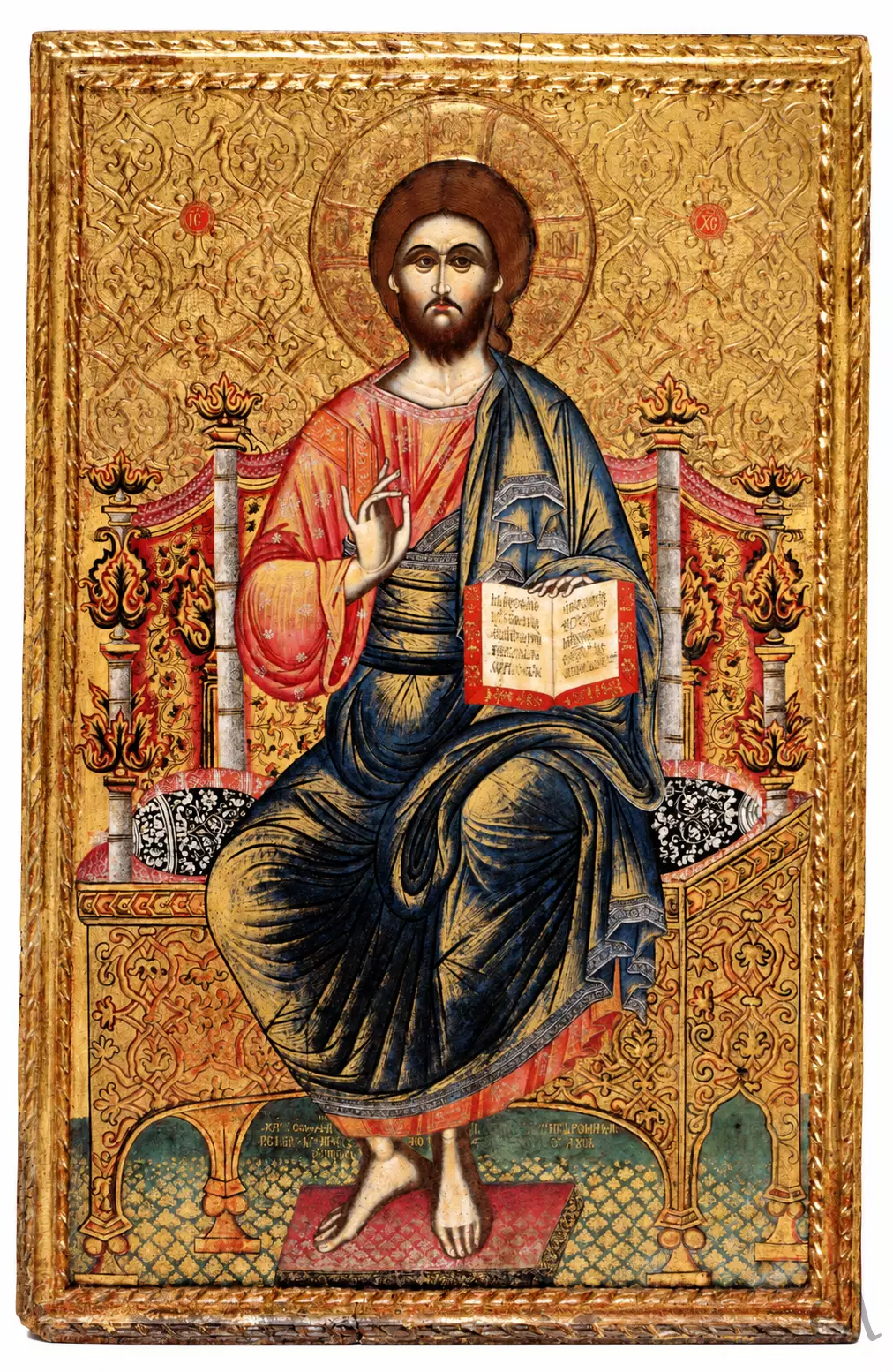
The Christ Pantokrator icon painted by Konstantinos the Hieromonk in 1694 is dominated by gold. It covers the background, spreads across the throne and its textiles, enters the painted garments, and surrounds the frontal figure of Christ with a densely worked ornamental field. Measuring 97 × 63.8 × 6 cm, the panel came from the Monastery of the Virgin at Llëngë, near Pogradec, and is preserved in the National Museum of Medieval Art in Korçë under inventory number 7488. It belongs among the earliest known icons by Konstantinos.
Christ is represented full-length upon an elaborate throne. He raises his right hand in blessing and supports an open Gospel book with his left. Although the iconographic scheme is well established, the execution bears the painter’s particular decorative language: raised gilded ornament, strongly linear facial modelling, extensive chrysography and a close visual relationship between figure, throne and patterned ground.
The Christ Pantokrator Icon and Its Enthroned Type
The title Pantokrator, from the Greek Παντοκράτωρ, identifies Christ as ruler and sustainer of all. In the Christ Pantokrator icon, this meaning is expressed through enthronement, frontality and a composition ordered around a firm vertical axis. The head occupies the centre beneath the upper arch of the throne; the torso is broad, the blessing hand held close to it, while the overlapping disposition of the legs introduces the principal deviation from the otherwise settled geometry.
No attendants share the pictorial field. The throne, developed with unusual elaboration, acquires something approaching an architectural presence. Slender supports rise along either side of Christ, interrupted by projecting finials shaped like flames. Curving arms, narrow shafts and patterned panels establish a layered frame within the rectangular frame of the icon itself. Behind the figure appears a red textile whose edges descend towards the sides, visually joining the backrest to the richly ornamented garments.
The feet rest upon a low rectangular footstool covered in red and gold. Beneath the throne, a narrow green zone is strewn with small floral forms. Here the otherwise almost continuous ornament briefly gives way to a distinct ground plane, which also provides space for the damaged dedicatory inscription.
Gold Relief and the Decoration of the Throne
Interlocking guilloches and palmettes cover the background in raised relief. Tightly organised, the pattern nevertheless changes sufficiently across the surface to avoid the appearance of a mechanically repeated screen. Curling stems pass behind the halo and around the red medallions bearing the abbreviated name of Christ, IC XC. As light falls differently across the uneven relief and the flatter painted passages, the gold acquires a changing surface rather than a single uniform brilliance.
Comparable gilded relief grounds occur in icons from Romania and in seventeenth- and eighteenth-century painting from northern Greece. In the present Christ Pantokrator icon, that decorative tendency has been absorbed into the visual culture of the southern Balkans. The inherited Pantokrator type remains intact, while the surrounding richness corresponds to the increasing attraction of patrons and workshops towards elaborately worked surfaces during the later seventeenth century. Elements associated with Baroque taste entered Orthodox painting through ornament, textiles, engravings and luxury objects while inherited iconographic forms continued to be used.
The throne carries the same decorative impulse further. Its upholstery is patterned with scrolling foliage, while two cushions, unequal in colour and treatment, support the seated figure. The dark lower cushion is covered with finely drawn white floral decoration; above it, red and gold predominate. Even the smaller structural members of the throne receive painted motifs or imitations of costly materials, leaving very little of the surface visually inactive.
Such abundance also belongs to the circumstances of patronage. Gold signalled expense, while on the icon itself it altered the behaviour of the painted surface. The background offers no developed earthly interior; spatial recession is compressed, and the throne advances strongly within a field that remains almost entirely given over to ornament.
The Face of Christ and Konstantinos’s Linear Manner
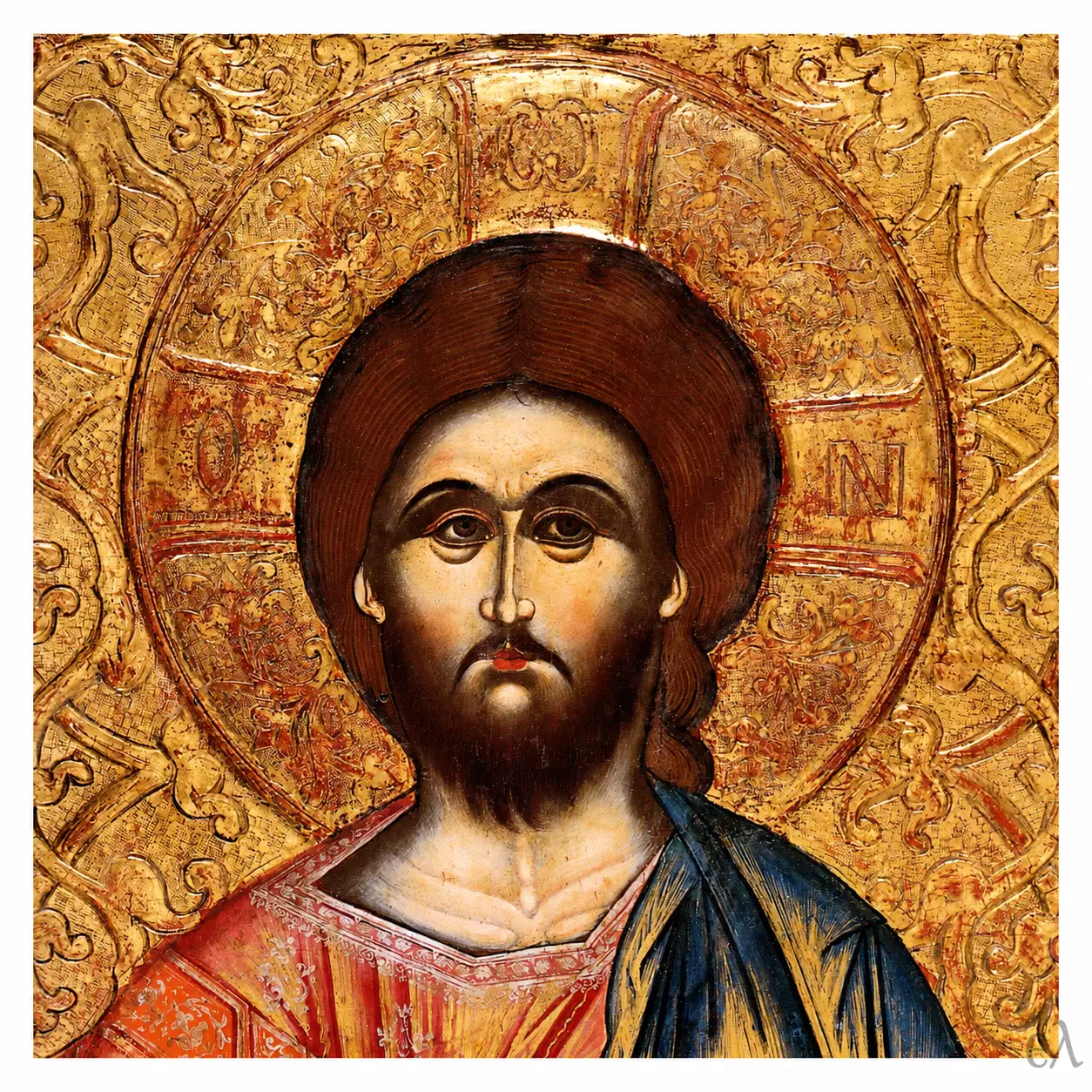
The accompanying detail shows particularly clearly how the face differs from its elaborate setting. Christ has a high forehead, long dark hair, a narrow nose and a compact beard. Large eyes, set almost level, lie beneath heavy arched brows. Red is used sparingly around the cheeks and lips, while the flesh tones remain strikingly pale beside the dark hair and intense gold.
Facial modelling proceeds through clearly differentiated bands of light and shadow. Fine linear strokes describe the hair; darker contours articulate the eyelids, nose and mouth. Around the eyes and along the neck, tonal transitions can be abrupt, giving the physiognomy a distinctly graphic firmness. Already evident in the Christ Pantokrator icon of 1694, this handling would remain characteristic of Konstantinos’s icon painting.
The direct gaze remains fixed and without visible movement. Ornament presses close around the head, particularly where the relief ground meets the cross-inscribed halo, yet the broad dark mass of the hair separates the face decisively from the gold. Immediately below appear the red chiton and deep blue himation. Both carry extensive gold decoration, from linear highlights marking the folds to ornamental hems and small floral details on the red fabric.
Particularly dense is the treatment of the himation. Gold striations follow the folds across the shoulder and lap, at times describing volume, elsewhere functioning almost as pattern in their own right. Colour and line articulate the body beneath the garments, while the frontal authority required by the subject remains undisturbed.
The Halo and the Open Gospel
Within the cruciform halo appear the Greek letters Ο Ω Ν, conventionally read as Ὁ Ὤν, “He Who Is”. The inscription evokes the divine name revealed to Moses in Exodus (Exodus 3:14) and identifies the enthroned Christ with eternal being. Each letter occupies a separate arm of the cross. Fine vegetal ornament fills the remaining areas, binding the halo to the decorative system of the background while concentric lines preserve its clear outline.
Christ’s open Gospel introduces a quieter rectangular form among the curves of the throne and drapery. Its red border is embellished with gold, and the visible leaves carry the passage from Matthew:
“Learn from me, for I am meek and humble in heart, and you will find rest for your souls. For my yoke is easy, and my burden is light” (Matthew 11:29–30).
Within an image of sovereignty, the choice has particular force. The Christ Pantokrator icon presents Christ enthroned amid costly ornament, while the Gospel displayed before the worshipper speaks of meekness, humility and rest. Beside the book rises the blessing hand, closely associating the written passage with the figure represented as its speaker.
Konstantinos the Hieromonk and the Donor Inscription
Konstantinos commonly signed his icons with the formula “the hand of Konstantinos the hieromonk”. More than fifty portable works connected with him have been identified in Albania, including Korçë, Elbasan, Vithkuq and Voskopojë, as well as in western Macedonia, on Mount Athos and within the former Archbishopric of Ohrid. Their geographical distribution points to an icon painter active within ecclesiastical networks extending across regions whose artistic traditions remained closely connected.
His production continued established Post-Byzantine forms, including references to Cretan painting and the legacy of Onouphrios, while giving exceptional prominence to ornament. The 1694 Christ Pantokrator icon already contains features associated with his work: pale flesh tones, emphatic contour, patterned vestments and gilded relief extending far beyond the halo. Its early date and secure signature give the panel a particular place within his surviving oeuvre.
The icon formed part of the Korçë collection presented in the Museum of Byzantine Culture’s 2006 exhibition, which followed a five-year programme of study and conservation. The accompanying catalogue publication, edited by Anastassia Tourta with entries by Evgenia Drakopoulou, documented the work among icons gathered from Orthodox communities in Albania.
Written in three sections around Christ’s lower legs, the dedicatory inscription is damaged but preserves its essential information. It names Konstantinos as the painter, dates the Christ Pantokrator icon to 1694 and records the contribution and desire of Nikolaos, a priest who also held the office of oikonomos. Within a coenobitic monastery, the oikonomos supervised financial and practical affairs, so his appearance in the inscription places the commission within the administrative life of the monastic community as well as within its liturgical setting.
The gold lettering participates in the ornamental character of the panel. Especially elaborate is the omega, whose expanded form recalls highly embellished Byzantine scripts. Painter, donor and date are recorded in words that also belong visually to the richly decorated lower field of the icon.
(The translation was edited by E. Wilson.)