
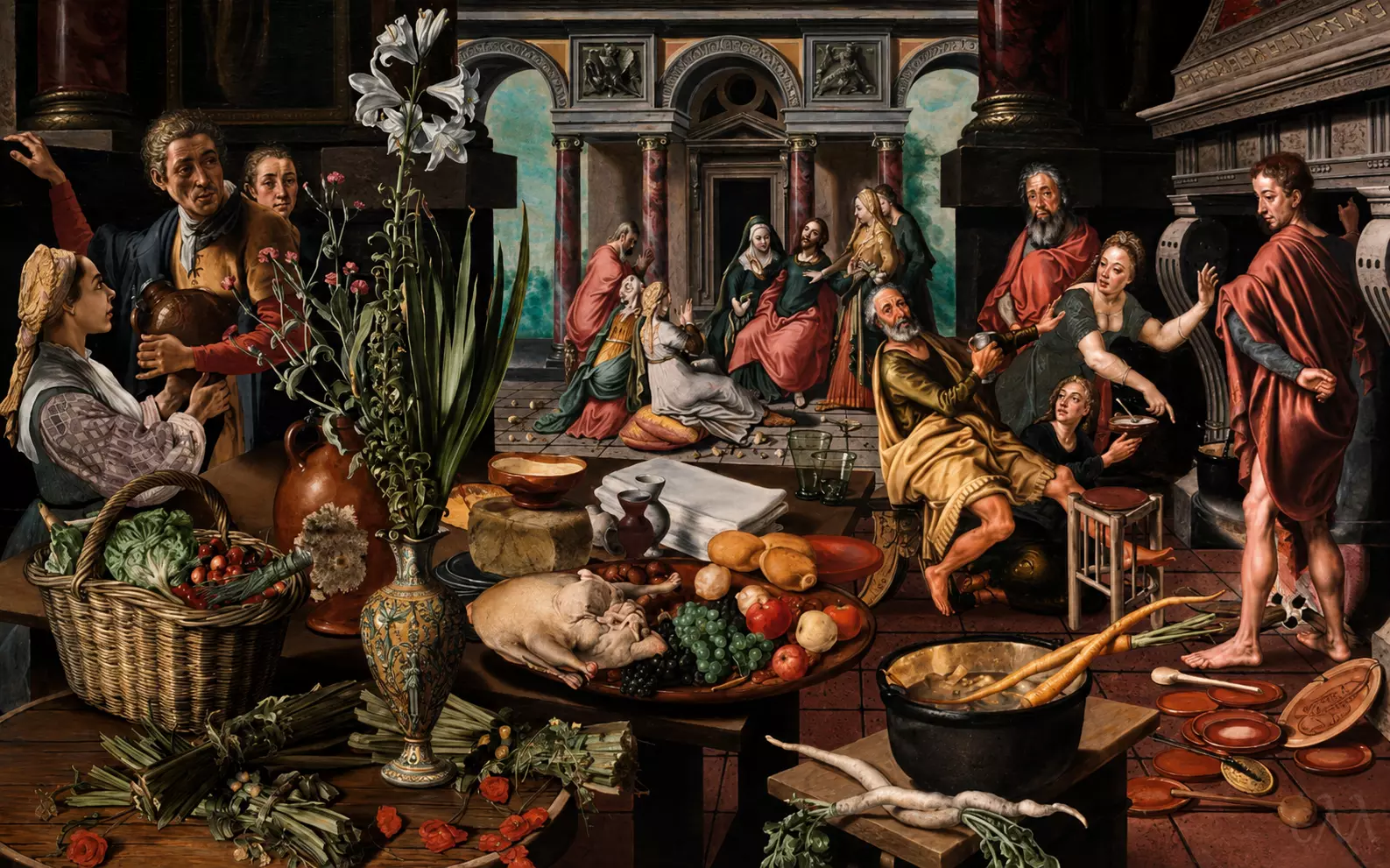
Pieter Aertsen’s Christ in the House of Martha and Mary makes the biblical narrative compete for attention with the physical abundance of ordinary life. Dated 27 July 1553, the large oil-on-panel painting measures 126 × 200 cm and is preserved in the Museum Boijmans Van Beuningen in Rotterdam. The museum’s collection record documents both the unusually precise date and the work’s material details. Aertsen, who was born in Amsterdam around 1508, spent an important part of his career in Antwerp at a moment when Netherlandish painters were enlarging the territory of painting itself: kitchens, food markets, domestic labour and objects of daily use began to claim a prominence previously reserved largely for sacred history and portraiture.
This development is almost provocatively visible in the panel. Christ appears deep within the composition, seated in an architectural interior and surrounded by the figures associated with the episode recounted in Luke (Luke 10:38–42). Mary sits at his feet listening, while Martha stands nearby amid the obligations of hospitality. Before the eye reaches them, however, it encounters flowers, cabbages and other vegetables, bread, fruit, cheese, poultry, ceramic vessels, glassware, folded linen and cooking utensils. Human activity presses in from both sides. The sacred episode occupies the spatial centre, yet Aertsen has made access to it dependent upon a journey through things.
Christ in the House of Martha and Mary: Sacred Narrative and Kitchen Abundance
The foreground has the density of an independent still life. At the left, a wicker basket is packed with leafy vegetables and small red fruits; beside it rise earthenware vessels and an ornate vase whose tall white lilies and smaller red flowers extend far above the tabletop. Bundled plants lie horizontally along the lower edge, their broken stems and scattered blossoms forming an untidy counter-rhythm to the carefully arranged vessels. Wicker, glazed pottery, vegetation, cloth and flesh receive different treatments of surface, contour and reflected light, giving the materials distinct visual weight without reducing them to decorative accessories.
Across the middle foreground, the display becomes heavier. A large platter carries a plucked bird among grapes, apples and other fruit, with rounds and loaves of bread occupying the space immediately beyond it. A substantial cheese and a dark ceramic jug sit beside a conspicuous pile of folded white linen. The cloth, pale and sharply angled amid the surrounding reds, greens and browns, interrupts the chromatic density of the food display. Its receding edges also participate in the movement towards the biblical group beyond, allowing still-life description and linear perspective to operate within the same passage of the painting.
More unsettled is the right foreground, where a large dark cooking pot projects towards the picture plane amid long wooden implements, root vegetables and scattered earthenware dishes. Figures cluster around the kitchen equipment, exchanging vessels and drink, while another man stands beside the architectural structure at the far edge. Their gestures generate lateral movement across this part of the panel. Deeper within the room, Christ and Mary remain comparatively still. The household proceeds around the sacred conversation according to its own urgent timetable.
Between these zones rises an imposing Renaissance architectural setting of coloured columns, rounded arches, sculpted relief panels and a tiled pavement. Through the openings, patches of pale landscape and sky relieve the dark interior. The repeated orthogonals of the pavement guide the eye inward, though bodies, furniture and food continually interrupt the route. Aertsen’s architecture therefore acquires a structural role beyond description. Mark A. Meadow, in his Meadow study, connects the painting specifically with the architectural vocabulary disseminated through Sebastiano Serlio and treats location as an active element in its rhetorical construction.
This unusual organisation has led Aertsen’s works of the period to be discussed as “inverted” paintings: motifs that conventional hierarchy might have treated as secondary expand dramatically, while the scriptural subject contracts into the distance. In Christ in the House of Martha and Mary, however, the inversion remains perfectly legible. Christ is positioned near the central visual axis and framed by the architecture, his red garment immediately distinguishable within the interior. Mary, lower before him, establishes another point of attention in the biblical encounter. Around them, the architectural setting forms something close to a separate picture embedded within the larger panel.
The traditional interpretation connects this arrangement with the theological distinction between the active and contemplative lives. Medieval Christian exegesis frequently understood Martha as a figure of active service and Mary as a figure of contemplation, an interpretative history examined specifically in Kenneth M. Craig’s study of Aertsen’s Martha-and-Mary paintings. Against Mary’s attentive stillness, the foreground abundance can consequently acquire another register of meaning. Food is prepared, vessels circulate, people move; farther back, listening takes precedence.
The material foreground remains closely bound to the Gospel episode itself. Food sustains the household in which Christ is received, while Martha’s labour belongs directly to the narrative of hospitality (Luke 10:38–42). Aertsen has enlarged the practical conditions of that hospitality until they occupy nearly the entire visual field. Meadow’s reading is useful at precisely this point, since worldly and spiritual experience extend through both pictorial zones, with architecture regulating their relationship rather than enclosing either one completely. The viewer repeatedly moves between these spaces and their different demands upon attention.
There is also an art-historical problem embedded in the composition. By 1553, still-life and genre painting had yet to acquire the fully autonomous status they would possess in the seventeenth-century Netherlands. Aertsen gives food, utensils and domestic figures an almost unprecedented pictorial scale while retaining the biblical story as the intellectual framework of the work. Scholarship on the emergence of Netherlandish genre painting places him among the sixteenth-century painters through whom ordinary life became an increasingly substantial subject in its own right.
From a distance, the tall lilies, basket of produce, gleaming vessels and laden table can dominate the first glance. Following the tiled pavement inward gradually alters that hierarchy and brings Christ into clearer focus. A return to the foreground then changes the objects themselves: bread, drink, prepared food and domestic labour have acquired a more explicit relation to the hospitality unfolding behind them. Looking moves back and forth across the panel, through objects, figures and architectural depth, with each passage modifying what seemed visually dominant only moments before.
(The translation was edited by E. Wilson.)