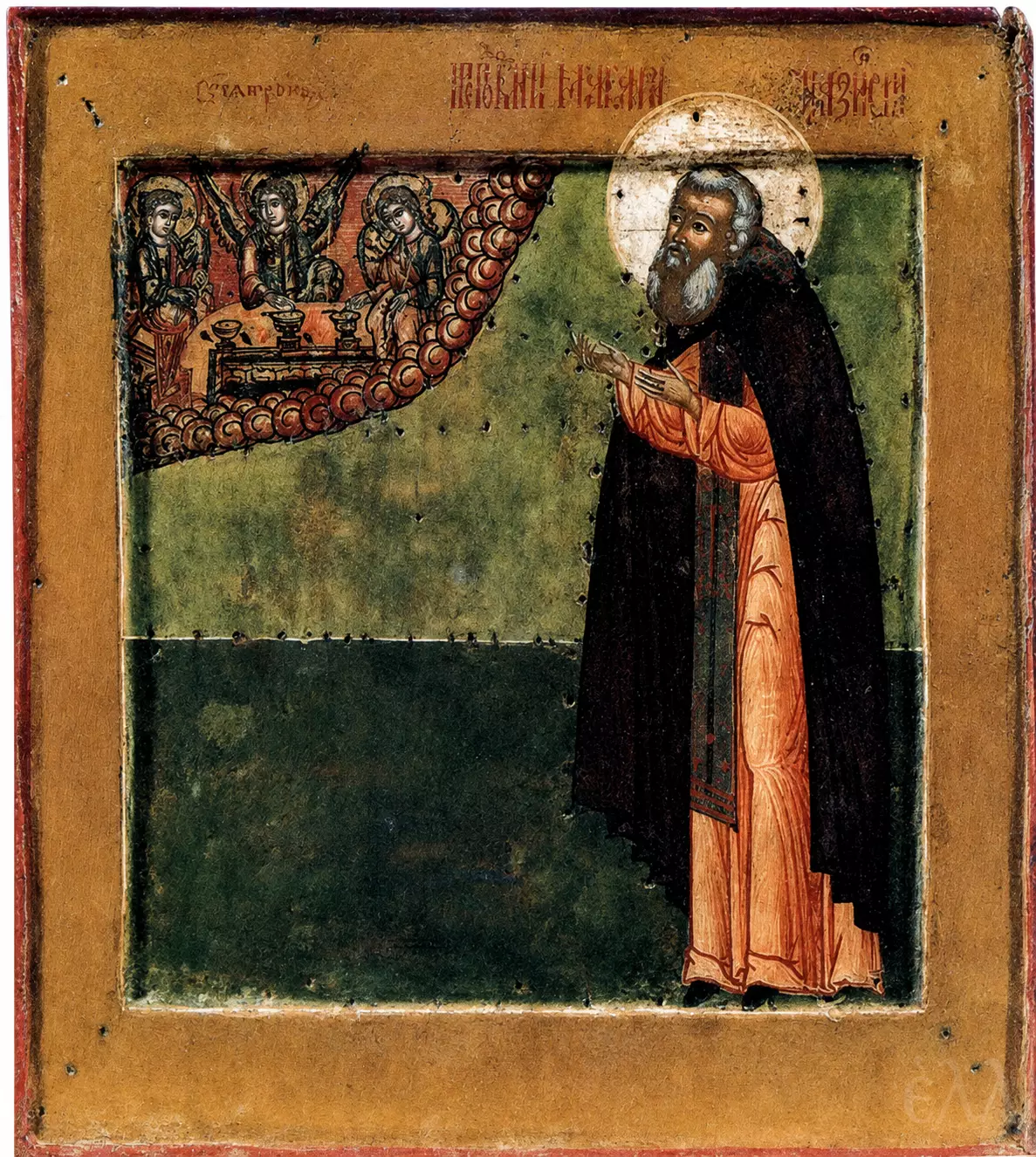
The Saint Macarius of Kalyazin icon, dating from the seventeenth century and associated with the Church of Saints Peter and Paul in Kashin, presents the Russian monastic founder in a composition centred upon prayer and visionary encounter. Macarius stands at full length on the right of the pictorial field, while above and opposite him the Holy Trinity appears in the form of three angels gathered around a table. Between the two parts of the composition is established a pronounced hierarchy of scale. The saint occupies much of the panel’s height; the sacred vision, compressed into a small cloud-bordered segment, remains distant in pictorial space yet commands the direction of his gaze and gesture.
Macarius is shown as an elderly monk with grey hair and a long, divided beard. A broad pale halo surrounds his head, partly overlapping the upper field reserved for the identifying Church Slavonic inscription. His monastic clothing establishes the principal chromatic contrast of the image: a dark, almost black mantle falls heavily from his shoulders, while the warm orange-red garment beneath is articulated by a network of fine, energetic highlights. Both hands are raised towards the apparition, the fingers slender and extended, their quiet articulation reinforcing the character of supplication without introducing dramatic movement.
The panel belongs to a well-established seventeenth-century iconography of Macarius of Kalyazin in prayer before the Holy Trinity, a form connected particularly with the saint’s monastery and the region around Kalyazin and Kashin. Research into his cult and visual tradition has shown how images of the saint developed after the discovery of his relics in 1521 and became increasingly varied during the seventeenth century.
The Saint Macarius of Kalyazin Icon and Its Seventeenth-Century Composition
Across the pictorial field stretches a broad green ground, horizontally divided into lighter and darker zones, with no architecture, landscape or descriptive setting to locate the encounter in ordinary physical space. Against this emptiness the vertical figure acquires unusual weight. His feet rest close to the lower boundary of the inner field, yet the body inclines slightly forward, directing the composition diagonally towards the upper left.
There the diagonal movement ends with the Trinity. Three winged angels are grouped around a small table bearing vessels, an abbreviated version of the Hospitality of Abraham (Gen. 18:1–15), the Old Testament subject that became an established Russian visual formulation of the Trinity. Enclosing the figures is a scalloped red-and-white border resembling a bank of stylised clouds. Their reduced scale creates a considerable spatial distinction: the heavenly manifestation occupies another order of pictorial reality, suspended above the monk rather than sharing his physical ground.
Colour carries much of the image’s structure. Macarius’s dark mantle forms a dense vertical mass, interrupted by the salmon-orange sleeves and lower garment; thin light strokes model the folds, particularly along the forearms and descending fabric, giving the drapery a graphic energy characteristic of Russian icon painting of this period. More subtly worked is the face. Dark brown modelling around the cheeks and eyes is broken by lighter strokes across the forehead, nose and hair, producing an individualised physiognomy within the established conventions used for the monastic saint.
Particular attention falls upon the saint’s gaze. It rises sharply towards the angelic group, leaving the viewer outside the direct exchange. Macarius does not confront the beholder frontally. Head lifted, shoulders inclined, hands extended, his entire posture assumes the visual form of prayer. Especially legible against the green background are the open palms and elongated fingers.
Surface wear has altered the visual balance without obscuring the design. Numerous small losses puncture the painted field and halo; abrasion appears along the borders, while areas of the green background have darkened unevenly. The outer frame retains a warm golden-ochre tone crossed by scratches and small losses, and the red edge survives irregularly around the perimeter. Separately from the painter’s original system of line and colour should be read these marks, which belong to the material history of the panel.
Macarius, born Matvei Kozhin near Kashin around the beginning of the fifteenth century and deceased in 1483, founded the Trinity Monastery at Kalyazin after an earlier period of monastic life. By the seventeenth century his image had become closely tied to the religious identity of the Upper Volga region. Documentary evidence records several representations of him associated with the Trinity, including icons produced for or connected with the Kalyazin monastery. A scholarly account of the monastery’s seventeenth-century artistic environment is supplied by Alexander Avdeev’s 2022 study of the painters who decorated its Trinity Cathedral in 1654; the evidence establishes an active regional culture of icon and monumental painting, although it does not provide an attribution for the present panel.
The icon’s effectiveness comes from this concentration of means. A monk, a broad field of green, the small celestial gathering above; between them, raised hands and an uninterrupted line of vision.
(The translation was edited by D. Smith.)