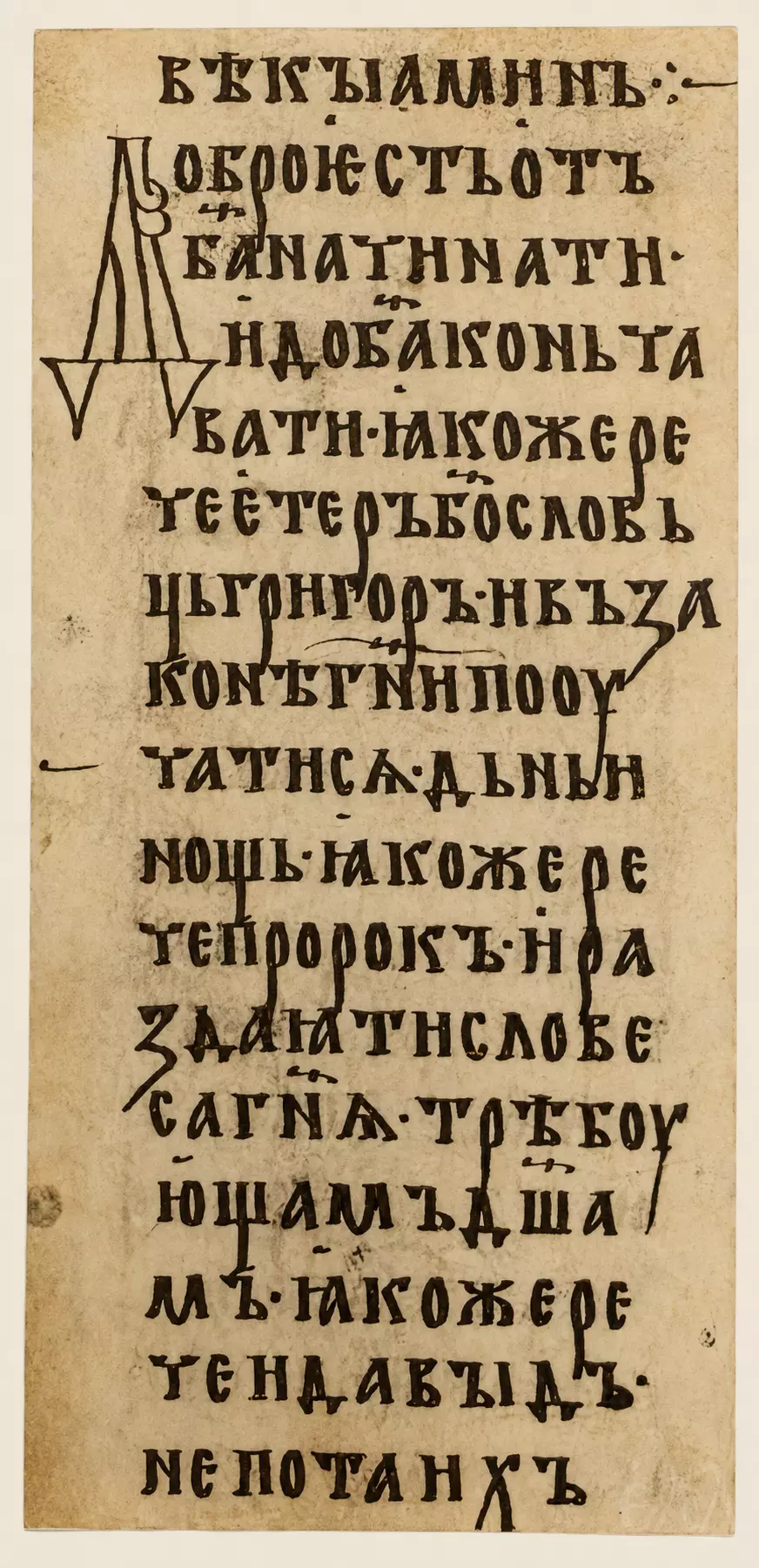
Folio 3 of the Teaching Gospel of Constantine the Presbyter is a particularly revealing page because its visual hierarchy coincides with a change in the literary structure of the work. The uppermost line closes the preceding text with “Amen”; beneath it, an enlarged Cyrillic Д opens the prose prologue with the words Добро есть… (“It is good…”). The manuscript, GIM Syn. 262 in the State Historical Museum in Moscow, is written on parchment in formal ustav and, according to the catalogue information supplied with the page, comprises 264 folios arranged in two columns. That catalogue dates the codex to the late twelfth or early thirteenth century and cautiously associates its production with Vladimir or Rostov.
The dating has remained contested. Roman Krivko, drawing on Elena Ukhanova’s palaeographic study, argues that its graphic and orthographic evidence supports an earlier date at the end of the eleventh or beginning of the twelfth century, while acknowledging the later chronology proposed in previous scholarship. His Krivko’s analysis identifies Syn. 262 as the earliest surviving East Slavonic witness to Constantine’s late ninth-century Bulgarian work.
Folio 3 of the Teaching Gospel of Constantine the Presbyter
The folio is visually austere. Across a warm, mottled parchment field run lines of dark brown-black writing, with no pictorial miniature in the surviving area and almost no ornamental colour. The catalogue identifies iron-gall ink among the materials employed in the manuscript, although the precise composition of the ink on this particular leaf cannot be established from appearance alone. The script is a disciplined Cyrillic ustav: upright letterforms, broad vertical strokes, comparatively stable proportions and clearly separated characters give the text a dense, measured rhythm. Abbreviations marked by titla interrupt the upper contour of several words, particularly sacred names and recurrent contracted forms. Punctuation appears sparingly, principally through points and paired marks that articulate the movement of the text. Script, abbreviation, ornamental initial, parchment support: these are the features most immediately available here to palaeographical and calligraphic examination.
The large initial Д changes that rhythm at once. It extends through several lines along the left side of the written field, its narrow upper structure carried downwards through elongated strokes into strongly splayed, triangular feet. A curved internal element slightly relaxes the severity of the surrounding geometry, while the letter itself remains unfilled, allowing the parchment to participate in its design. Scale provides the ornament. The initial occupies the same dark visual register as the main script and serves as a calligraphic marker, announcing a new textual unit without recourse to painted imagery.
Beside the initial, successive lines begin farther to the right; once its lower extensions have ended, the normal left alignment of the text resumes. The page has plainly been organised around the enlarged letter. There is no surrounding foliage, interlace or figural embellishment. Its effect comes from proportion, contour and the displacement of the ordinary text block. This restraint matters because the catalogue records other artistic materials elsewhere in the codex, including tempera, cinnabar and gold paint. Their presence in the manuscript as a whole cannot simply be transferred to folio 3. On this passage, what survives visibly is graphic in character.
The precise location of the initial matters as well. Д begins Добро, the first word of Constantine’s prose introduction, directly after the conclusion of the alphabetic prayer. A literary boundary thus acquires visual form: above, the end of the prayer; below, the opening of the prose discourse. Between them stands the enlarged letter, occupying several lines and altering the left edge of the text.
Constantine begins by declaring that it is good to begin with God and to end with God, invoking Gregory the Theologian before moving into Psalmic language concerning meditation “day and night” (Psalm 1:2). Dobriela Kotova has examined this passage closely and argues that the opening corresponds to Gregory Nazianzen’s Second Oration, in which beginning and ending with God establish the proper order of speech and action. Earlier discussion had often associated the formulation with Gregory’s alphabetic verse, an understandable connection given the alphabetic prayer immediately preceding Constantine’s prose. Kotova’s study traces the more specific textual relationship.
Free Translation of the Visible Text
“…unto the ages. Amen.
It is good, brothers, always to begin with God and to end with God, as Gregory the Theologian said; and to meditate upon the law of the Lord day and night, as the prophet [David] said (Psalm 1:2); and to set down the words of the Lord for souls that have need of them, as David said: ‘I have not concealed…’ (Psalm 39:10 LXX; 40:10 MT)”
The translation follows the sense of the passage visible on the folio and preserves its unfinished ending. The words following “I have not concealed…” lie beyond the portion shown; supplying them from expectation would blur the distinction between what can be read here and what would have to be reconstructed from the larger textual tradition.
Even across these few lines, the mechanics of medieval reading become unusually clear. The enlarged Д controls the entrance into the new section; once that entrance has been crossed, the compact ustav maintains continuity. Titla compress familiar forms without interrupting the horizontal movement of the writing. Small fluctuations in stroke thickness and ink density, meanwhile, retain something of the physical action of the pen on parchment. Formal as the letters are, they remain individually executed rather than mechanically identical.
The codex as a whole preserves further archaic graphic and orthographic evidence. Krivko notes its use of all four yus signs, an exceptional feature within the early East Slavonic manuscript tradition, and connects its linguistic history with a South Slavonic Cyrillic protograph. Those conclusions depend upon comparative study of the entire manuscript and cannot be extracted from folio 3 alone. Here the most conspicuous sequence is simpler and entirely visible: the terminating Amen, the great dark Д, the prose beginning Добро есть.
(The translation was edited by N. Jones.)