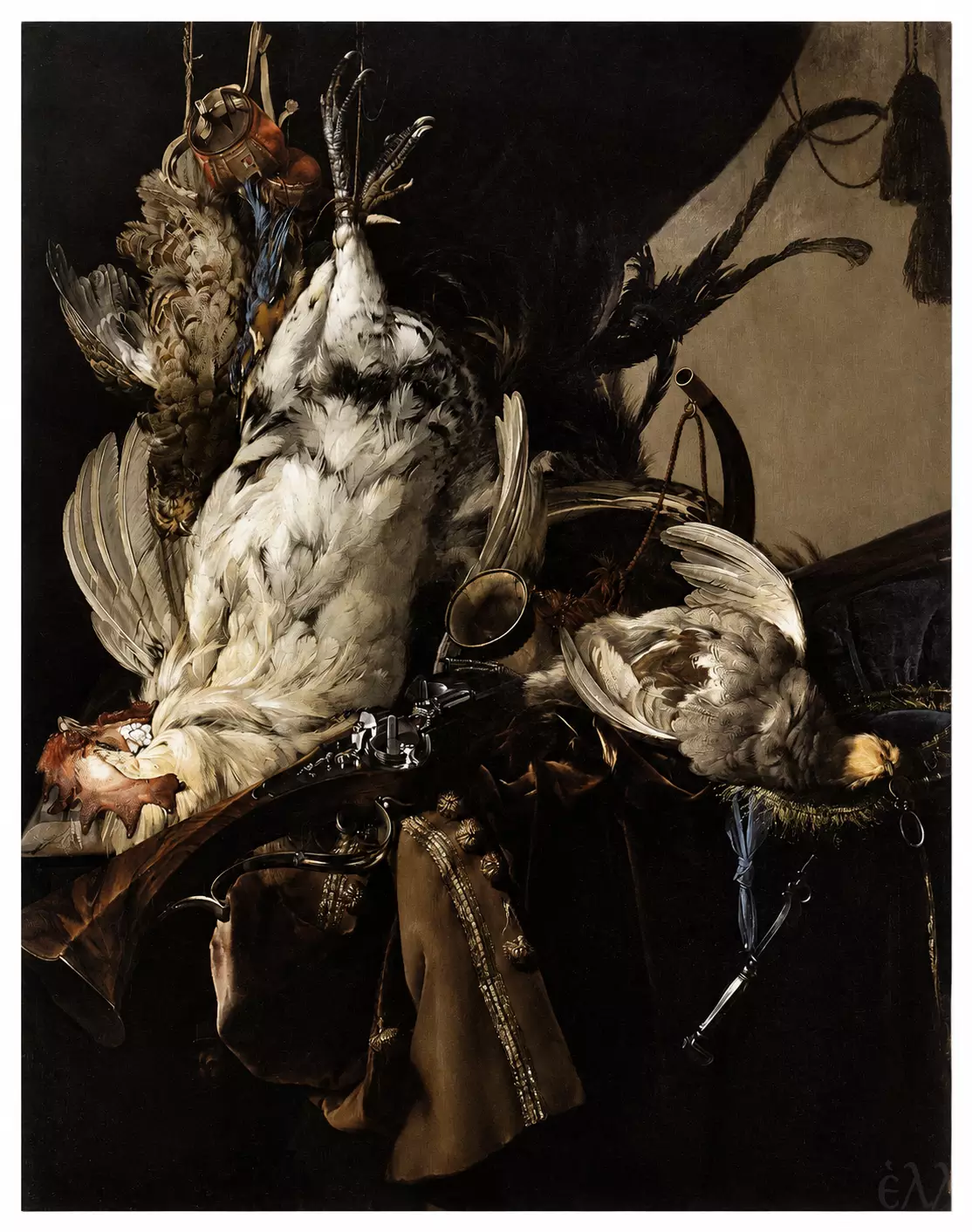
Suspended plumage dominates Willem van Aelst’s Still-Life of Dead Birds and Hunting Weapons, painted in 1660, an oil on canvas measuring approximately 86.5 × 68 cm and now in the Gemäldegalerie of the Staatliche Museen zu Berlin. The vertical format is unusually well suited to the subject. From above descend cords, birds and feathers, while a firearm crosses the lower part of the canvas and a dark garment falls heavily over the edge of the supporting surface. Nothing has been arranged as a simple inventory of trophies. Van Aelst compacts the objects, overlaps them, partially conceals one behind another, allowing a dense mass of pale feathers to emerge from a field of browns and near-blacks.
At centre-left hangs the largest bird, a white cock whose body forms the principal luminous mass of the composition. Its head has dropped towards the marble surface below, while smaller birds occupy the more crowded zone above. On the opposite side, a dead partridge rests close to the edge with one wing opened sufficiently to expose the layered structure of its feathers. The instruments and accessories of hunting appear between and beneath them: the gun, a hunting horn and clothing, all absorbed into the same carefully orchestrated disorder. The museum identifies the work as a hunting still life and records it as a signed and dated painting of 1660.
Willem van Aelst and the Hunting Still Life
Van Aelst had reached a mature stage of his career by the time this painting was made. Born in Delft in 1627 and trained initially by his uncle, the still-life painter Evert van Aelst, he worked in France before travelling to Italy. His years in Florence brought him into the circle of Cardinal Gian Carlo and Cardinal Leopoldo de’ Medici, for whom he produced a number of paintings. By 1656 he had returned north and subsequently established himself in Amsterdam. Hunting pieces, flower paintings, fruit still lifes and related subjects formed the core of his production, yet hunting still lifes became one of the areas in which his influence was especially pronounced after the middle of the seventeenth century.
The Berlin canvas belongs firmly to that development, but its effect depends on composition as much as subject. The great white bird establishes a descending axis slightly to the left of centre. Against it, the gun cuts through the lower field on a diagonal, beginning near the bottom edge and directing the eye back into the crowded interior. Curving elements interrupt these stronger lines: the circular opening of the hunting horn, the cords, the bent wings, loops and straps. Above, the birds seem to hang freely; below, objects become increasingly compressed against the ledge and the folds of the garment. Van Aelst therefore keeps the composition asymmetrical without allowing it to become unstable.
A gathered curtain at the upper right alters the pictorial space again. Its dark mass cuts across the background in a broad diagonal and opens onto a quieter grey-brown field, where hanging cords make thin linear marks. The curtain also establishes a shallow theatrical enclosure around the trophies. It does not open onto a landscape or a distant room. Depth remains restricted, and this compression concentrates attention upon the objects themselves: feather, fabric, wood, metal, horn.
Feathers, Metal and Cloth in a Dark Pictorial Field
Material differentiation is one of the most accomplished aspects of Still-Life of Dead Birds and Hunting Weapons. Van Aelst makes the pale feathers of the large cock change character from one area to another. Some lie smoothly against the body; others separate into thin, irregular tips, catching light along their edges. Grey and cream plumage darkens towards the surrounding forms, while isolated white highlights cause certain feathers to project almost abruptly from the shadow. The partridge is handled differently. Its shorter feathers create denser patterns of brown, grey and off-white, with the opened wing offering a particularly controlled sequence of overlapping forms.
Against such softness, the gun introduces a different visual language. The hard edges and small reflective points of its metal mechanism are sharply defined, though much of the weapon remains submerged in shadow. Van Aelst does not illuminate the entire object in order to demonstrate its construction. A few selected reflections are enough. The hunting horn, partly concealed near the centre, is treated in much the same way, its curved contour catching a narrow highlight before the surrounding darkness closes in again.
Then the fabric. Heavy folds descend over the front edge, their weight conveyed through broad areas of brown-black interrupted by narrow decorative bands and small ornaments. The garment identified in the museum description as a man’s jacket occupies a substantial area, yet at first it almost disappears because its tonal value approaches that of the surrounding background. This is characteristic of the painting’s visual method. Objects emerge slowly. Light is concentrated on selected surfaces, and neighbouring forms can remain only partly disclosed.
The resulting chiaroscuro — restrained, yet structurally important — gathers the eye toward the central birds through bright plumage; metallic reflections break the darkness lower down, and a muted light across the right-hand background keeps the composition from closing completely. Colour plays a quieter role. White, silver-grey, ochre, brown and black predominate, punctuated by the reddish head of the cock and small warmer notes among the hanging birds and equipment. Through that reduced chromatic range, differences of texture become more conspicuous.
Van Aelst’s brushwork appears correspondingly controlled. The paint describes the frayed edge of a feather, the gleam of polished metal, the soft thickness of cloth, each according to its physical character. Such differentiation was specifically admired in his work, and the Berlin museum draws attention to his ability to render materials as dissimilar as metal, feathers and textiles. The virtuosity is evident, but it never functions apart from the compositional structure, since surface and arrangement remain bound together throughout the painting.
Hunting Culture and the Meaning of the Still Life
By 1660 the hunting still life had become an increasingly prominent form within Dutch painting. Van Aelst was among the painters who contributed decisively to its development, and examples by him were valued for the combination of refined composition and technical finish. The subject itself carried social associations. The Staatliche Museen connects paintings of this kind with the growing interest of prosperous Dutch citizens in hunting pursuits during the second half of the seventeenth century. Guns, horns, specialised clothing and carefully displayed quarry could therefore evoke a cultivated world of leisure, equipment and possession.
That social dimension changes the way the apparent disorder may be understood. The birds have been killed, suspended, laid down; the equipment has been used and then abandoned among them. Yet every object has been positioned for visibility. The gun lock faces outward. The broad pale body of the cock turns towards the light. The partridge’s wing opens across the darker surface beneath it, and even the garment, apparently dropped over the ledge, forms a large tonal base upon which smaller details become legible, so that what looks like disorder turns out, in fact, to be carefully designed.
The death of the birds inevitably gives the painting a different emotional register from a flower or fruit still life. Their bodies retain a remarkable visual presence, particularly through the freshness with which the feathers are represented, while movement itself has ceased. Van Aelst exploits that contradiction without requiring a single allegorical explanation. A direct vanitas interpretation would go beyond what the visible evidence demands; no explicit emblem forces the spectator towards such a reading. The painting can sustain awareness of mortality while continuing to operate as an image of the hunt, material luxury and painterly accomplishment.
One small piece of evidence brings Van Aelst himself into the carefully staged world of objects. The Berlin catalogue records a partially legible signature at the lower left, “G[…]lmo van Aelst 166[0]”. His use of an Italianised form of his given name occurs elsewhere and recalls the years spent in Florence before his return to the Netherlands. It is a discreet assertion of authorship, offered in a painting whose very subject gave him every chance to display his skill through the handling of plumage, polished metal, cord, horn and cloth, each rendered with the same close attention.
The Gemäldegalerie acquired the canvas in 1960 from a private collection in Berlin.
(The translation was edited by F. Kalimeris.)