
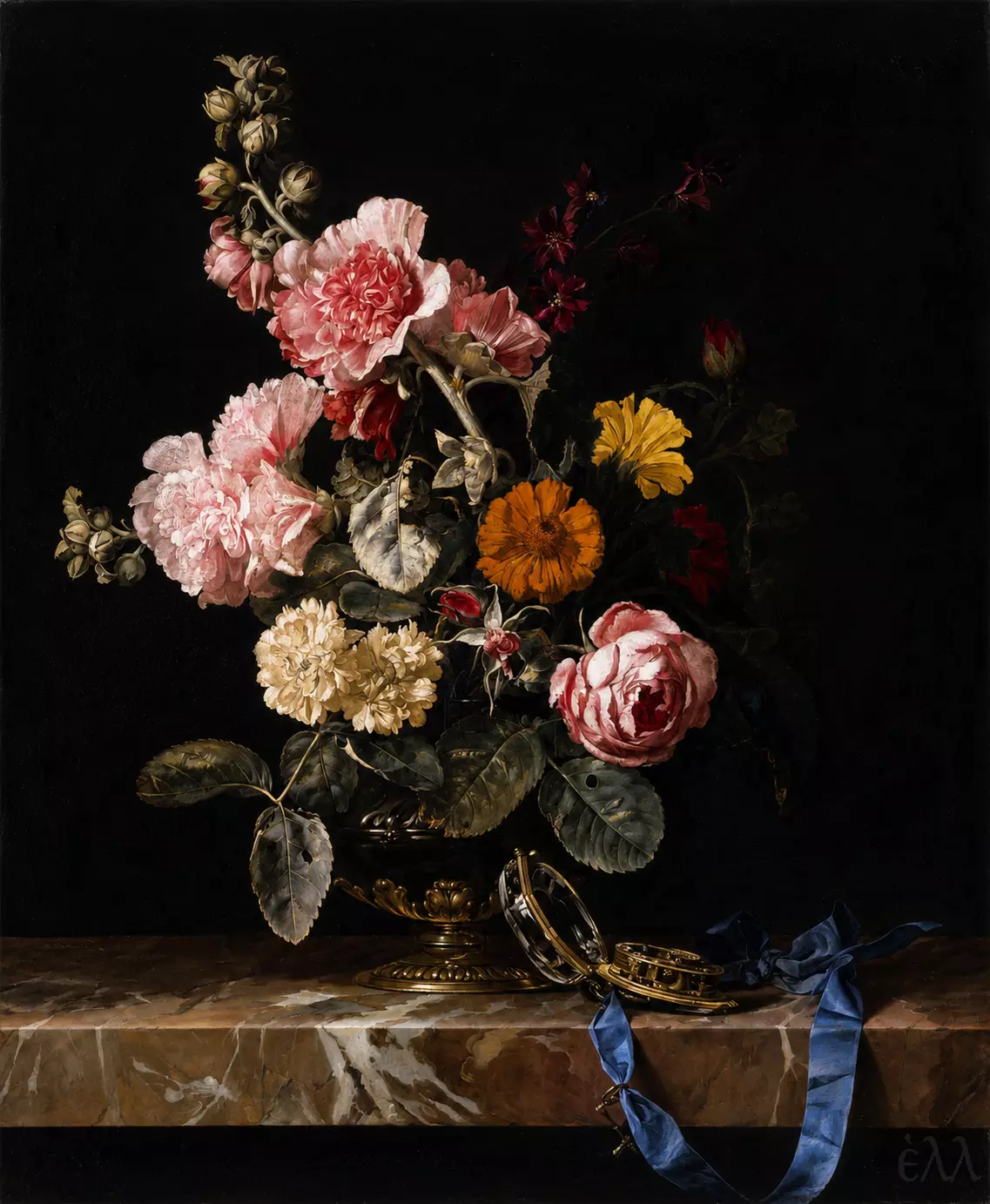
Painted in 1656, Willem van Aelst’s Vase of Flowers with Pocket Watch brings together two subjects governed by very different measures of time. A bouquet rises from a dark vessel in a succession of pale pink, white, orange and deeper red blossoms, some fully opened, others turning away or remaining in bud. At the foot of this floral abundance lies the object named in the title: a pocket watch, its gold-toned case opened upon the marble ledge and attached to a long blue ribbon that falls over the edge. The painting, executed in oil on canvas and now in the Staatliche Museen, Kassel, belongs to the sophisticated tradition of seventeenth-century Dutch still-life painting in which close visual observation is joined to an equally calculated orchestration of luxury, fragility and surface.
Van Aelst, born in Delft in 1627, gives the composition no surrounding interior and almost no conventional setting. Darkness isolates the objects — deliberately, almost completely — and against it, petals acquire weight and texture, leaves emerge only where reflected light finds their surfaces, and the metallic watch catches a sharper, colder brilliance. Yet the arrangement never becomes a botanical inventory. Stems cross, blossoms overlap, several flowers retreat towards obscurity; the bouquet develops irregularly, with one tall spray climbing into the upper left of the composition while darker forms remain scarcely detached from the ground. Its apparent spontaneity is therefore carefully structured.
Vase of Flowers with Pocket Watch: Composition, Surface and Time
From the marble ledge upward, the composition unfolds through an asymmetrical movement that gives Vase of Flowers with Pocket Watch much of its visual tension. The vessel stands slightly left of the painting’s central axis, but the bouquet cannot be contained by that stable base. A large pink flower near the upper zone pushes outward, another pale blossom opens broadly to the left, while orange flowers introduce concentrated areas of warmer colour towards the centre and right. Lower down, a pink rose turns towards the light with its outer petals curling around a densely folded centre. No single bloom entirely dominates. Attention moves instead through successive points of illumination, from petal to leaf, from leaf to polished metal, then down towards the ribbon.
That movement is reinforced by the treatment of the dark ground. Van Aelst does not separate every stem or leaf with equal clarity. Several forms disappear almost completely, particularly towards the right side and behind the central mass of flowers. The resulting figure-ground relationship is unstable in a deliberate way: one leaf is crisply modelled, another little more than a silhouette; a flower may be struck by light while the stem supporting it vanishes into shadow. The bouquet, as a result, appears to emerge from the darkness itself, its edges never settling neatly against a uniformly coloured backdrop.
Colour works through comparable interruptions. Pale petals contain small shifts from cream and cool white to blush pink, deeper rose and subdued red. The orange flowers provide stronger accents, though even these are moderated by shadow. The foliage is considerably darker, its greens frequently approaching brown or black except along curled edges and raised veins. Against this restrained chromatic field, the blue ribbon becomes unexpectedly prominent. Its colour is saturated enough to attract the eye immediately, but its importance also derives from shape: it twists, folds, narrows, broadens, passes across the ledge and hangs freely into the dark lower space.
The ribbon leads directly to the pocket watch. Its placement deserves attention. Van Aelst has not tucked the object discreetly among the flowers; he has brought it forward, close to the front edge of the marble surface, and opened its case so that several concentric metallic forms catch the light. The polished surfaces differ markedly from the soft petals above them. Petals absorb and diffuse illumination; metal concentrates it into thin, bright reflections. Beside the flowers, the watch introduces another order of precision — circular, engineered, measurable.
Time, consequently, enters the painting without requiring a narrative. A seventeenth-century pocket watch was a costly possession and an object associated with increasingly exact measurement, yet in still-life painting a timepiece could also evoke the passing of hours and, by extension, the instability of material things. Such associations need not turn every flower picture into a rigid moral allegory. Van Aelst leaves the relationship open enough for the objects themselves to sustain it. The flowers are at different stages: buds remain closed; some blossoms appear newly opened; others bend, turn or show petals beginning to loosen. Beside them rests an instrument designed to divide duration into controlled units. Living time, however fleeting — and measured time, however exact — share the same narrow ledge.
Beside these measures of time, the marble ledge introduces a third temporal register of its own. Its veined surface appears solid, cold and enduring when set against petals whose physical delicacy Van Aelst stresses repeatedly. Across the front face of the ledge run irregular veins and fissure-like markings, rendered with considerable attention to differences in colour and texture. Above: flowers, leaves, gold, ribbon. Below: darkness. The narrow architectural surface becomes the point at which these objects are briefly assembled, almost balanced before the eye.
For all the descriptive precision, the painting is not organised through equal detail. This is central to its effect. The uppermost buds are comparatively subdued; the deepest foliage is partially withheld; certain red flowers on the right almost merge into the background. Elsewhere the painter becomes exacting. The folded rose petals receive thin highlights along their edges, the watch flashes with minute reflections, the ribbon is modelled through alternating bands of illumination and shade. Van Aelst controls visibility rather than simply increasing it.
The vessel itself is similarly restrained. Its dark body is difficult to separate completely from the surrounding shadow, though ornament and reflected highlights appear around its lower portion. This partial concealment makes the profusion above seem larger. Stems converge into a comparatively narrow base, then spread upward and laterally, producing an arrangement that alternates density with open intervals. One branch extends towards the upper left; another, much darker, ascends through the right half but remains almost absorbed by the background. An asymmetry governs the whole, deliberate rather than disordered.
Within Dutch still-life painting, such attention to individual surfaces could display technical accomplishment, yet Van Aelst’s handling avoids the impression of indiscriminate virtuosity. He differentiates substances because their differences structure the image. The marble is veined and opaque, the metal hard and reflective, the ribbon smooth and pliable, the leaves heavy or curling, the petals soft enough to seem bruised by contact. Distinctions of material, in Van Aelst’s hands, become distinctions of composition.
There is also a marked tension between vertical and downward movement. The bouquet climbs, branches, opens. The ribbon falls. Its long descending strip crosses the edge of the ledge and continues towards the bottom of the composition, carrying the gaze away from the concentrated flowering mass. The pocket watch forms the hinge between these opposing movements. Set close to the vessel yet angled towards the viewer, it belongs visually to the flowers while simultaneously initiating the descent.
The painting’s sophistication lies partly in this refusal to make abundance static. Flowers at their fullest occupy the upper and middle areas, but nothing is presented as permanently secure. Petals fold over one another, stems incline under their weight, leaves turn into darkness; below them, a ribbon slips across stone. Even the brightest surfaces are surrounded by shadow. The effect is luxurious, certainly, but it is also unstable.
In Vase of Flowers with Pocket Watch, Van Aelst makes close observation serve an arrangement of intervals, interruptions and material contrasts. The eye can linger over the pink rose, follow the pale clustered blossoms, move into the orange centres, lose a stem in the black ground, recover it beside a leaf, descend at last to the opened watch and the blue ribbon. Nothing requires an emphatic symbolic statement. The measured object lies quietly beside forms whose beauty depends upon change, and the contrast remains visible long after the individual flowers have been counted.
(The translation was edited by F. Kalimeris.)