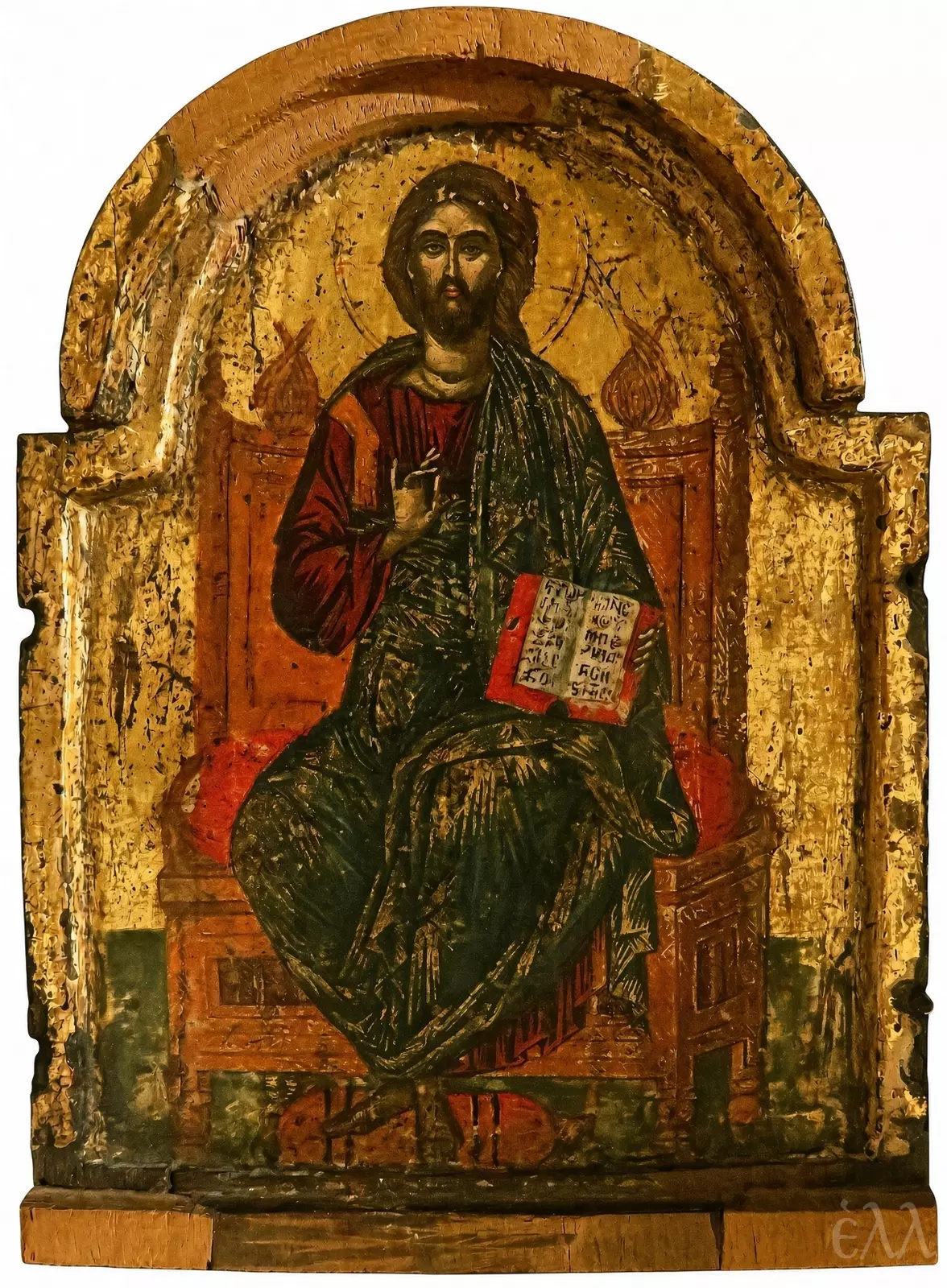
The Christ Pantocrator icon preserved in the Ikonen-Museum Recklinghausen is a small Greek panel of the 16th century, measuring only 20 × 15.2 cm, yet its composition retains the scale and ceremonial authority associated with much larger representations of the enthroned Christ. Painted in egg tempera on wood, it originally formed the central section of a triptych. The lateral wings have disappeared, leaving the semicircular upper termination and the stepped profile of the panel to suggest something of its former architectural character. The work entered the museum in 2019 as part of the collection donated by Reiner Zerlin and bears inventory number 4288.
Christ sits frontally upon a high-backed throne, his body contained within a compact, almost immobile silhouette. His red chiton remains visible beneath a dark blue-green himation crossed by numerous fine gold strokes. The throne, largely red and ochre in tone, is furnished with a broad cushion and rises behind the figure as a severe rectangular structure. Christ raises his right hand in blessing and supports an open Gospel book with his left. According to the museum documentation, its text is John 8:12: “I am the light of the world. Whoever follows me will not walk in darkness” (John 8:12), a passage frequently associated with images of the Pantokrator.
Age has altered the visual balance of the panel. Around the perimeter and upper arch, abrasion and losses interrupt the gold ground; the exposed, irregular surface now stands in sharp relation to the surviving passages of dense red, green and gold.
Christ Pantocrator Icon: Enthronement, Gesture and the Open Gospel
The representation belongs to one of the most enduring iconographic types in Eastern Christian art. Pantokrator, conventionally rendered as “Ruler of All” or “Almighty”, identifies Christ through a combination of frontality, blessing gesture, Gospel book and sovereign bearing. In this panel the addition of the throne develops the type into an explicitly enthroned image. Christ occupies the centre of the composition, while the architecture of the throne fixes him to its vertical axis. Its straight back rises to either side of the shoulders; the cushion and projecting seat establish a shallow spatial enclosure around the body.
The proportions are deliberately concentrated. A large head, relatively narrow shoulders and the ample mass of the drapery make the figure dominate the restricted pictorial field. Beneath the robes, the legs cross with a degree of movement, yet the upper body remains almost perfectly frontal. This small deviation matters. It keeps the seated figure from becoming an entirely geometric construction and allows the lower half of the composition to move across the otherwise emphatic verticality of head, torso and throne.
The face, although affected by surface wear, retains a clear underlying structure. Long dark hair frames an elongated oval physiognomy; the beard broadens towards its lower edge, while the narrow nose establishes the central axis. Set beneath strongly defined brows, the eyes meet the space before the icon directly. Facial modelling is economical. Dark underlying tones remain prominent around the eyes, cheeks and beard, while lighter passages articulate the forehead, nose and upper cheeks. The painter relies considerably on line. Contours carry much of the descriptive work that, in a more volumetrically conceived image, might have been achieved through wider tonal gradation.
Across the garments, the same linear instinct becomes more conspicuous. Fine gold striations traverse the dark himation, breaking its large surface into narrow folds and angular intersections. Some correspond to the construction of the drapery; elsewhere their decorative rhythm seems nearly independent of physical volume. Against the red chiton, these gold lines also sharpen the chromatic separation between the two garments. The effect would originally have been stronger when the surrounding gold ground was more continuous.
Such gold highlighting belongs to an established pictorial vocabulary extending deep into Byzantine artistic practice and continuing in post-Byzantine icon painting. Produced after the political end of the Byzantine Empire, this 16th-century Greek icon remains firmly within an inherited visual language. “Post-Byzantine” is therefore useful in its precise art-historical sense: chronology has changed, while iconographic conventions, workshop practices and forms of visual thought continue through regional transformation.
That continuity should not be converted into a more exact attribution than the evidence permits. The museum records Greece as the place of production and dates the icon to the 16th century. No painter is named, and the available information does not justify assigning it to a specific regional workshop or to the Cretan School. Greek icon painting during this period embraced several interconnected centres; painters moved between territories, established models circulated in numerous forms. A scholarly discussion of comparable late 15th- and 16th-century representations of the Pantokrator can be found in Alexandra Trifonova’s study of Pantokrator iconography, which also demonstrates the persistence and adaptability of the type in post-Byzantine painting.
The Gospel book introduces a second visual centre. Its pale pages, bordered by the intense red of the binding, interrupt the dark mantle at Christ’s left side. Because the book is opened outward, its written surface belongs simultaneously to the represented figure and to the viewer. The documented text from John 8:12 has a long history in images of Christ and is particularly appropriate to the Pantokrator type. Text and figure work together: the identity expressed by the inscription on the page is presented through the person who holds it.
His right hand answers the book across the torso. Framed by the red sleeve, the blessing gesture occupies the opposite half of the composition, making the exposed hand unusually prominent despite its small scale. Book and gesture create a transverse relationship within the otherwise frontal scheme. Between them, the body remains still. That compositional economy helps explain the extraordinary durability of the Pantokrator formula, in which very few elements are required to establish identity, authority and direct visual address.
The original triptych format adds another dimension. A central panel of this kind would have been encountered together with images painted on the missing wings, their subjects now unknown. When opened, the wings would have expanded the visual field laterally around the enthroned Christ; when closed, they would have altered or concealed the central image according to the particular construction of the object. Small triptychs were especially suited to forms of personal or restricted devotional use, although an exact original setting for this example has not been documented. Byzantine scholarship has shown how portable icons could participate in changing ritual and spatial circumstances rather than belonging to a single fixed mode of display; Nancy Patterson Ševčenko’s study of their liturgical use remains an important discussion of that broader relationship.
The physical condition of the icon has become inseparable from its present appearance. Large areas of the gold field are abraded, minute losses scatter across the painted surface, and the edges have undergone substantial wear. Around the upper curve, breaks in the gold ground reveal successive pale and dark layers beneath it. The available museum documentation does not establish when these changes occurred or what conservation interventions may have taken place, so the surviving surface should be read cautiously. What can be observed is a material history accumulated upon the image: paint, gold ground, losses, exposed preparation, further abrasion.
Yet some passages remain unexpectedly forceful. The deep red surrounding the throne survives with considerable density; narrow gold strokes still catch the folds of the himation; the open Gospel remains immediately legible as an object even before its words are considered. Christ’s feet project beneath the heavy drapery and rest within the compressed lower zone of the throne, whose architectural members are articulated by incised-looking lines and small rectangular divisions.
The semicircular summit gives the whole panel a final architectural accent. Its nested, stepped bands curve above the halo almost like the reduced outline of an apse, concentrating the field over the head of Christ. Whether the missing wings repeated or modified this profile cannot be established from the surviving central panel. In its present state, the arch, the throne and the frontal body form a compact sequence of enclosing shapes. The eye returns towards the face, descends along the blessing hand, passes across the pale leaves of the Gospel, then enters the darker mass of the drapery.
At twenty centimetres high, the icon achieves its effect through visual concentration. Its anonymous painter inherited an image already centuries old and worked within conventions recognisable across the Orthodox world, while the handling of line, colour and gold belongs to the conditions of a much later Greek artistic culture. The damaged surface now makes those layers of time unusually visible. Gold persists beside exposed preparation; crisp passages beside abrasion. The original triptych has contracted to a single central panel, with Christ still seated within its worn, arched frame as it survives today.
(The translation was edited by A. Orfanos.)