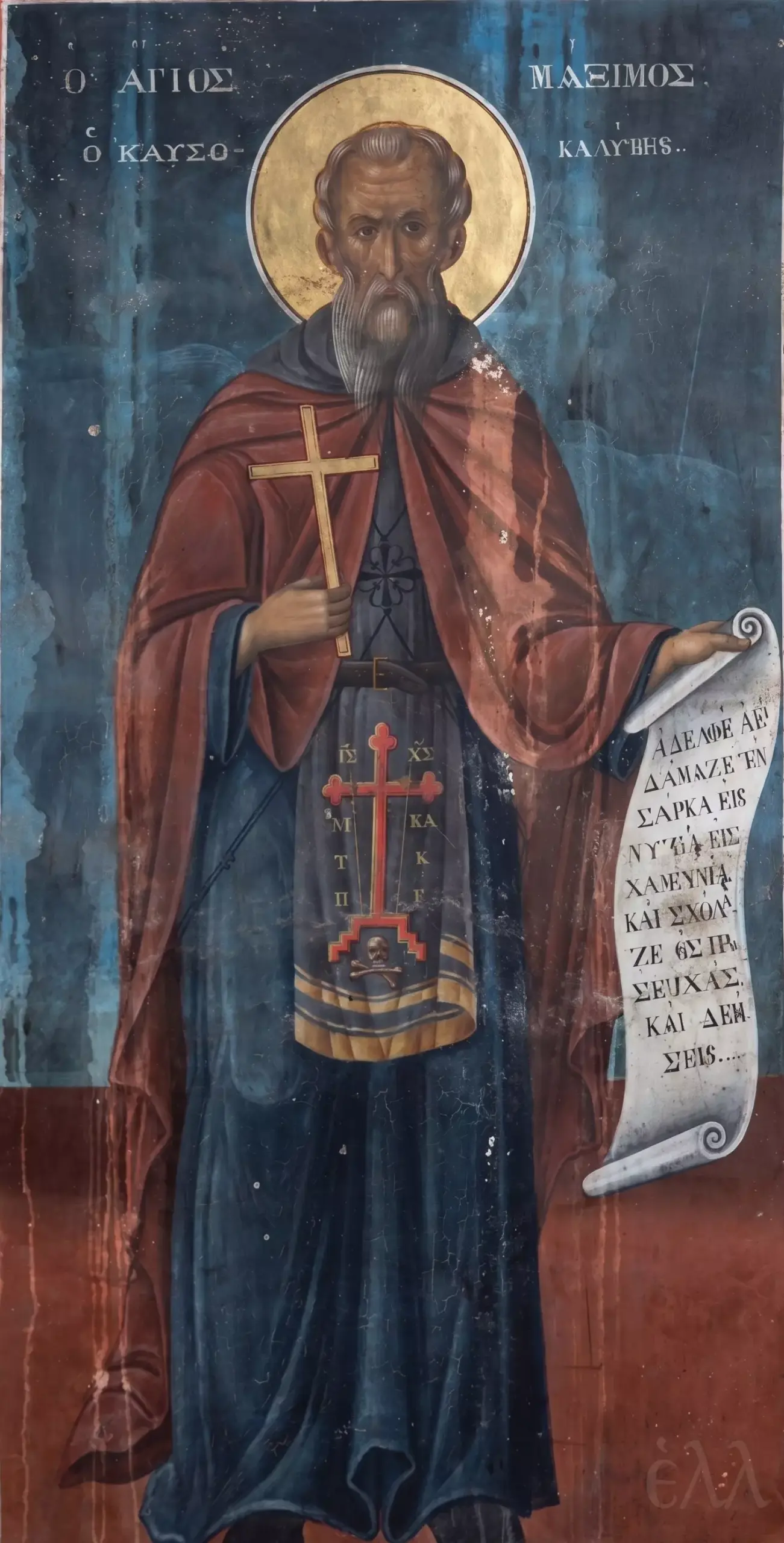
Saint Maximos Kausokalybites appears as a full-length monastic saint in the wall painting preserved at the Holy Monastery of Pantokrator on Mount Athos. Frontal and immobile, the figure is closely ordered around a vertical axis formed by the head, beard, monastic habit and long folds descending towards the feet. His right hand holds a slender golden cross, while his left supports an open scroll whose text carries an ascetic exhortation. The identifying inscription, distributed across the deep blue field beside the halo, names him plainly: Ο ΑΓΙΟΣ ΜΑΞΙΜΟΣ Ο ΚΑΥΣΟΚΑΛΥΒΗΣ.
A nineteenth-century surface now determines the visual character of much of the katholikon of Pantokrator. The church itself preserves a substantially older history: its original wall paintings belong to the second half of the fourteenth century, while extensive repainting was undertaken in 1854 by Matthaios Ioannou of Naousa. Recent non-destructive investigation at the monastery has revealed earlier painted strata beneath a number of the visible nineteenth-century compositions, although such evidence cannot automatically be extended to every individual figure without specific technical examination. (Pantokrator Monastery)
Within this later Athonite environment belongs, visually, the representation of Maximos. Strong contour, a controlled chromatic range, direct frontality and considerable attention to costume combine with a more softly modelled face. The result retains the hieratic authority of the Byzantine artistic tradition while speaking in the language of late Post-Byzantine monumental painting. Especially marked is the contrast between the dark blue habit and background, the broad red-purple mantle, the pale scroll and the concentrated gold of halo and cross.
Saint Maximos Kausokalybites and the Athonite Monastic Image
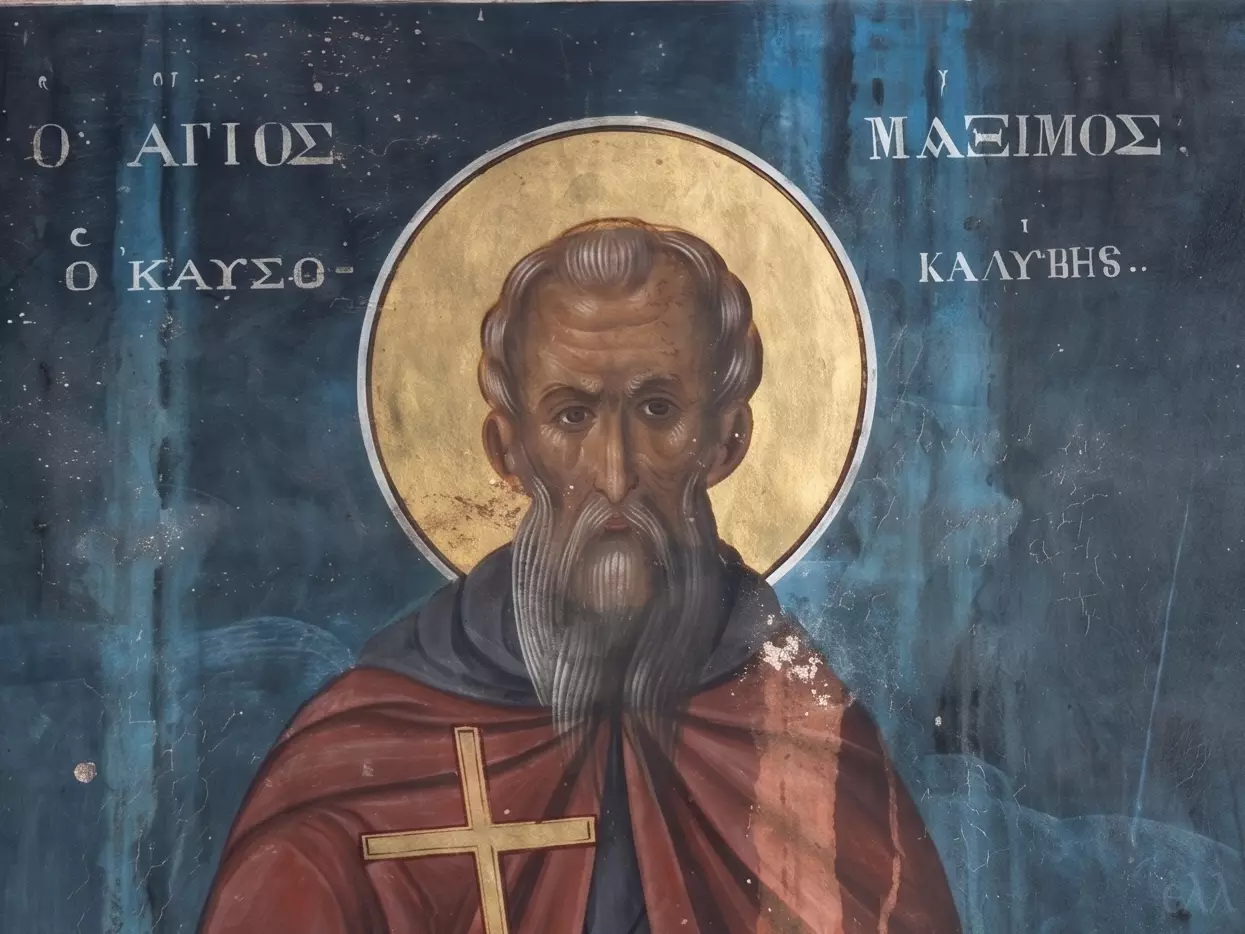
Much of the expressive weight resides in the saint’s physiognomy. A high, furrowed forehead rises beneath carefully separated locks of greying hair; the eyes are deep-set and fixed directly ahead, the nose long, the cheeks lean. From the lower face falls an exceptionally extended grey beard, divided into narrow strands through repeated linear highlights. Its vertical movement continues the central axis of the body and leads the eye downwards towards the insignia of the Great Schema. Severity dominates the expression, though without dramatic exaggeration: tight mouth, dark eye sockets, sharply defined brow, sparse transitions between illuminated and shadowed flesh.
Over the dark blue tunic lies the deep red mantle, fastened at the neck and opened sufficiently to expose the monastic analavos. Across the shoulders its folds spread in broad diagonal movements; beside the body, heavier masses. Areas of the painted surface have suffered abrasion and localised paint loss, with pale interruptions particularly noticeable across the mantle and blue ground, while vertical discolourations pass through sections of the composition. These alterations now interrupt colour fields that would originally have appeared more continuous.
Among the most informative elements in the image is the analavos. A tall cross rises from a three-stepped base, its arms ending in trefoil forms. Beneath the base appears the skull of Adam, while the lance and sponge associated with the Passion flank the lower part of the cross. Abbreviated inscriptions include ΙΗΣΟΥΣ ΧΡΙΣΤΟΣ ΝΙΚΑ, together with the monastic cryptogram ΤΟΠΟΣ ΚΡΑΝΙΟΥ ΠΑΡΑΔΕΙΣΟΣ ΓΕΓΟΝΕ—“the place of the skull has become Paradise.” Image and lettering are compressed into a single emblematic field: Cross, Golgotha, instruments of the Passion, Adam’s skull, Christogram. On the body of a Great Schema monk, this compact iconography relates ascetic identity to the imagery of the Crucifixion.
A second cross, simpler and more immediately legible, is held upright in the saint’s right hand. Gold, used sparingly and strategically, establishes two luminous forms in the upper half of the composition: the circular halo behind the head, the cross before the torso. Across from them, in the saint’s left hand, the white open scroll establishes a lighter mass of a different kind. Its curling ends introduce one of the few strongly curved forms outside the halo.
The surviving words on the scroll begin with the address ΑΔΕΛΦΕ ΑΕΙ ΔΑΜΑΖΕ… (“Brother, always discipline…”), while subsequent lines refer to the flesh, sleeping on the ground and devoting oneself to prayers and supplications. The writing therefore operates as more than an identifying attribute. It gives visible textual form to the ascetic discipline associated with the saint. Unusually conspicuous, the scroll descends beside much of the forearm and lower garment, making the lettering itself an active component of the composition.
Maximos belonged to the fourteenth-century Athonite world. Born in Lampsacus around the closing decades of the thirteenth century, he became an eremitic monk on Mount Athos and was closely associated with the hesychast environment of the period. His epithet Kausokalybites, commonly rendered “Hutburner”, derives from accounts of his practice of burning the temporary huts in which he had lived before moving elsewhere. His life survives in two medieval accounts, by Niphon and Theophanes, both presented with Greek texts and English translations in the scholarly volume Holy Men. His position within late Byzantine Athonite ascetic culture, including the relationship between hesychasm and forms of unconventional holy behaviour, has also received sustained treatment in an Oxford study.
Against this historical background, the strict frontal pose becomes especially intelligible as an iconographic construction. No landscape describes the difficult terrain of southern Athos, no hut explains the unusual epithet, no narrative episode competes with the person. Biography has been condensed into attributes: monastic habit, Great Schema, cross, scroll, inscription. Ordinary space recedes within the dark blue ground, while the halo isolates the head with geometric clarity.
The painter holds together two registers of representation. The face, receiving individualising attention through wrinkles, grey hair, asymmetrical strands of beard and the concentrated gaze, differs in treatment from the body, which remains organised according to older monumental principles of frontality, verticality and controlled gesture. The nineteenth-century wall painting thus preserves a long-established Athonite conception of the monastic saint while adapting its surface language to the visual habits of its own period. Saint Maximos stands austere, still, immediately recognisable; around him, words and signs carry much of the narrative.
(The translation was edited by A. Orfanos.)