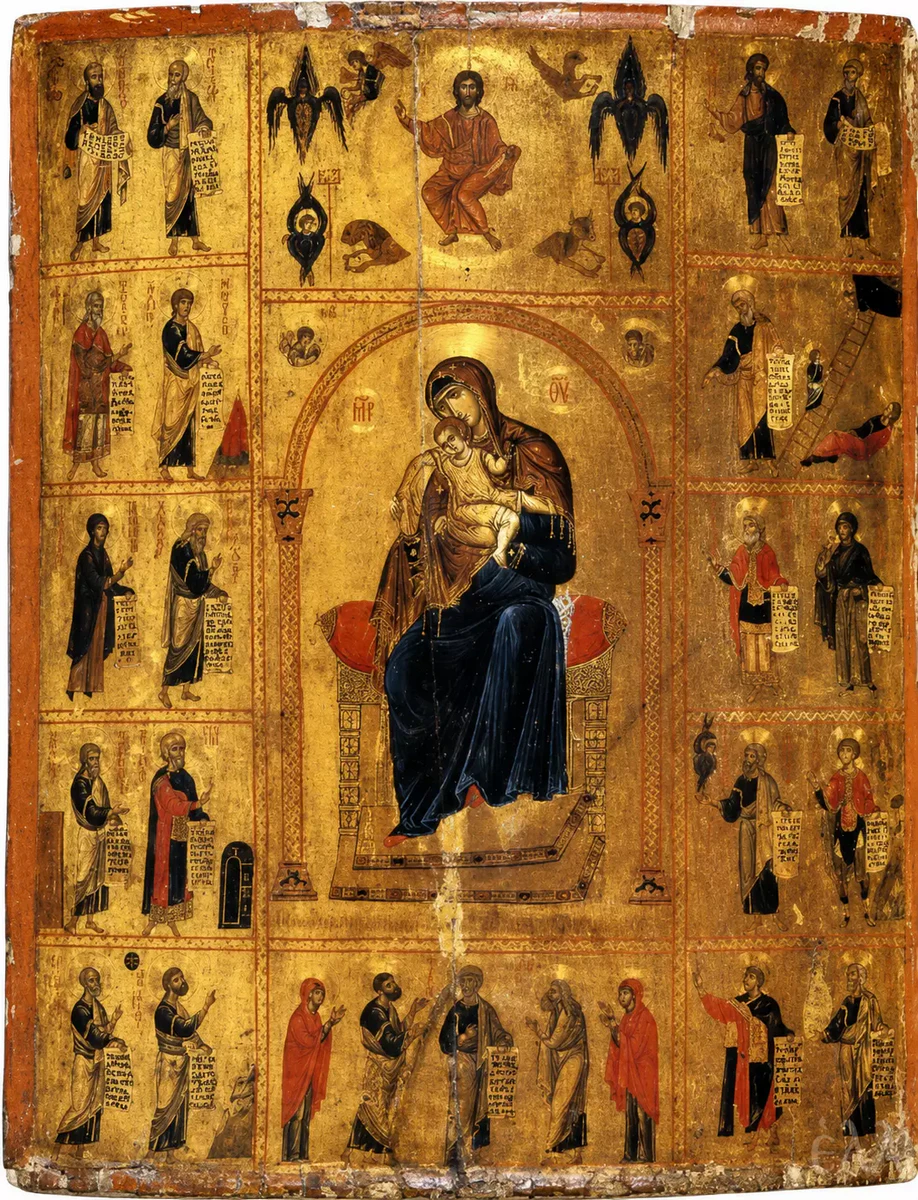
The Theotokos Kykkotissa with Christ in Glory and Saints, preserved at the Monastery of Saint Catherine on Mount Sinai and generally dated to the first half of the twelfth century, condenses an exceptionally ambitious iconographic programme into a panel measuring only 48.5 × 41.2 cm. At its centre, beneath a broad painted arch, the enthroned Virgin holds the Christ Child closely against her body. Around this intimate group unfolds another order of imagery altogether: Christ seated in glory above, celestial powers and symbolic creatures, prophets arranged in paired compartments along both sides, and, below, figures associated with the ancestry and human history of the Incarnation. The panel is therefore centralised, although its surrounding programme remains visually complex. Its centre is still; everything around it explains that centre.
The Marian image follows the Kykkotissa type associated with the celebrated icon of the Kykkos Monastery in Cyprus. The Child presses towards his Mother with conspicuous physical immediacy, his body turned across her lap, while the inclination of the Virgin’s head answers his movement. One hand reaches towards her maphorion, tightening the physical exchange between Mother and Child. The catalogue entry available through Mused identifies the work as tempera on wood and places it around 1100, while also connecting its iconography with the Kykkos tradition. The Sinai panel, however, expands the familiar Marian type into something much more elaborate: an image of the Incarnation interpreted through prophecy, sacred history and celestial manifestation.
Theotokos Kykkotissa and the Prophets of the Incarnation
Dominant within the composition is the enthroned Theotokos. Her dark blue maphorion forms the deepest chromatic mass on the gold ground, spreading downward in long, densely articulated folds and making the comparatively pale figure of Christ especially prominent. The throne itself is partly concealed. Red cushions appear at either side; beneath them, ornamented architectural members and a footstool construct a compact ceremonial setting. Yet the figures resist the immobility such furniture might imply. The Virgin bends. The Child twists. Their faces nearly meet. Within an icon filled with frontal prophets, scrolls, rigid divisions and symmetrical correspondences, this curved movement at the centre has particular force.
Above them appears Christ “in Glory,” seated frontally within the upper field. He raises his right hand in blessing, while his left gathers the drapery across his lap. Around him the gold ground is inhabited by winged celestial beings and the symbolic creatures associated with the heavenly visions (Ezekiel 1:5–14; Revelation 4:6–8). The composition establishes a vertical theological axis: Christ in celestial majesty above; the incarnate Christ as Child below, borne by his Mother. Between the two representations lies no narrative episode. The relationship is conceptual. Eternal Logos above, incarnate Child below: the same Christ occupies two levels of one pictorial structure.
Along the flanks the painter constructs a remarkably disciplined sequence of paired figures. Prophets and other sacred personages stand inside rectangular compartments, several displaying open scrolls covered with Greek inscriptions. Beside certain prophets appear the objects through which Byzantine exegesis understood Old Testament passages as prefigurations of the Virgin and the Incarnation. Moses is associated with the Burning Bush (Exodus 3:2–4); Ezekiel with the Closed Gate (Ezekiel 44:1–2); Jacob’s Ladder (Genesis 28:12) occupies the opposite side. Other prophetic symbols continue this typological language. Words, figures, signs: each supports the central Virgin and Child without competing with their scale.
This arrangement constitutes the earliest surviving formulation generally associated with the iconographic theme known as Ἄνωθεν οἱ Προφῆται, “The Prophets from Above.” The prophets, whose scrolls preserve the textual dimension of the programme and whose accompanying attributes translate prophecy into visible form, create an exegetical frame around the Theotokos. Passages separated across the Old Testament are brought into visual proximity with the event that Christian interpretation understood them to anticipate. A substantial study of Sinai’s icons and their institutional setting is available in the Getty catalogue, while the subsequent diffusion and transformation of the Kykkotissa type in Mediterranean painting has been examined in Kouneni’s study. The latter demonstrates how far the type would eventually travel beyond its Byzantine and Cypriot setting; its wider publication context may also be consulted in the JSTOR issue.
At the bottom the prophetic argument changes register. Joseph, Joachim and Anna appear together with Adam and Eve, binding the genealogy of the Virgin and the history of humanity to the theological structure above. The first-created humans, the parents of Mary, her betrothed: different moments of sacred history brought onto one narrow strip. This lower sequence gives the icon a temporal breadth that the central composition alone would never disclose. Above, prophecy; at the centre, fulfilment; below, ancestry and human history.
The architecture of the image reinforces this reading. Painted borders separate the numerous scenes, yet the great arch surrounding the Virgin interrupts the logic of a conventional grid and gives the central group something approaching the visual authority of an apse composition. Indeed, the entire panel has been compared with the hierarchical decoration of a Byzantine church interior: Christ in Glory occupying the highest zone, the Virgin and Child assuming the dominant Marian position beneath, prophets and saints distributed around them. Scholarship on the icon has specifically noted this resemblance between the panel’s internal arrangement and monumental ecclesiastical programmes in Ecce Mater Tua. A small portable icon has absorbed, in compressed form, the spatial hierarchy of monumental decoration.
Its visual language remains strongly Komnenian. Faces are slender and controlled, gestures economical; the draperies, by contrast, are animated by tightly drawn linear folds and sudden angular turns. Gold dominates without flattening every distinction. Reds, ochres, dark blue and muted earth tones divide the figures into small chromatic accents against the luminous field. Particularly striking is the alternation of scale: the monumental Virgin and Child, the smaller prophets, the still smaller symbolic beings. Through these measured differences becomes visible the hierarchy itself.
The attribution demands greater caution. The refinement of the painting and the sophistication of its iconographic conception have encouraged comparison with Constantinopolitan production. A technical peculiarity noted in the Sinai group, however—the differing tone of the gilded haloes and medallion-like elements in relation to the surrounding gold field—complicates an automatic assignment to a workshop of the capital. Secure is the panel’s place within the artistic world of the early twelfth century; less certain, the precise circumstances of its production.
Time has marked the object heavily without destroying its extraordinary legibility. Vertical fissures cross the painted surface, losses interrupt portions of the upper and lower edges, scattered abrasions expose the material history of the panel. Still intact is the governing idea: around one closely joined Mother and Child gathers an entire architecture of prophecy and fulfilment. Scrolls, ancestors, celestial beings, symbolic objects, gold. At the centre, the Theotokos Kykkotissa.
(The translation was edited by E. Alexandraki.)