
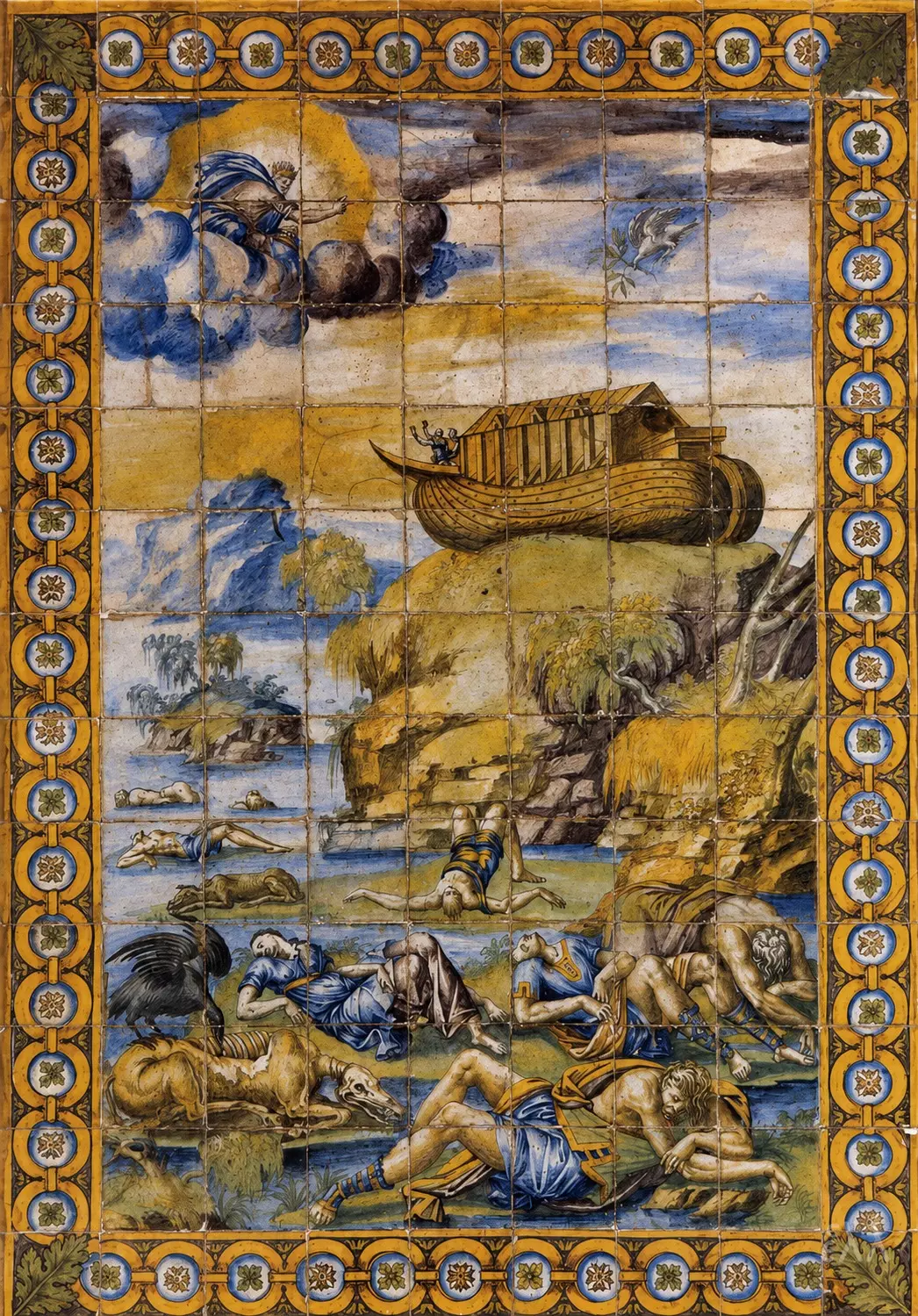
Masséot Abaquesne‘s The Flood, produced in Rouen around 1555 and preserved in the Musée National de la Renaissance at Écouen, transforms the biblical catastrophe into an unusually monumental work of French Renaissance ceramic art. Executed in faience, the panel forms part of a celebrated three-part cycle devoted to the History of the Flood (Genesis 6–8). The museum records the ensemble at 147 × 233 cm and associates it with Abaquesne, the leading Rouen faience maker of the sixteenth century.
Within the sequence, this panel represents the withdrawal of the waters and the desolate landscape left after the Deluge. The Ark has come to rest on elevated ground, while a dove carrying a leafy branch crosses the pale sky nearby, signalling the approaching end of the catastrophe. The scene belongs to a wider narrative that also included the construction of the Ark and the embarkation of the animals. Across hundreds of individual ceramic tiles, Abaquesne constructs an image with the scale and narrative ambition of monumental painting, yet the grid of joints remains plainly visible, continually reminding the eye of the work’s material structure.
The most arresting area lies below the Ark. Receding channels of blue water divide a terrain strewn with human figures and animals, the aftermath presented with an almost archaeological accumulation of bodies across rocks, pools and patches of earth. Several of these personages occupy the foreground at considerably larger scale. Twisted limbs, reclining torsos and sharply changing poses create a dense rhythm across the lower register, while garments in blue, ochre and brown break against paler flesh tones. To the left, large animals lie among the human figures; elsewhere smaller bodies recede into the scenery, extending the catastrophe into depth.
Masséot Abaquesne, The Flood, and Renaissance Faience
Above this field, the Ark introduces a completely different geometry, its curving hull, horizontal bands and carefully delineated timber superstructure rendered in warm yellow-brown tones. Set firmly upon the rising terrain, the vessel becomes the stable visual centre of an otherwise unsettled composition. A small group of figures appears aboard it, dwarfed by the structure and by the surrounding landscape. Higher still, a monumental robed figure emerges among clouds in the upper part of the scene, giving the sky its own figural presence.
Abaquesne divides the landscape through successive bands of water, vegetation, rock and distant terrain. The result is spatially expansive despite the rigid rectangular network created by the tiles. Trees and shrubs diminish toward the distance, while pale blues and greys open the upper field into atmospheric space. In the foreground, by comparison, contours are stronger and colours denser.
The dove provides one of the smallest yet most significant motifs. Positioned against an open area of sky, it carries vegetation in its beak and therefore marks the transition between destruction and the return of habitable land. The Musée National de la Renaissance explicitly identifies the dove on the right-hand panel with the withdrawal of the floodwaters. Its scale is modest, almost incidental beside the Ark and the foreground figures, a placement that renders it particularly effective within the relatively uncluttered sky.
The Landscape after the Deluge
For Abaquesne, faience offered far more than architectural covering. The tin-glazed ceramic surface supported complex figural compositions, chromatic modelling and extensive landscape imagery. Blues dominate water, garments and clouds; yellow and ochre structure the earth, the Ark and much of the decorative surround; greens appear in vegetation and in the repeated botanical motifs of the border. The glaze gives these colours a particular clarity, even where ageing, abrasion and irregularities in individual tiles interrupt the continuity of the image.
Around the narrative field runs a broad ornamental frame composed of circular medallions containing alternating floral forms. Blue, white, green and ochre recur in a measured sequence, joined by dark linear ornament. This decorative enclosure separates the biblical narrative from its architectural setting while retaining the visual language of luxury ceramic decoration.
With the broader History of the Flood, the museum has connected several artistic sources: its general narrative conception may reflect prints by the Lyon painter and engraver Bernard Salomon, while the stronger treatment of figures and drapery has affinities with the School of Fontainebleau. The vegetation and aspects of the human figure have also been related to Jean Cousin. Through such sources, Abaquesne translated the pictorial vocabulary of contemporary French Renaissance art into fired clay, tile by tile, preserving the seams of construction within an image conceived on a monumental scale.
(The translation was edited by P. Alexiou.)