
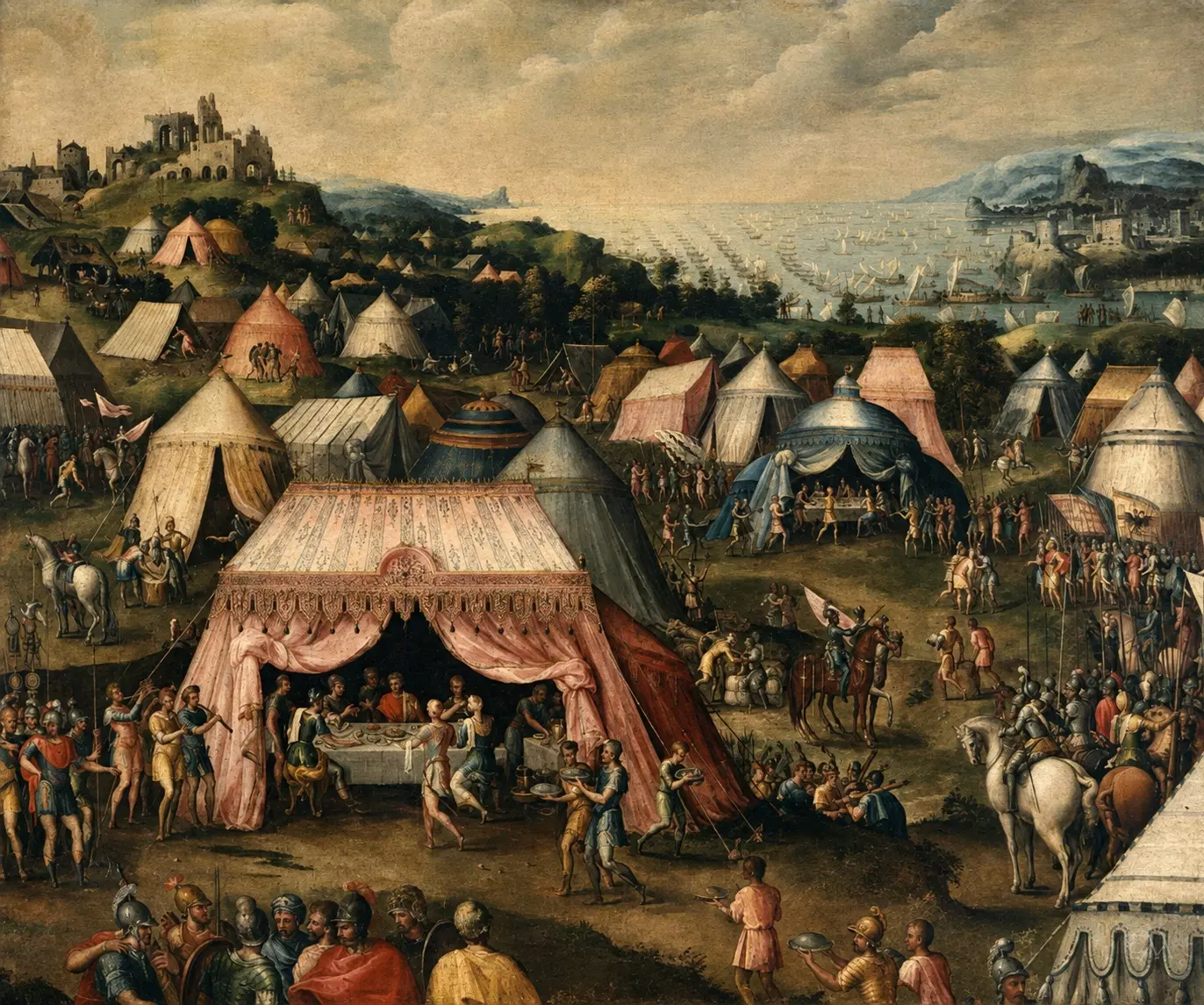
Across a field crowded with tents, soldiers, horses and distant ships, the painting traditionally known as Meeting of Charles V and the Bey of Tunis turns a political encounter into an expansive theatre of military occupation. Long attributed to Niccolò dell’Abate and often dated to about 1545–50, the large oil painting on canvas measures approximately 175.5 × 211 cm and belongs to The Courtauld in London. The museum’s current catalogue has revised both attribution and dating, recording the work as by a follower of dell’Abate, around 1550–60, under the title The Meeting of Charles V and Barbarossa (Khayr al-Din) after the Siege of Tunis.
That revision is important, since the older identification remains widespread. The Art Fund, through which Sir Alec and Lady Martin gave the painting to the Courtauld in 1951, preserves the earlier title and attribution to Niccolò dell’Abate. Its archival record notes the Habsburg double-headed eagle, crescent emblems and figures in North African or Ottoman dress as the principal clues through which the subject was connected with Charles V and Tunis. Whatever the precise authorship, the painting belongs unmistakably to the visual culture that transformed sixteenth-century political history into elaborate, densely populated spectacle.
Meeting of Charles V and the Bey of Tunis: an imperial encampment
From a remarkably elevated viewpoint, the composition extends across almost the entire lower two-thirds of the canvas as a temporary city of cloth: conical tents, striped pavilions, makeshift shelters, standards, horses, armed troops, groups of men moving through narrow passages between the encampments. Pale cream, ochre, pink, blue-grey and muted red alternate across their roofs, producing a complex geometric pattern. Human figures thread through this arrangement in small clusters, their actions dispersed rather than concentrated into a single dramatic centre.
Near the foreground, the largest pavilion opens directly toward the viewer. Its pale patterned roof and rose-coloured curtains frame a group seated around a table, attended by standing figures and surrounded by soldiers. Into the provisional architecture of a military camp, the arrangement carries the formality of court ceremony. Nearby, mounted men wait beside groups of infantry; elsewhere servants carry vessels or supplies, soldiers gather in conversation, horses are led through the crowd. Along the right edge, ranks of armed men create a more disciplined vertical rhythm of spears, helmets and bodies.
The scale changes gradually toward the horizon. Behind the tents, dark masses of vegetation lead the eye toward an immense bay filled with ships. Their masts, sails and hulls become progressively finer until the fleet seems almost to dissolve into the luminous surface of the water. A fortified settlement occupies the opposite shore, while ruined or damaged architecture rises on the higher ground to the left. Sky, sea, coast, camp: broad horizontal zones crossed continually by figures, roofs, trees and distant structures.
History dispersed across the landscape
The subject refers to the Mediterranean struggle surrounding Charles V’s expedition to Tunis in 1535. Khayr al-Din, commonly known in European sources as Barbarossa, had taken Tunis in the previous year and established an important Ottoman-aligned base. Charles responded with a major naval and military campaign, after which Hafsid authority was restored under Mulay Hasan. The expedition, when it entered European commemorative culture, quickly generated an extensive body of court imagery. Jan Cornelisz Vermeyen, who accompanied Charles on the Tunis campaign, later designed the celebrated series of tapestries devoted to the conquest, working with Pieter Coecke van Aelst on the cartoons during the late 1540s.
Against that background, the Courtauld painting appears less concerned with reconstructing a single instant than with accumulating the visible signs of an imperial expedition. Ships proclaim naval strength; tents and supplies evoke logistics; cavalry and infantry establish military presence; ceremonial gatherings insert hierarchy into the temporary city. Even the principal protagonists remain absorbed within this elaborate environment, among the pavilions and troops that occupy the middle distance.
This diffusion of emphasis gives the work much of its distinctive character. A viewer first encounters the camp as a whole and only gradually begins to separate individual incidents: a gathering beside a pavilion, a rider crossing an open space, men grouped beneath trees, troops standing in formation, servants attending a table. Narrative spreads across the field. The eye moves, stops, returns, finds another episode among the closely packed tents.
A Mannerist language of narrative and landscape
The painting’s long association with Niccolò dell’Abate is understandable in stylistic terms. Born in Modena around 1509 and later active at the French court, dell’Abate developed a form of narrative painting in which elegant figures frequently inhabit broad landscapes or elaborate architectural settings. His career eventually became closely connected with the artistic environment of Fontainebleau, and surviving works and drawings demonstrate his sustained interest in landscape as an active element of pictorial narrative.
In the Courtauld canvas, landscape performs such an organizing role. The human figure seldom acquires monumental autonomy. Figures exist in relation to tents, paths, trees, shorelines and distant buildings; scale itself becomes an instrument for directing attention through the pictorial space. From the comparatively large soldiers at the lower edge to the nearly miniature activity along the coast, recession is created through repeated reductions in size as much as through atmospheric perspective.
Strong, too, is the decorative instinct visible in the encampment. The tents, especially, transform military necessity into colour and pattern. Pointed roofs rise and fall across the surface in irregular succession, some sharply illuminated, others darkened almost to silhouettes. Their repeated triangular forms establish a visual rhythm carrying the eye from the immediate foreground toward the bay. Between them appear flashes of costume, armour, standards, animals, vegetation—small interruptions within the continuous spread of the camp.
Colour supports this structure with considerable restraint. Dusty pinks and warm creams stand against deep greens and blue-grey passages, while the subdued sky occupies a large, comparatively quiet expanse above the restless activity below. At the horizon opens the sea, releasing the compressed movement of the encampment into distant light, scattered hulls and tiny sails.
Imperial history as spectacle
Works concerned with Charles V’s Tunis campaign occupied an unusual position between historical record, dynastic commemoration and courtly spectacle. Vermeyen’s designs for the Conquest of Tunis tapestries demonstrate how extensively the expedition could be reconstructed through topography, military incident and the detailed observation of an enormous campaigning force. Within the same broader appetite for history conceived on a panoramic scale stands the Courtauld painting, although its authorship, specific episode and relationship to contemporary representations remain subjects requiring caution.
Around the supposed meeting, the artist assembled an unusually complete world. The eye can wander from an intimate meal beneath patterned fabric to massed soldiers, from horses waiting beside their riders to a harbour almost overwhelmed by shipping. Political authority is expressed through the occupation of space: land, coastline, sea, fortification, camp. Ceremony and everyday military activity coexist within this immense arrangement, with riders, servants and soldiers continuing their separate movements between the pavilions.
For decades the work circulated under the name of Niccolò dell’Abate, and that attribution remains embedded in older catalogues and digital records. The Courtauld’s present classification as the work of a follower, dated around 1550–60, places useful distance between historical association and established authorship. The qualities that made the older attribution plausible remain visible across the surface: elegant small-scale figures, expansive landscape, complex narrative distribution, activity extending from the foreground tents to the coast, where ships diminish into pale marks against the water.
(The translation was edited by A. Orfanos.)