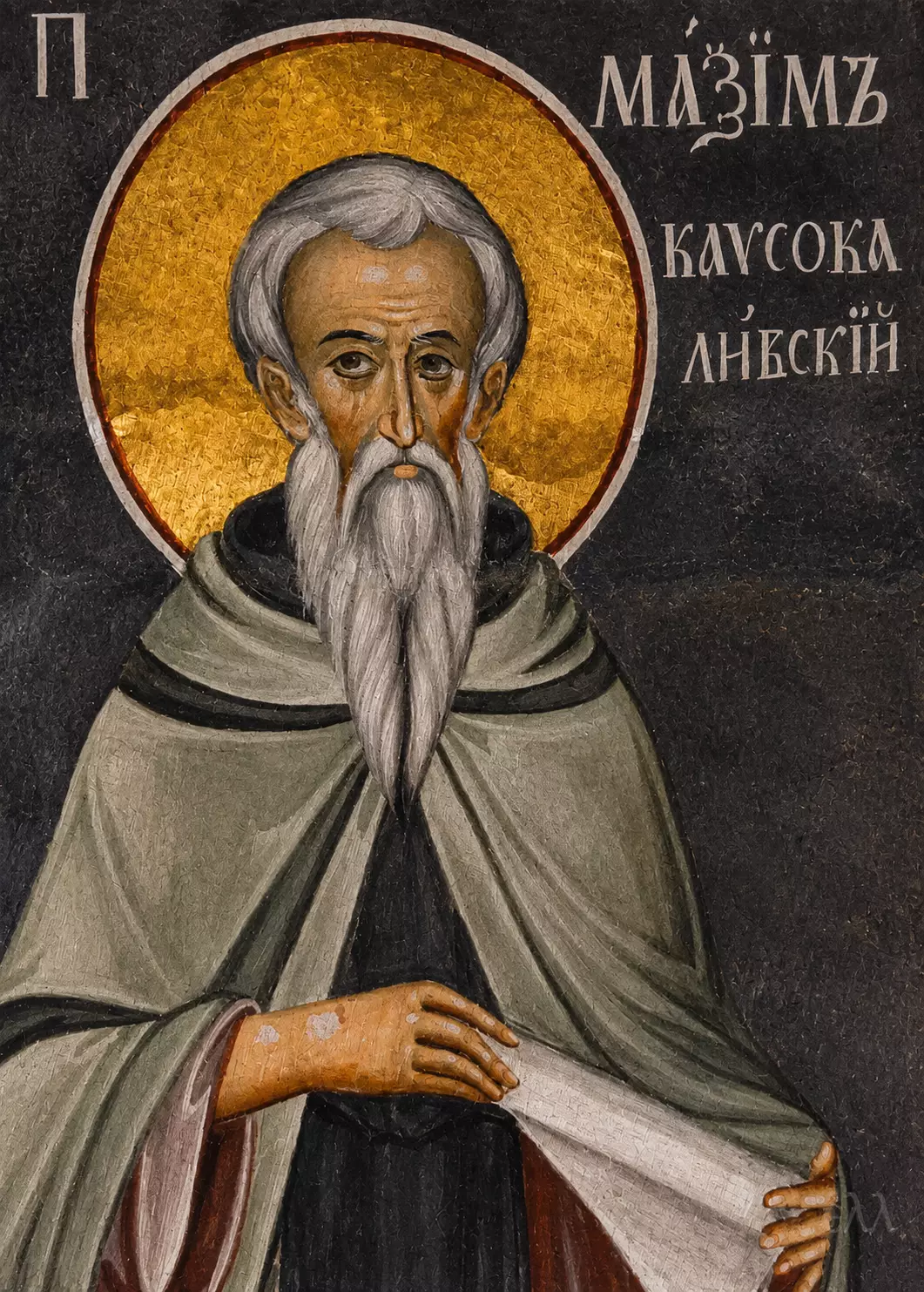
Deep-set eyes, unmoving and fixed on whoever stands before him, look out from beneath a forehead scored by decades of vigil and fasting. Grey hair swept back from a receding hairline frames features hollowed by age, while a long beard, forked toward its lower end into two twisted strands, falls to the middle of the chest. Painted in the eighteenth century by a hand that has left no signature, this half-length portrait of Maximos Kavsokalyvites — “the Hut-Burner,” after his habit of repeatedly building and then destroying his own hermitage — belongs to the kelli of the Typikarion at Karyes, one among the many anonymous productions that carried the Post-Byzantine tradition of Athonite monumental painting into the later centuries of Ottoman rule.
The saint stands frontally against a ground so dark it reads almost as an absence of colour, the hieratic frontality customary for monastic and ascetic figures throughout Athonite painting. Behind the head, a broad halo of gold catches the eye with unusual force: its surface, built up in mottled, unevenly worked passages instead of a smoothed, uniform sheen, suggests hand-applied gilding of some age. Toward the lower left the gold has thinned and, in places, lifted away entirely, exposing the warmer, ochre-red bole that once lay beneath it — an area of wear consistent with centuries of candle smoke and handling.
What sets this particular portrait of the saint apart from the more familiar Greek-inscribed icons of Athos is its epigraphy. To the right of the halo, in majuscule Church Slavonic lettering complete with ligatures and abbreviation marks typical of liturgical manuscripts, the painter recorded the saint’s name and epithet. A single letter — presumably the opening of an abbreviated honorific such as “Prepodobne,” Venerable — precedes the name itself, rendered as “Maksim” and apparently contracted through the letter Ksi, a device Church Slavonic orthography borrowed from Greek for transliterating names containing the consonant cluster κσ; a stress mark above the second syllable follows the same liturgical convention. Below, in a second line, the adjectival form “Kausokalivskii” completes the identification.
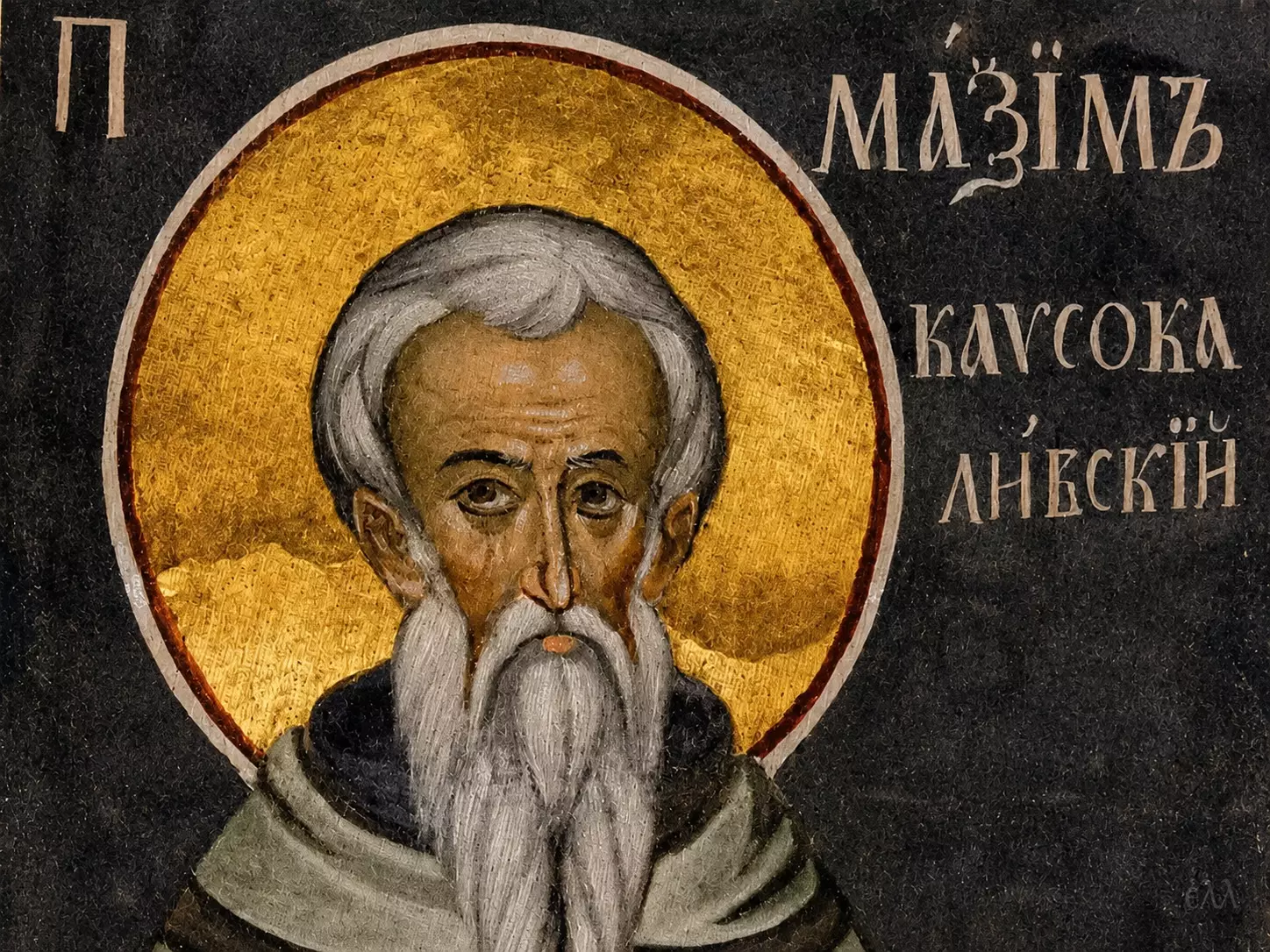
The Saint Maximos Kavsokalyvites Fresco and Its Slavonic Inscription
Such an inscription points to a workshop, or at minimum a patron, connected with the Slavic monastic presence long established at Karyes, where kelli attached to Bulgarian, Serbian, and Russian brotherhoods coexisted alongside Greek foundations throughout the Post-Byzantine period. Whether the painter himself worked in a Slavonic-rite milieu, or was simply following the instructions of a patron from one, the fresco alone cannot resolve.
Beneath the beard, both hands emerge from a dark tunic worn under a grey-green mantle, its collar trimmed with a narrow band of nearly black cloth. The right hand grips a length of white fabric, its lower edge bordered in dark red, gathered into soft folds between the fingers; a smaller portion of the same cloth is held at its far corner by the left hand, largely cropped from the surviving field of paint. No inscription or ornament interrupts its plain surface, and it functions here chiefly as a passage of drapery, its white catching the eye against the ochre flesh tones, silvered hair, and sombre ground that otherwise dominate the palette.
The documentary record of Maximos’s life rests on several hagiographers, and their broad outline agrees even where particulars diverge. Born Manuel in Lampsakos on the Hellespont, he received the monastic habit while still young at a monastery on Mount Ganos, then passed through Constantinople and Thessaloniki before settling, eventually, at the Great Lavra. The decades that followed on the Holy Mountain were marked by an asceticism unusual even by the standards of Mount Athos itself: perpetual wandering, feigned madness in the tradition of the holy fool, and a refusal to keep any dwelling more permanent than a hut of branches, which he burned down himself whenever it threatened to become a home.
The skete that later monks founded near the site of his final years took his epithet, and the saint has been commemorated under it ever since, his feast falling on 13 January. His cult remained active enough among both Greek and Slavic communities of the Holy Mountain that new likenesses of him, such as this one at the Typikarion, continued to be commissioned well into the eighteenth century.