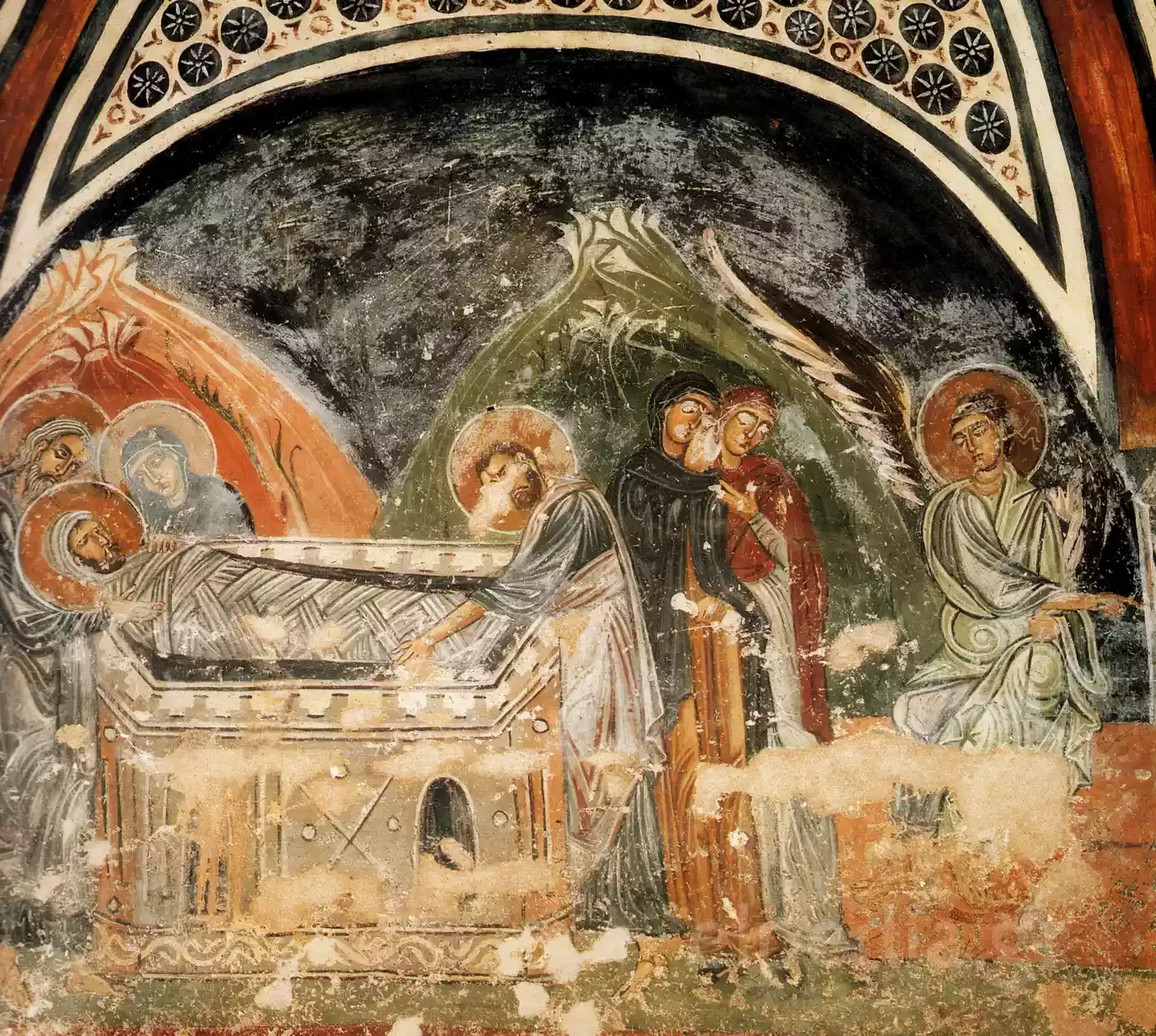
On the southern side of the crypt, beneath the Katholikon of the Hosios Loukas Monastery in Boeotia, near the foothills of Mount Helicon, an unknown painter composed two scenes into a single fresco around the third quarter of the 11th century: the Entombment of Christ and the arrival of the Myrrh-bearing Women at the now-empty tomb. Created using the fresco technique on wet lime plaster, the composition covers a wall within a space that was not built to be admired by crowds, but to receive the relics of monks, functioning simultaneously as an ossuary and a monastery chapel. The result is a visual narrative where the burial is not the end, as the angel waiting on the right side of the composition already heralds the next chapter of the story. Microanalyses of Byzantine frescoes in similar monuments of the same period have documented that artisans relied on natural earth ochres mixed with lime, an observation that explains the warm, almost burnt, color base that characterizes this specific composition. The crypt of Hosios Loukas is considered one of the most complete surviving ensembles of Middle Byzantine fresco painting, featuring eight scenes around the walls dedicated to the Passion and numerous medallions with figures of saints on the vaults—a program that the monastery’s Katholikon, also known for its mosaics, does not repeat in the same way anywhere else in the upper church. The Entombment and the Myrrhbearers, placed side by side, do not function as two separate episodes, but as a single theological proposition, written on plaster rather than paper, concerning the relationship between death and what follows.
The Diptych of the Burial and the Announcement
The composition reads like two acts of the same drama, placed tightly next to each other without any gap in between. A unified landscape of rocks—warm on the left side and cooler, more greenish towards the right—visually binds the two scenes beneath a dark, nearly black cave vault. Running above all of this is a decorative band featuring rosettes within circles, the only purely geometric element among so many human figures, a framing convention that would later be seen, in various iterations, in other monuments of the same era in northern Greece and Macedonia.
The Burial of the Body: Joseph, Nicodemus, and the Silence of the Virgin
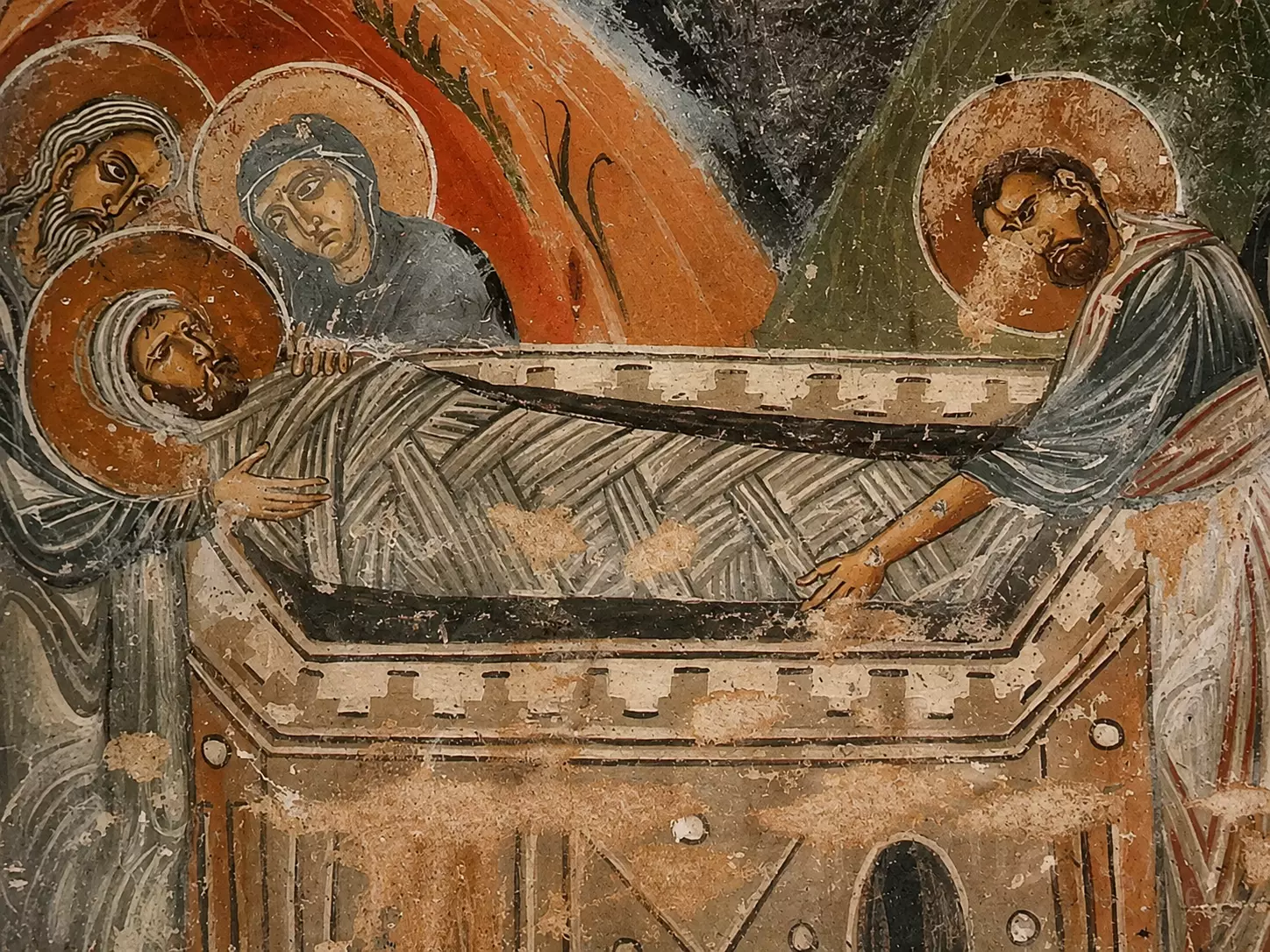
In the left section of the composition, two bearded men with halos lift the body of Christ from both ends. He is wrapped in a shroud where the painter has rendered the weave of the fabric like wicker using fine, intersecting lines. According to the established iconography of the scene, these are Joseph of Arimathea and Nicodemus, the two men who, according to the Gospel accounts, requested the body from Pilate and placed it in a rock-hewn tomb. Between them, slightly further back, the face of the Virgin Mary is visible. With her head covered by a blue maphorion, she leans slightly towards her son’s body, devoid of theatrical gestures or tears painted on her face. At the right edge of this same group, a man with a short beard, wrapped in a gray-green mantle with warm reflections, bends down and rests his hand on the shroud—perhaps John, the disciple who remained by the cross until the end.
The stone sarcophagus where they lay the body is not a simple box. The artist has given it a decorative rim with small, rounded protrusions, resembling the battlements of a small fortress, a detail that evokes real marble tombs of the era rather than a conventional, abstract sarcophagus. On the front face of the sarcophagus, traces of crisscrossing geometric patterns and small circular ornaments are still visible, elements that artisans frequently borrowed from contemporary furniture or reliquaries, transferring them into their painting with near-architectural precision. The background behind the scene is a warm ochre that leans toward terracotta, a color of the earth rather than the sky, and against this, two thin branches faintly stand out—perhaps the remnants of a tree that once framed the scene. The deterioration cannot be hidden. Plaster is missing in places, and the color has calcified and turned white, yet the weight of the two men’s gesture, the bending of their bodies over the deceased, remains entirely clear.
This iconography, also known in the Byzantine tradition as the scene of the Lamentation when the emotional intensity deepens, would reach its most fully realized dramatic form a century later in the frescoes of Nerezi in Skopje, where the Virgin bends and touches her son’s face with a despair that borders on the limits of human endurance. At Hosios Loukas, restraint is still the rule. There is no embrace, no physical contact between mother and child, only the proximity of their bodies and the inclination of their heads—a visual language closer to the austerity of older Middle Byzantine ensembles than to the emotional realism that would follow.
The Myrrhbearers Before the Angel at the Empty Tomb
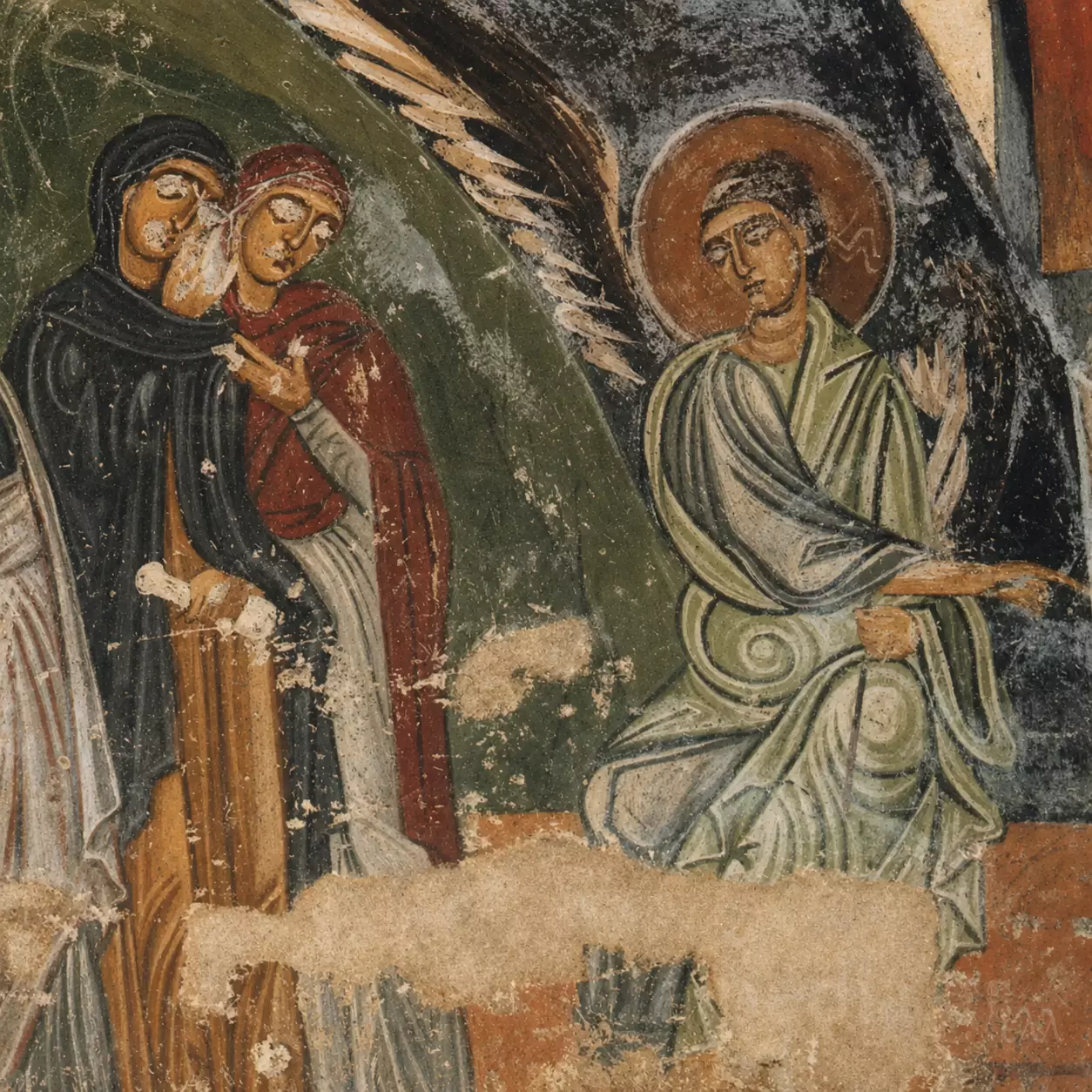
Right next to this, three women approach in a tight formation, their postures almost merging into a single dense volume of dark, black, and deep red fabrics. Their heads are covered by maphoria that leave only their faces exposed, and one of them brings her hand near her mouth—a gesture that Byzantine painting systematically uses to indicate surprise mixed with sorrow. The Myrrhbearers, according to the Gospel narrative, were the first to arrive at the tomb with myrrh to tend to the body, only to find it empty. It is this exact moment—the bewilderment just prior to comprehension—that the painter chooses to depict.
Opposite them, seated on what remains of the tombstone, an angel with large, light-colored wings and a garment in shades of sea green extends his hand to the right, toward the empty space of the tomb that we can no longer see in the composition but is implied by the direction of his gesture. The drapery of his clothing forms a spiral swirl of lines at the height of his knee, a favored technique in Middle Byzantine painting used to give volume without resorting to realistic shading, with white highlight lines running over the green like streams. The green background behind the angel is neither a landscape nor a sky; rather, it is an abstract representation of a rock, closer to what we would call today color symbolism than a realistic depiction of nature. The angel does not look the women directly in the eyes. His gaze falls low, almost contemplative, contrasting with the dynamic extension of the wing behind him—a contrast that was likely a deliberate choice by the painter. White patches of salt efflorescence cover parts of the background, traces of moisture that the crypt, being semi-subterranean, could hardly avoid throughout its long history. However, the faces, where preserved, still maintain a lively, almost confessional expression.
The Material Trace: Fresco Technique and Earth Pigments
The very technique with which the wall was worked deserves a pause. The color was applied onto the fresh, still-wet lime plaster so that the pigment would chemically bind with the plaster as it dried, a process that left little room for correction and demanded that the painter draw with confidence, without second thoughts. The earth ochres, the greens derived from iron or copper oxides, and the black from charcoal make up a palette poor in raw materials but rich in outcome, precisely because the artist knew how to draw intensity from the contrast of a few well-chosen tones rather than from their sheer variety. Similar analyses in other Byzantine ensembles of the period have confirmed this exact austerity of materials, an element that betrays not poverty, but a conscious choice of visual language.
What remains today of this fresco is not just a square meter of painted plaster, but a document on how the artisans of the Middle Byzantine period thought, organized space, and painted—without a signature, without a resume, with only their own work as evidence. The crypt, dug beneath the main church and dedicated to Saint Barbara, housed three tombs, among them that of Hosios Loukas himself, and functioned as a burial space for monks long after the founder’s relics had been moved to the upper church. Its iconographic program focuses on scenes of death and resurrection, a choice that was more functional than decorative, created for the eyes of those who would pass through that space carrying a body for burial—monks who knew well what it meant to bury someone and to wait.
To view such a composition today as a historical document, and not solely as an object of worship, means to examine it as a layer of information regarding workshop techniques, apprenticeship networks among craftsmen, and the preferences of patrons who do not always leave their names behind. Byzantine fresco painting, like mosaics or portable icons, operates simultaneously on two levels: as a devotional object for anyone praying before it, and as a dense artifact of material and artistic history for anyone studying it today with scientific tools. Both levels are valid simultaneously, without one canceling out the other.
The study of such ensembles, by both art historians and materials scientists, continues to reveal details that the casual viewer finds difficult to grasp, from the composition of the mortar to the slight deviations of a hand from the manuals of the time. Every such analysis adds a grain of knowledge about workshops and artisans who left behind no names, only walls. Yet, what endures beyond any technical analysis is the precision with which an unknown painter managed to place side by side the weight of a passing body and the lightness of an angel who already knows the end of the story. In the same frame, without transition, without explanation.