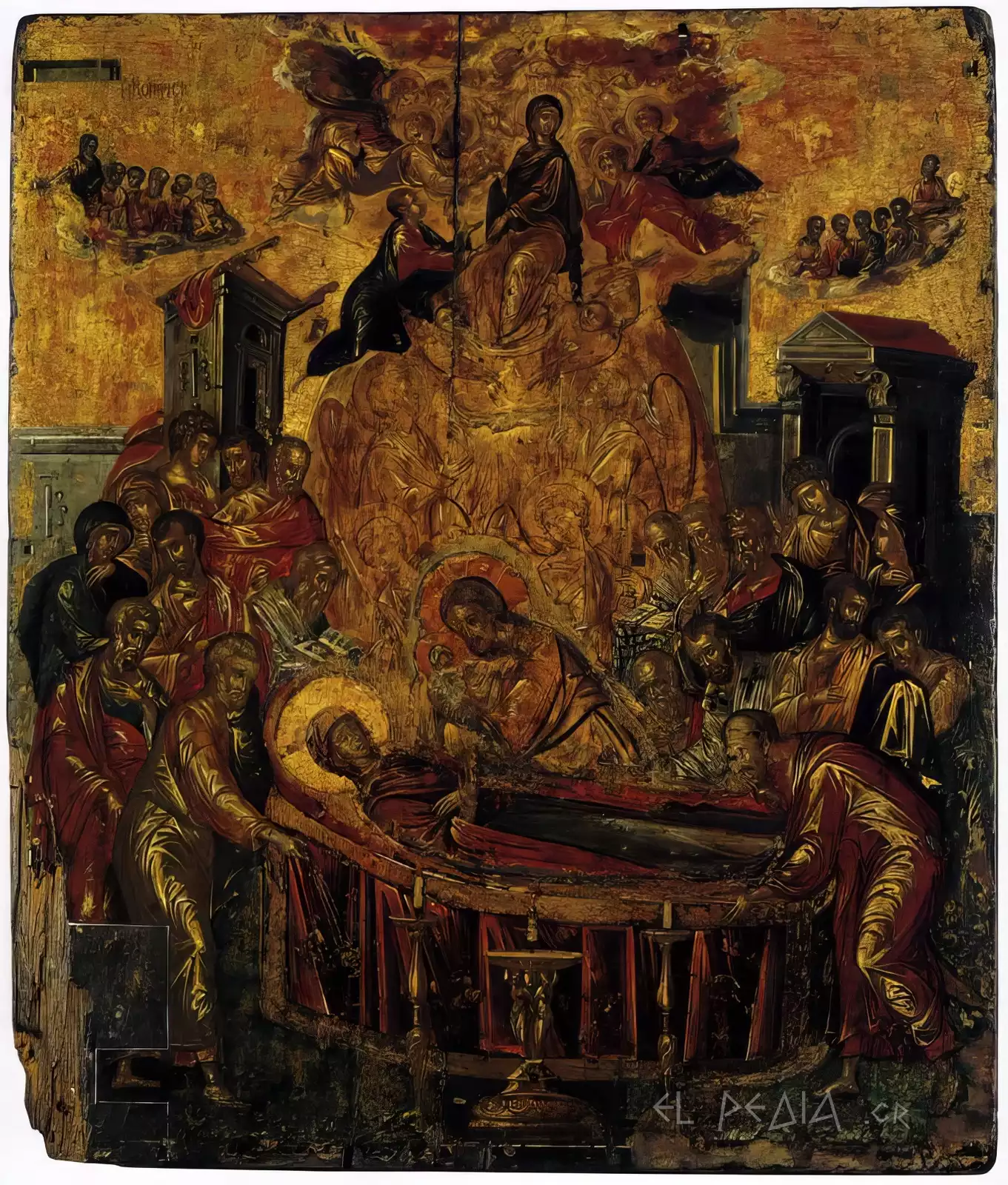
A portable icon, its dimensions barely 61.4 by 45 centimetres, is preserved today in the metropolitan church of the Dormition of the Theotokos, in Ermoupoli on Syros, executed on wood in egg tempera and gold leaf. This is the Dormition of the Theotokos by Domenikos Theotokopoulos, a work the artist completed in Crete before departing for Venice in 1567, at a moment in his life when he was not yet the El Greco whom Toledo would later come to know, but a painter formed entirely within the canons of the post-Byzantine tradition. The composition follows faithfully the iconography of the Dormition as it had been established centuries before, with the Virgin lying upon her funeral bier, the apostles surrounding her, and Christ rising up behind her, holding in his hands the form of her soul. What makes this particular icon of the Dormition of the Theotokos so significant, however, is not merely its subject matter, already familiar from countless other works of the Cretan school of Byzantine hagiography, but the identity of the hand that painted it. A hand that, a few years later, would leave behind its native land to build one of the most singular careers in the history of Western painting.
The study of the Cretan painting of the period offers the context within which one may understand how such an artist was born before becoming what the history of art today honours as El Greco. In the lines that follow, the composition, its iconographic elements, and the eventful history of its recognition are examined.
The iconographic composition and the discovery of an early work by Theotokopoulos
A dark gold, almost brown from the patina of time, covers the entire background of the composition. Upon this deep golden canvas there unfolds a scene dense with figures, in which no space is left unused. At the top, two groups of apostles appear seated upon clouds, to left and right, borne miraculously to the place of the Dormition, according to the tradition that has the disciples coming from the ends of the earth to bid farewell to the Virgin. In the centre, higher than all the other figures, Christ stands upright within a haze of light recalling a great almond-shaped mandorla, holding in his arms the small, swaddled form that symbolises the soul of his mother. The folds of his garments are rendered in fine gold striations, a technique known as chrysography, characteristic of the Cretan workshop tradition in which the young Theotokopoulos was trained.
Below, the Theotokos herself. Lying upon a narrow funeral bier with a red covering, her face serene, asleep rather than dead, turned slightly to the left. Around her throng dozens of figures of apostles and hierarchs, clothed in broad robes in shades of red, ochre, and dark green, most with their hands in postures of lamentation, some bent over the body, others merely present, mute witnesses. Two buildings frame the scene at either edge, one with an arched opening and red cloth hanging above, the other with a classicising pediment that already gestures toward elements of Western architecture, a detail that does not go unnoticed by those seeking the first traces of a gaze turned toward Italy. In the upper left portion a fragment of an inscription can be discerned, a trace of the title of the scene, while below, before the bed, a kneeling cleric performs something like a liturgical act amid candlesticks rising like pillars of light within the darkness of the composition.
In 1983 an archaeologist, Georgios Mastoropoulos, found himself in the church during his holidays and stood before this very painting. The panel had been discovered buried in the churchyard, dirty, neglected, with no one suspecting its significance. Carefully cleaning the surface at the point of the central candlestick, the Byzantinist made out a few letters. It took time to decipher them. Domenikos Theotokopoulos, who painted this. The signature changed the fate of the painting, transforming it from a simple, local icon into one of the very few attested works of the artist’s early, Cretan period.
The crowded assembly around the Virgin
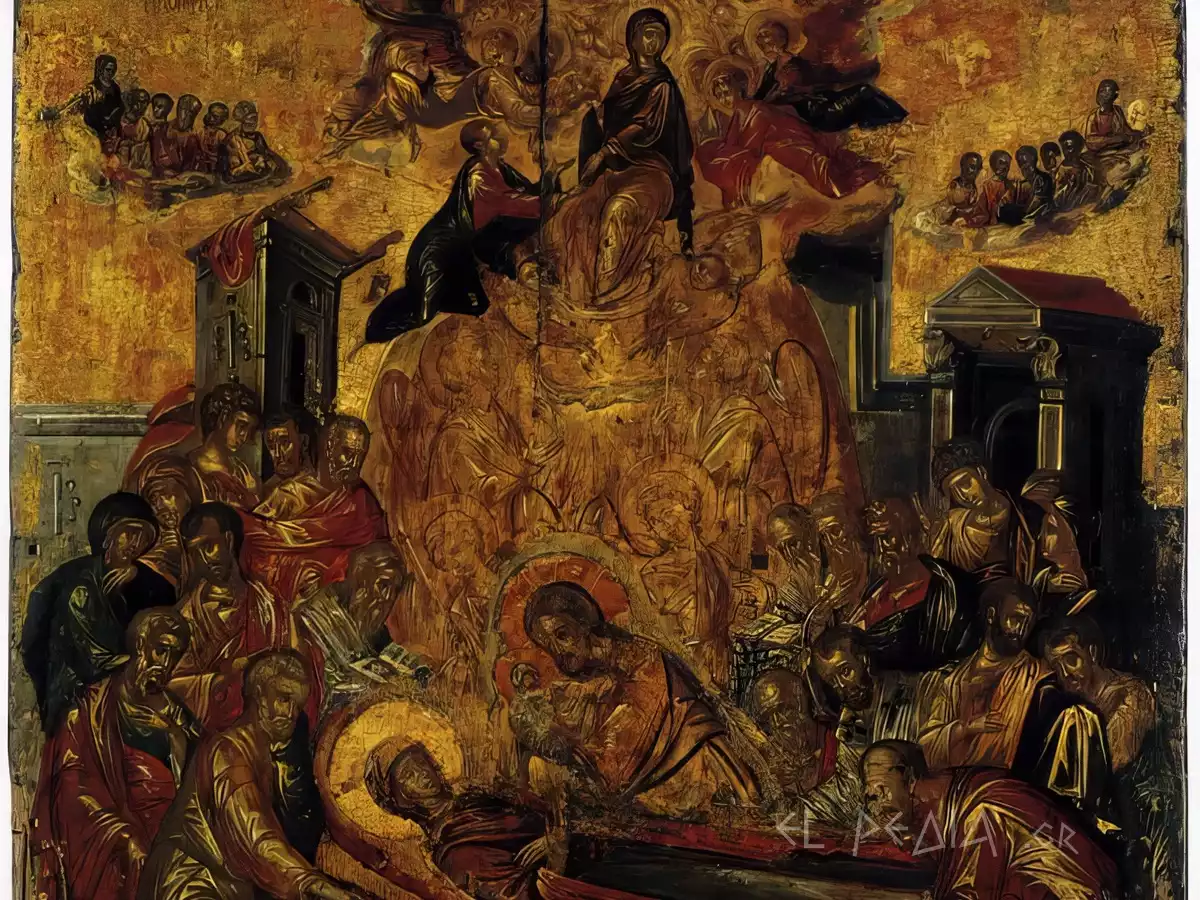
Drawing closer to the central part of the composition, there where the figures throng around the funeral bed, one perceives how densely the faces are arranged, one almost pressed upon another, without the breathing space that a more sparsely populated scene would allow. The expressions are not all alike. Some apostles hold books, a mark of their apostolic office as heralds of the word. Others bring a hand close to the face, in a gesture of lamentation that Byzantine painting has repeated for centuries, by now almost codified into a grammar of emotion. In the background, the building with the classical pediment can be discerned more clearly here, its columns standing austere, almost foreign amid the density of the human bodies surrounding them.
The colour palette, wherever one’s attention settles, remains dark, deep, with reds dominating over the golden background and the faces emerging through tones of ochre and brown that recall aged wood more than human skin. Perhaps it is precisely this darkness, the result as much of technique as of the time that passed over the surface, that concealed the signature for centuries, allowing it to emerge only once someone decided to clean away the grime. The figures do not look toward the viewer. They look at one another, or toward the centre, toward the scene of death, creating a closed, inward-turned composition that offers the gaze no way out.
The identification of this icon with Theotokopoulos did not remain an isolated event. Its connection to the artist led to the recognition of three further works, among them a triptych preserved today in Modena and a composition in which Saint Luke paints the Virgin with the Child, works that share the same technique, the same chromatic character, the same tension between Byzantine severity and an emerging modern outlook already seeking a way out.
Not a few scholars have pointed out that in this particular icon two worlds coexist. One is the Cretan Byzantine tradition, with the linearity of the figures, the use of the gold background, the conventional rendering of space. The other is something that only just glimmers through: an early fascination with Italian Mannerism, a subject explored at length in studies of Cretan painting, visible here in the architecture of the buildings and in the freedom with which certain figures turn and move within their confined space. The young painter had not yet travelled. Yet he was already painting like someone dreaming of other horizons.
Today, this icon is regarded by art historians as a document of the first order for understanding the formation of one of the most important painters in European history. It is not a mature work of El Greco, with the elongated figures and cool colouring that would make him famous in Toledo. It is something perhaps more precious: the record of a moment of transition, in which the Cretan school of painting, with its own canons and its own severity, already harboured within it the seed of a rupture. The discovery of the signature in 1983 did not merely change the attribution of a painting to a particular artist; it opened an entire chapter of research into the Cretan period of Theotokopoulos, a period that until then remained largely obscure, documented more through hypothesis than through concrete works. The Dormition of the Theotokos on Syros stands today as one of the very few firm points of reference upon which the understanding of this early, decisive phase can be built.

