
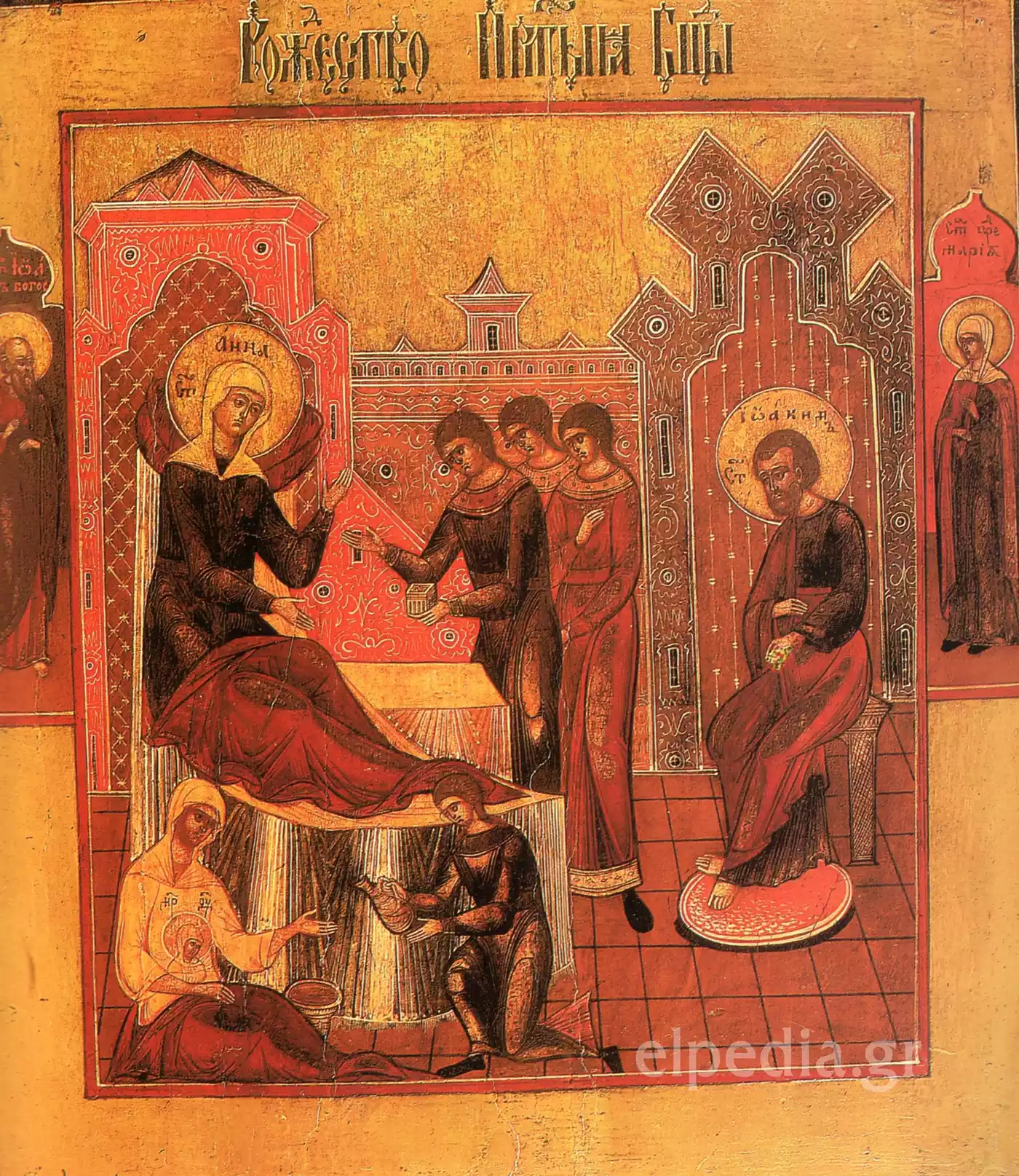
An icon painted in Russia during the nineteenth century preserves, with rare narrative completeness, the moment of the birth of the Mother of God, an event which the Orthodox Church honours every September as one of the twelve great feasts of the Mother of God within the liturgical year. Saint Anna, mother of the Theotokos, is depicted lying upon a bed with dark-red coverings, while her husband Joachim sits a little apart, almost uninvolved in the movement surrounding the woman who has just given birth, as the older iconographic custom prescribed. This event is not narrated by the canonical Gospels. Its source lies in the Protevangelium of James, an apocryphal text of the second century which proved foundational for the shaping of almost all the scenes of the Mother of God that we know today.
This iconographic formula, rooted deeply within Byzantine art and the centuries that followed it, travelled through copies and models as far as the Russian workshops of icon-painting, where hundreds of variations upon the same theme were born, at times faithful to the letter of the model, at times freer in colour and in the arrangement of the figures. The painter remains anonymous, something common enough, moreover, in the workshops of religious painting in the Russian provinces, where the personal signature was considered secondary before fidelity to the model. The wooden panel that we are examining is kept today in the Galleria Antiquaria of Rome, far from its place of origin, carrying nevertheless intact the memory of a formula centuries old.
The Composition: A Reading of the Nativity of the Mother of God
The Golden Background and the Architectural Staging
At the top of the composition the title of the feast is preserved, in Slavonic script, a custom that made the icon legible even before the beholder had managed to stand before the figures. The whole scene is set up within an architectural invention of little towers and gables, painted in vivid red and in deep russet, with small windows and lace-like finials that correspond to no real dwelling. This is an old convention, borrowed from Byzantine painting, in which architecture does not describe a place but intimates an interior space, dissolving any expectation of a single point of view. At the two edges of the icon, only partly visible, stand additional figures of saints, a bearded elder on the left and a haloed female figure on the right, elements which belong to the wider whole of the iconographic programme without, however, forming part of the principal narrative. The golden background, where it can be discerned at the sides of the composition, serves as a reminder that whatever takes place within the scene belongs to a time other than the everyday.
Between the two little towers a narrow entrance opens, with a stepped crown, a detail that recalls real Russian wayside chapels of the period. The painter does not pursue a realistic representation of a building. He pursues something more difficult: to persuade the eye that it stands, at once, both within and without, before a lying-in bed and before a symbolic palace.
Saint Anna and the Women Bearing Gifts
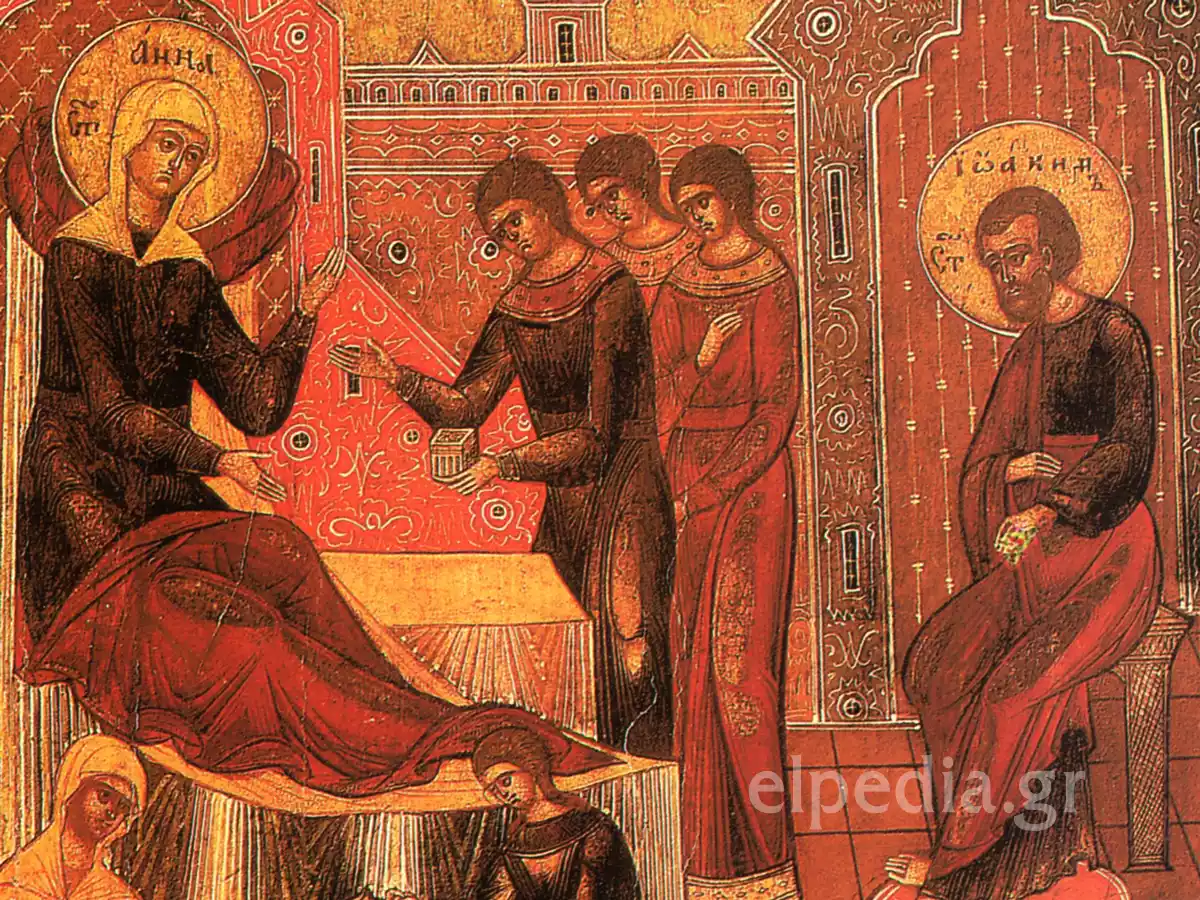
The figure of Saint Anna dominates the left-hand portion, half-reclining upon a mattress with a dark-red covering that falls in broad folds to the base of the bed, with a fine striped border at its lower edge. She wears a dark russet mantle and a white head-covering, while her halo bears the inscription of her name. Her right hand is raised in a gesture of acceptance towards the women who approach, a gesture which expresses not weariness but a kind of calm authority over the moment. Before her, three female figures compose an almost pyramidal group: the first bends slightly, holding out a small rectangular casket, perhaps a vessel with myrrh or swaddling-clothes, clad in a dark tunic with red sleeves, while the two behind her, in purple garments, hold their hands crossed upon their breast with an expression of restrained reverence. No face smiles; none mourns. There is a gravity diffused through every expression, as though the figures know something which the beholder learns only later.
Joachim, at the right-hand edge, sits upon a low footstool with his feet resting on a round reddish cushion. He wears a dark tunic and a red mantle that falls in heavy folds over his knees, holding in his arms something resembling a small posy in pale tones of blue and white. His posture has nothing of the activity of the women opposite him. He sits almost withdrawn, his gaze lowered, in an iconographic convention that occurs frequently also in the scene of the Nativity of Christ, where Joseph likewise sits apart, sunk in a contemplation that tradition never fully explains.
The Bathing of the Infant and the Language of the Colour Red
At the lower part of the composition, immediately beneath the bed, a second scene of smaller scale unfolds. Two women occupy themselves with the infant’s first bathing: one sits and pours water from a vessel into a round basin, the other holds the child in her arms, already haloed despite its infant age. This detail is not decorative. It belongs to an iconographic type shared with the Nativity of Christ and the Nativity of the Forerunner, a constant that reminds us that even the most sacred persons were born with true flesh, had need of bathing, of swaddling-clothes, of human care.
The colour red runs through almost every surface of the icon, from the covering of the bed to the walls behind Anna, where small rosettes and circles with a dot at the centre repeat like a textile motif upon a flat surface. In the Russian iconographic tradition, red of this degree of intensity does not function merely as a background. It carries warmth, life, blood, all that accompanies a birth, in contrast to the golden radiance which promises something beyond time. Two languages of colour, two orders of reality, bound together within the same wooden panel without either cancelling the other. The repetition of the decorative circles upon the walls is not accidental geometry. It recalls textile patterns of the period, transferred from embroidery into painting, a custom that occurs frequently in provincial Russian workshops of the nineteenth century, where the abstraction of form replaced the faithful description of the natural world.
This icon, examined today as a historical document, reveals far more than a religious narrative. It records manners of dress, conventions of colour, the practices of a workshop that worked within strict limits of tradition without, however, entirely losing its own personal tone. Its anonymous painter did not pursue originality in the modern sense of the term. He pursued accuracy within a system, fidelity to a chain of models that had begun centuries before him and would continue centuries after. The transfer of the scene to Russia, through copies and manuals drawn from Byzantine art, did not corrupt the core of the theme. It adapted it to a new chromatic vocabulary, warmer, more decorative, without betraying its theological weight.
Today, far from every ecclesiastical wall and every liturgical use, this wooden panel stands in a gallery room in Rome as testimony to a technique, an age, a way of seeing birth as an event at once domestic and cosmic. The women bearing gifts, the silent Joachim, the infant at its bathing, all remain there, painted with the same materials always, ready to tell their story to whoever stands long enough to see them.
(This is a translation from the original Greek text; the translation was made by K. Pappas.)

